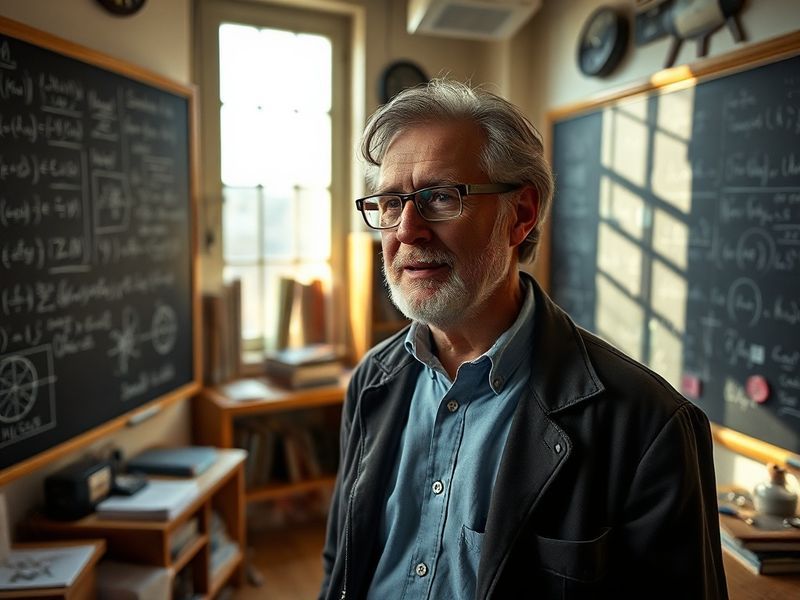
David Gross stands as one of the most influential theoretical physicists of the past half-century. His groundbreaking work on the strong nuclear force reshaped our understanding of particle physics, earning him the 2004 Nobel Prize in Physics alongside Frank Wilczek and David Politzer. Beyond his Nobel-winning contributions, Gross has spent decades probing the deepest questions about the fabric of reality itself.
The strong force, which binds quarks together inside protons and neutrons, was once considered an impenetrable mystery. Before Gross and his collaborators introduced quantum chromodynamics (QCD) in the early 1970s, physicists struggled to explain why quarks never appeared in isolation. Their discovery that the strong force actually becomes weaker at shorter distances—an idea known as asymptotic freedom—provided the missing piece of the Standard Model puzzle.
The Breakthrough: Asymptotic Freedom and the Birth of QCD
Gross’s most celebrated achievement came from solving a critical paradox in quantum field theory. In the 1960s, physicists knew quarks were real but couldn’t reconcile their confinement with the mathematical framework of quantum electrodynamics (QED). QED worked beautifully for electromagnetism, but the strong force behaved differently—quarks were never observed alone, suggesting an unseen barrier.
Working with his graduate student Frank Wilczek at Princeton, Gross developed a radical new theory. They proposed that the force between quarks actually diminishes as the particles approach each other, unlike electromagnetism, where force increases with proximity. This counterintuitive behavior explained why quarks remained trapped inside hadrons (like protons and neutrons) at larger distances, while behaving almost like free particles at the smallest scales. The theory became known as quantum chromodynamics, describing how quarks interact via gluons.
This discovery wasn’t just a theoretical curiosity—it transformed particle physics into a predictive science. QCD became the cornerstone of the Standard Model, the most successful framework in physics history. Gross’s work bridged the gap between abstract mathematics and observable phenomena, proving that nature’s fundamental forces could be both elegant and experimentally verifiable.
The Road to Nobel Recognition
Gross’s path to Stockholm began in a modest Brooklyn household. Born in 1941, he developed an early fascination with mathematics, later shifting to physics at Harvard. His doctoral work under Geoffrey Chew at UC Berkeley introduced him to the “bootstrap” approach to particle interactions, a precursor to his later insights. By the time he joined Princeton’s faculty in 1969, Gross was already recognized as a bold thinker willing to challenge conventional wisdom.
The breakthrough came during a 1973 collaboration with Wilczek. Their paper, “Ultraviolet Behavior of Non-Abelian Gauge Theories,” demonstrated that certain quantum field theories—including QCD—exhibited asymptotic freedom. This ran contrary to decades of physics orthodoxy, which assumed all forces grew stronger at short distances. The discovery was so unexpected that some reviewers initially dismissed it. Yet within months, experimental data from SLAC (Stanford Linear Accelerator Center) confirmed their predictions, cementing their place in history.
When the Nobel Committee awarded Gross the prize in 2004, they acknowledged a discovery that “laid the foundation for the theory of the strong force.” The citation highlighted how QCD had become the most thoroughly tested component of the Standard Model, with experimental precision matching theoretical predictions to an extraordinary degree. For Gross, the recognition validated a lifelong pursuit: uncovering the simple mathematical rules governing nature’s most complex phenomena.
Beyond QCD: Gross’s Quest for a Unified Theory
While QCD remains Gross’s most famous contribution, his later work has focused on an even grander challenge: unifying all fundamental forces into a single theoretical framework. Since the 1980s, he has been a leading advocate for string theory, which posits that the universe’s fundamental constituents are not point-like particles but tiny, vibrating strings. String theory offers a potential path to reconcile quantum mechanics with Einstein’s general relativity—a problem that has stymied physicists for generations.
Gross’s role in advancing string theory has been multifaceted. In 1984, he co-organized a pivotal conference at Caltech that reignited interest in the field after early setbacks. His subsequent research focused on the mathematical structures underlying string theory, particularly in the context of heterotic string theory, which combines different types of strings to achieve a more realistic model of particle physics.
Yet Gross has also been a vocal critic of string theory’s limitations. In recent years, he has questioned whether the theory’s reliance on extra dimensions and abstract mathematics has led physics astray. “We’ve been stuck for 30 years,” he remarked in a 2015 lecture, referring to the lack of experimental confirmation for string theory’s predictions. His skepticism reflects a broader tension in modern physics: the need to balance mathematical beauty with empirical reality.
The String Theory Debate: Elegance vs. Evidence
Gross’s ambivalence toward string theory’s current state highlights a central dilemma in theoretical physics. String theory’s mathematical elegance is undeniable—it naturally incorporates gravity and offers potential solutions to black hole information paradoxes. However, its predictions remain far beyond the reach of current particle colliders like the Large Hadron Collider (LHC).
Gross has argued for a more pragmatic approach, suggesting that physicists should explore alternatives like loop quantum gravity or even revisit older ideas such as technicolor theories. His 2000s-era work on non-perturbative string theory sought to find concrete, testable predictions within the string framework. Yet he remains open to the possibility that new experimental data—perhaps from gravitational wave observatories or quantum simulators—could revive string theory’s fortunes.
This willingness to challenge even his own most cherished ideas exemplifies Gross’s scientific philosophy. “Theories must be judged by their predictive power, not their beauty,” he has stated. His critique of string theory’s current trajectory underscores a crucial point: even the most brilliant physicists must adapt when nature refuses to conform to elegant equations.
Legacy and Influence: Shaping the Next Generation
Beyond his research, David Gross has left an indelible mark on physics through mentorship and institutional leadership. As the former director of the Kavli Institute for Theoretical Physics (KITP) in Santa Barbara, he fostered an environment where collaboration flourished. Under his guidance, KITP became a global hub for theoretical physics, hosting conferences that brought together researchers from diverse backgrounds.
Gross’s pedagogical approach emphasizes clarity and rigor. His 1990s-era lectures on quantum field theory, later compiled into textbooks, remain standard references for graduate students. He has also been an outspoken advocate for improving physics education, arguing that modern curricula often prioritize rote calculation over conceptual understanding. His 2010 essay in Physics Today titled “The Privilege of Being a Physicist” urged researchers to engage more deeply with the public, bridging the gap between complex science and everyday curiosity.
Today, Gross continues to shape the field through his role at the University of California, Santa Barbara, where he holds the Frederick W. Gluck Chair in Theoretical Physics. His recent work explores the landscape problem in string theory—the idea that string theory permits a vast number of possible vacuum states, each corresponding to a different universe. While controversial, this research has sparked renewed debate about the nature of scientific explanation itself.
Inspiring Future Breakthroughs
Gross’s career offers a blueprint for how theoretical physics evolves. His early work on asymptotic freedom solved a specific problem, but its implications rippled across the entire field. Similarly, his later critiques of string theory demonstrate that even paradigm-shifting ideas must be subject to scrutiny. For aspiring physicists, Gross’s journey underscores the importance of intellectual courage—willingness to challenge dogma and follow evidence wherever it leads.
His influence extends beyond academia. Gross has advised government agencies on science policy, including the U.S. Department of Energy’s High Energy Physics Advisory Panel. He has also been a vocal advocate for international collaboration, particularly in the context of particle physics experiments. His support for projects like the International Linear Collider reflects his belief that big science requires global cooperation.
For those interested in exploring the frontiers of physics, Gross’s career provides both inspiration and caution. His achievements remind us that progress often comes from questioning the foundations of our knowledge, while his skepticism toward untested theories serves as a reminder of science’s empirical core.
Where to Go Next: Resources for the Curious
For readers eager to delve deeper into the topics discussed here, several resources offer accessible entry points into David Gross’s world. The Science category on Dave’s Locker features articles on quantum physics and particle theory, while the Education section includes guides to theoretical physics concepts.
To explore Gross’s own writings, his Nobel Lecture from 2004 provides a concise overview of his work on asymptotic freedom. For a more technical treatment, his 2003 paper “The Role of Symmetry in Fundamental Physics” (published in Symmetry) offers insights into his broader philosophical approach to science. Those interested in string theory should start with Edward Witten’s 1995 review article “String Theory Dynamics in Various Dimensions,” which builds on Gross’s contributions.
For a historical perspective, historian of science Helge Kragh’s Quantum Generations: A History of Physics in the Twentieth Century> provides context for Gross’s work within the broader evolution of particle physics. Meanwhile, Brian Greene’s The Elegant Universe> offers an accessible introduction to string theory and its challenges—though readers should approach its more speculative claims with the same critical eye Gross himself would apply.
Ultimately, David Gross’s career is a testament to the power of curiosity and rigor in science. Whether through his Nobel-winning discoveries or his ongoing critiques of theoretical frameworks, he has consistently pushed physics toward deeper truths. For anyone seeking to understand the universe’s fundamental workings, his work remains an essential starting point.