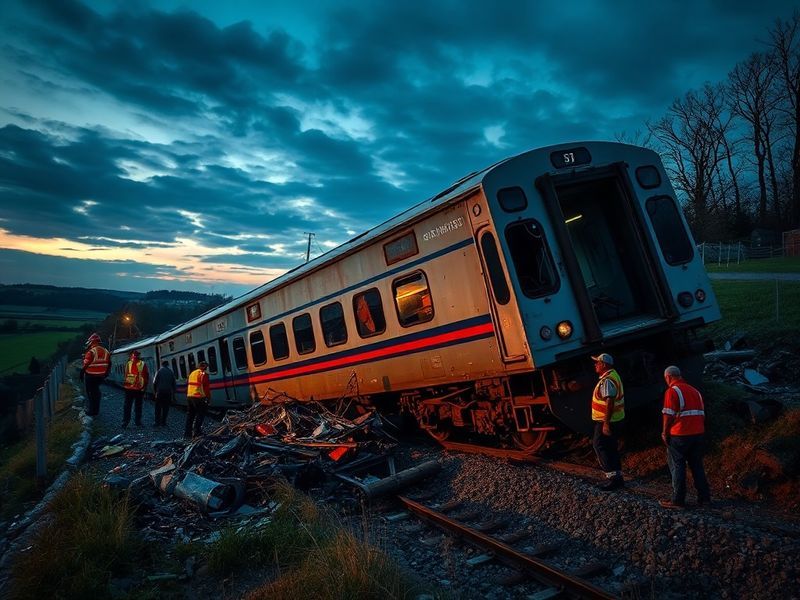
derailment
“`html
Understanding Derailments: Causes, Consequences, and Prevention
Derailments represent one of the most serious risks in rail transportation, with the potential to cause catastrophic damage, significant economic losses, and tragic loss of life. Unlike minor accidents, derailments often involve entire trains leaving their tracks, creating cascading consequences that extend far beyond the immediate incident. These events demand careful analysis to understand their root causes, assess their impacts, and develop effective prevention strategies.
The Mechanics Behind Train Derailments
At its core, a derailment occurs when a train’s wheels leave the rails, typically due to mechanical failure, track defects, or operational errors. The physics behind derailments are complex, involving forces that exceed the stability threshold of the train-track system. Wheel-rail interaction plays a crucial role, where excessive lateral forces can cause wheels to climb over the railhead—a phenomenon known as “flange climb.”
Several technical factors contribute to this failure mode:
- Track geometry issues: Sharp curves, improper superelevation (banking), or misaligned rails create uneven forces on wheels.
- Wheel and rail wear: Flat spots on wheels or worn rail profiles reduce the critical contact area needed for stable guidance.
- Track irregularities: Poorly maintained ballast, uneven sleepers, or debris on the track can destabilize train movement.
- Speed violations: Excessive speed through curves or turnouts increases centrifugal forces beyond safe limits.
Modern rail systems incorporate advanced monitoring technologies, including wayside defect detectors and onboard sensors, to detect anomalies before they lead to derailments. However, human factors and maintenance oversights continue to play a significant role in preventable incidents.
Human Error and Operational Failures
While mechanical and infrastructure issues account for many derailments, human error remains a persistent and often preventable factor. Train operators, dispatchers, and maintenance crews operate under intense pressure, where split-second decisions can mean the difference between safety and disaster. Fatigue, distraction, and inadequate training frequently contribute to operational failures that lead to derailments.
Several high-profile derailments in recent years have highlighted the consequences of human oversight:
- Pukhrayan derailment (India, 2016): Over 150 fatalities resulted from a train traveling at excessive speed on a curved section of track. Investigators found that the driver had ignored warning signals and speed restrictions.
- Amagasaki derailment (Japan, 2005): A commuter train entered a curve at nearly double the authorized speed, killing 107 passengers. The driver had been distracted and failed to apply brakes in time.
- Lac-Mégantic derailment (Canada, 2013): A runaway freight train derailed in a small town, causing explosions and 47 deaths. The incident stemmed from inadequate braking procedures and crew fatigue.
These cases underscore the importance of rigorous training, strict adherence to protocols, and robust safety culture within rail organizations. Many railways have implemented fatigue management programs, automated speed enforcement systems, and real-time monitoring to mitigate human error risks.
Economic and Environmental Consequences
Derailments extend far beyond the immediate safety concerns, creating ripple effects across economies and environments. The financial toll includes direct costs such as infrastructure repairs, train replacement, and compensation claims, as well as indirect costs like service disruptions, reputational damage, and regulatory penalties. In the United States alone, the Federal Railroad Administration estimates that the average derailment costs over $10 million in damages and economic losses.
Environmental impacts are equally severe, particularly when hazardous materials are involved. Derailments have led to catastrophic spills of crude oil, chemicals, and other toxic substances, contaminating soil, waterways, and communities. Notable examples include the 2013 derailment in Aliceville, Alabama, which spilled over 700,000 gallons of crude oil into a wetland ecosystem, and the 2015 disaster in Mount Carbon, West Virginia, where a derailed train burned for days, releasing hazardous pollutants into the air.
These incidents have spurred calls for stricter regulations on tank car design, routing protocols, and emergency response preparedness. Rail operators are increasingly investing in safer tank car models, such as the DOT-117, which features enhanced puncture resistance and thermal protection to reduce spill risks.
Advancements in Derailment Prevention
The rail industry has made significant strides in derailment prevention through technological innovation and regulatory reform. Modern trains are equipped with advanced braking systems, such as electronically controlled pneumatic (ECP) brakes, which allow for synchronized stopping across entire trains, reducing the risk of telescoping or jackknifing during emergencies. Additionally, positive train control (PTC) systems automatically intervene when operators fail to respond to speed restrictions or signal violations, effectively preventing many derailments caused by human error.
Infrastructure improvements also play a critical role in reducing derailment risks. High-speed rail networks, such as those in Japan and Europe, utilize advanced track design principles, including continuous welded rail (CWR) and advanced turnout systems, to minimize the likelihood of wheel climb and track misalignment. In the United States, the Federal Railroad Administration has prioritized the replacement of aging infrastructure, with over $6 billion invested in track upgrades since 2015.
Emerging technologies are further enhancing safety margins. Artificial intelligence (AI) is being deployed to analyze vast datasets from sensors and historical incidents, identifying patterns that precede derailments. Machine learning models can predict track defects, wheel wear, and operational anomalies with increasing accuracy, enabling proactive maintenance and intervention. Similarly, drones equipped with thermal and visual sensors are being used to inspect remote or hard-to-reach sections of track, reducing the need for manual inspections and improving detection rates.
For rail enthusiasts and professionals interested in exploring these technological advancements further, Dave’s Locker Technology section offers in-depth coverage of rail innovations, while the Transportation category provides broader insights into industry trends and safety developments.
Conclusion: A Path Forward for Rail Safety
Derailments remain one of the most pressing challenges in rail transportation, but the combination of technological innovation, regulatory oversight, and operational discipline offers a clear path forward. While no system can guarantee absolute safety, the integration of PTC, AI-driven analytics, and improved infrastructure maintenance has significantly reduced the frequency and severity of incidents in recent years.
However, complacency cannot be allowed to undermine progress. Rail operators must prioritize investment in safety technologies, enforce rigorous training standards, and foster a culture where safety is not just a policy but a core value. Communities and regulators must also remain vigilant, holding operators accountable and advocating for policies that prioritize public safety over cost-cutting measures.
As rail networks expand to meet growing demand for freight and passenger travel, the lessons learned from past derailments must guide future decisions. By embracing innovation and maintaining an unwavering commitment to safety, the rail industry can continue to evolve into a more reliable and secure mode of transportation for generations to come.
—
METADATA
{
“title”: “Train Derailments Explained: Causes, Costs, and Safety Solutions”,
“metaDescription”: “Learn about the causes, impacts, and prevention strategies for train derailments in this detailed analysis.”,
“categories”: [“Transportation”, “Technology”],
“tags”: [“rail safety”, “train derailments”, “track maintenance”, “positive train control”, “hazardous materials transport”],
“imageDescription”: “Aerial view of a derailed train on a curved track, with damaged rail cars and emergency response teams on site. The scene shows twisted metal, spilled cargo, and firefighters working under a cloudy sky, emphasizing the aftermath of a serious rail incident.”
}
—END METADATA—
“`