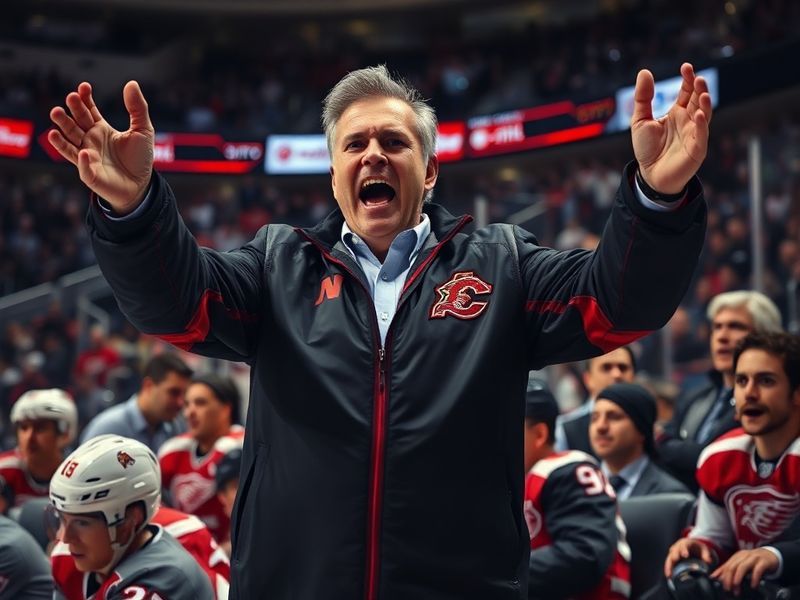
John Tortorella: The NHL’s Most Provocative Coach and His Lasting Legacy
“`html
John Tortorella: The NHL’s Most Provocative Coach
Few figures in professional hockey command attention quite like John Tortorella. For over two decades, the outspoken coach has shaped careers, ignited controversies, and left an indelible mark on the National Hockey League. His approach—blending fiery intensity with tactical precision—has made him one of the most polarizing yet influential figures in the sport.
Tortorella’s career spans multiple franchises, from his early days with the Tampa Bay Lightning to his current role as head coach of the Philadelphia Flyers. Along the way, he has earned a Stanley Cup, a Jack Adams Award, and a reputation for pushing players to their limits. But his legacy extends beyond wins and losses. Tortorella represents a coaching philosophy that prioritizes accountability, physicality, and unapologetic competitiveness.
The Rise of a Hockey Lifer
Born in Boston in 1958, Tortorella’s connection to hockey runs deep. His father, a former semi-pro player, instilled in him a love for the game early on. After playing collegiately at the University of Maine—where he captained the team—he transitioned into coaching, serving as an assistant under the legendary Shawn Walsh before taking his first head coaching job with the American Hockey League’s Rochester Americans in 1995.
His big break came in 2001 when he joined the Tampa Bay Lightning as an assistant under Steve Ludzik. When Ludzik was fired midway through the 2000-01 season, Tortorella was handed the reins. What followed was nothing short of a miracle. In 2004, he led the Lightning to their first Stanley Cup championship, defying expectations and establishing himself as a coach who could elevate underdog teams.
Tortorella’s success wasn’t just about Xs and Os. It was about culture. He demanded effort, enforced discipline, and created an environment where players thrived under pressure. His methods weren’t always conventional, but they worked—at least for a time.
Coaching Philosophy: Accountability Over Comfort
Few coaches in any sport are as transparent—or as unfiltered—as Tortorella. His press conferences are legendary, filled with blunt assessments and unvarnished opinions. For Tortorella, hockey isn’t just a game; it’s a battle, and every player must be prepared to fight for their spot.
This philosophy is evident in his coaching style. Tortorella emphasizes:
- Physicality: His teams are known for their aggressive, hard-nosed play. Tortorella believes in wearing down opponents with relentless pressure.
- Accountability: Mistakes are not tolerated. Players who underperform often find themselves on the bench—or on the trading block.
- Adaptability: While his systems are structured, Tortorella is willing to adjust based on personnel. His teams are often defined by their resilience rather than a single style of play.
- Mental toughness: Tortorella pushes players to embrace discomfort, whether through grueling practices or high-stakes situations. His mantra? “No excuses.”
Critics argue that his approach can be overly harsh, leading to player burnout or frustration. Yet, his defenders point to the long-term success of players who thrived under his guidance, such as Martin St. Louis and Steven Stamkos in Tampa Bay, and Vezina Trophy-winning goaltender Andrei Vasilevskiy in later years.
Controversies and Comebacks
Tortorella’s career has been defined as much by his clashes as his championships. His tenure with the New York Rangers (2009-2013) was marked by highs—including a trip to the Eastern Conference Final in 2012—and lows, including a locker room split that led to his dismissal. His infamous press conference tirade in 2013, where he declared, “We gave a rat’s ass about winning,” became a viral moment, encapsulating both his intensity and his unpredictability.
After a brief stint in Columbus, where he was fired midway through the 2015-16 season, Tortorella reinvented himself with the Columbus Blue Jackets. Under his leadership, the team became a perennial playoff contender, culminating in a historic 2019 season where they set the NHL record for most wins in a single campaign. That year, Tortorella earned the Jack Adams Award as the league’s top coach, proving that his methods could succeed at the highest level.
Yet, his move to Philadelphia in 2022 raised eyebrows. The Flyers were in the midst of a rebuild, and Tortorella’s abrasive style seemed an unlikely fit for a young, developing roster. Early results have been mixed, with flashes of brilliance tempered by inconsistency. Still, his influence is undeniable. Players like Travis Konecny and Sean Couturier have spoken about the renewed energy and accountability Tortorella brings to the locker room.
Legacy and Broader Impact
John Tortorella’s impact on the NHL extends beyond his win-loss record. He represents a coaching archetype that values grit over glamour, effort over entitlement. In an era where analytics often dictate decisions, Tortorella’s reliance on instinct and emotion is a refreshing counterpoint. His ability to connect with players—even in the face of adversity—sets him apart from more reserved coaches.
Yet, his legacy is complicated. While he has undeniably shaped the careers of countless players, his methods have also left scars. Some former players have spoken about the emotional toll of his coaching, describing it as a love-hate relationship. Others, like Lightning defenseman Anton Stralman, have credited Tortorella with transforming their careers by instilling a relentless work ethic.
Tortorella’s influence can also be seen in the NHL’s shifting culture. His emphasis on accountability has trickled down to other coaches, who now prioritize player development and mental resilience. Teams that once relied on star power alone now demand a more holistic approach to success—one that Tortorella helped pioneer.
As he enters the latter stages of his career, the question remains: What’s next for Tortorella? Will he finish his career in Philadelphia, or will he seek one last challenge elsewhere? Regardless of the outcome, his impact on the game is secure. He is a relic of a bygone era of hockey—a time when coaches ruled with an iron fist and players answered the bell.
For fans of the sport, Tortorella’s career is a reminder that hockey is more than just a game. It’s a test of character, a battle of wills, and a pursuit of excellence. And no one embodies that spirit quite like John Tortorella.
Conclusion
John Tortorella’s career is a study in contrasts: a coach who is both beloved and reviled, whose methods are both effective and divisive. He is a man of few words in interviews but speaks volumes through his actions. He demands everything from his players and gives everything in return.
As the NHL continues to evolve, Tortorella’s legacy serves as a reminder of the power of uncompromising leadership. Whether you agree with his approach or not, there’s no denying his influence on the game. In a league increasingly driven by data and analytics, Tortorella stands as a testament to the enduring value of passion, intensity, and sheer willpower.
For those who have played for him, the lessons learned under Tortorella extend far beyond the rink. They are lessons in resilience, accountability, and the pursuit of greatness—no matter the cost.
Explore more sports analysis on Dave’s Locker or check out our in-depth coverage of hockey strategy.