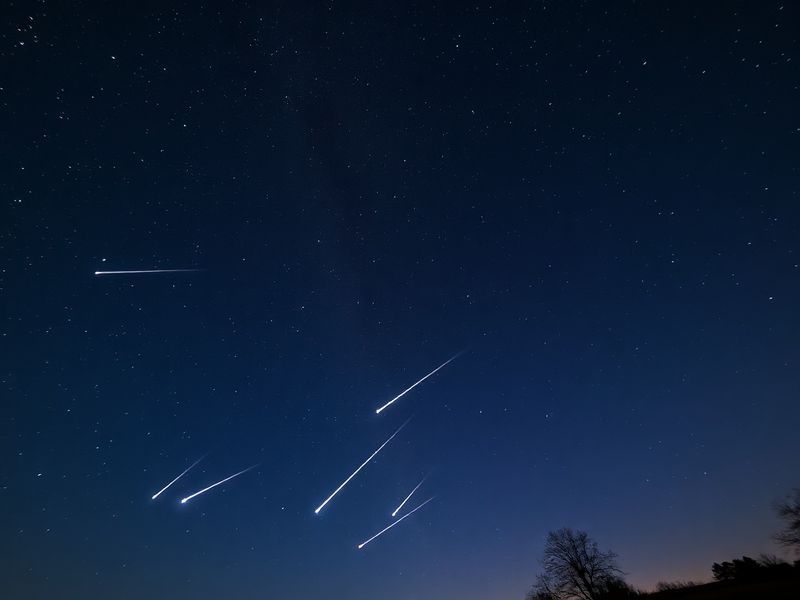
The Lyrids meteor shower arrives every April, offering stargazers a reliable and visually stunning display of shooting stars. Unlike some of the more sporadic meteor showers, the Lyrids have been observed for over 2,700 years, making them one of the oldest known annual meteor showers. This year, the shower peaks during the late evening hours of April 21 into the early morning of April 22, providing an excellent opportunity for both seasoned astronomers and casual observers to witness the cosmic spectacle.
What Causes the Lyrids Meteor Shower?
The Lyrids originate from the debris trail of Comet Thatcher, a long-period comet that orbits the sun once every 415 years. When Earth passes through the comet’s dusty wake each April, tiny particles—some no larger than a grain of sand—enter our atmosphere at speeds up to 110,000 miles per hour. These particles burn up due to friction, creating the bright streaks of light we recognize as meteors.
The radiant point of the Lyrids, from which the meteors appear to originate, lies near the constellation Lyra, home to the bright star Vega. This is why the shower bears the name “Lyrids.” However, meteors can appear anywhere in the sky, so observers don’t need to focus solely on Lyra to enjoy the show. The meteors are known for their brightness and occasional fireballs, which are larger, more luminous meteors that can cast shadows and leave glowing trails.
When and How to Watch the Lyrids
The Lyrids meteor shower is active each year from approximately April 16 to April 26. The peak activity, when the number of meteors is greatest, typically occurs on the night of April 21 or 22. This year, the moon will be in its waxing crescent phase, offering favorable viewing conditions with minimal interference from moonlight. The best viewing times are usually after midnight and before dawn, when the radiant point is highest in the sky.
To maximize your experience, follow these tips:
- Find a dark location: Light pollution significantly reduces visibility. Seek out rural areas, parks, or designated dark-sky sites away from city lights.
- Allow time for your eyes to adjust: It can take up to 30 minutes for your eyes to adapt to the darkness, enhancing your ability to spot fainter meteors.
- Dress appropriately: April nights can still be chilly, especially in northern latitudes. Bring warm clothing, blankets, and perhaps a thermos of hot coffee or tea.
- Use minimal equipment: A telescope or binoculars isn’t necessary for meteor showers. In fact, they limit your field of view. A reclining chair or blanket on the ground is ideal.
- Be patient: Meteors often come in spurts, with periods of inactivity followed by bursts of activity. Relax and enjoy the night sky.
For those unable to travel to a dark-sky location, many astronomy clubs and observatories host public viewing events. These gatherings often include telescopes for viewing other celestial objects, making them a great opportunity to combine meteor watching with deeper exploration of the cosmos. Check local listings or visit the Science category on Dave’s Locker for updates on organized events in your area.
Historical Significance and Cultural Impact
The Lyrids meteor shower has been chronicled throughout human history, with the earliest recorded sighting dating back to 687 BCE by Chinese astronomers. Ancient cultures often interpreted meteor showers as omens or messages from the gods. The Lyrids, in particular, were associated with the myth of Orpheus in Greek lore, where the musician’s lyre was placed in the sky as the constellation Lyra.
In modern times, the Lyrids continue to inspire awe and wonder. They serve as a reminder of our place in the universe and the dynamic nature of the solar system. Unlike unpredictable celestial events, the Lyrids offer a predictable and accessible way for people to connect with astronomy. For amateur astronomers, the Lyrids are often a gateway to more advanced observations, such as astrophotography or tracking other meteor showers like the Perseids or Geminids.
Photographers often capture the Lyrids, creating stunning images that highlight the contrast between the bright meteors and the dark night sky. Time-lapse photography can reveal the trails of multiple meteors over several hours, offering a unique perspective on the shower’s activity. These images not only serve as artistic expressions but also as educational tools to promote interest in science and space exploration.
The Science Behind the Spectacle
The study of meteor showers like the Lyrids provides valuable insights into the composition and behavior of comets. When a comet like Thatcher approaches the sun, solar radiation heats its icy surface, causing it to release gas and dust. This debris forms the comet’s tail and spreads out along its orbit. Over time, the dust particles disperse, creating a broad stream that Earth intersects annually.
Scientists use meteor showers to gather data on the density and distribution of cometary debris. By analyzing the number, brightness, and trajectories of meteors, researchers can infer details about the parent comet’s structure and history. The Lyrids, in particular, have been studied extensively due to their relatively high meteor rates and the brightness of their fireballs.
Additionally, meteor showers play a role in the broader field of planetary defense. While the particles from the Lyrids pose no threat to Earth, studying their behavior helps scientists better understand the dynamics of larger near-Earth objects (NEOs). This knowledge is crucial for developing strategies to mitigate potential future impacts from asteroids or comets.
Beyond the Lyrids: Other Meteor Showers to Watch
While the Lyrids are a highlight of the spring sky, they are just one of several major meteor showers that occur throughout the year. Each shower has its own unique characteristics, influenced by the composition and orbit of its parent comet or asteroid. Here are a few notable examples:
- Perseids (Peak: Mid-August): Known for their high rates of activity, often exceeding 60 meteors per hour, the Perseids are one of the most popular showers. They originate from Comet Swift-Tuttle and are famous for their bright, fast meteors and frequent fireballs.
- Geminids (Peak: Mid-December): Unlike most meteor showers, the Geminids are associated with an asteroid, 3200 Phaethon. They are known for their multicolored meteors and can produce over 100 meteors per hour at their peak.
- Leonids (Peak: Mid-November): The Leonids are famous for their periodic meteor storms, where rates can exceed thousands of meteors per hour. These storms occur roughly every 33 years, tied to the orbit of Comet Tempel-Tuttle.
- Orionids (Peak: Late October): Produced by debris from Halley’s Comet, the Orionids are known for their speed and brightness. They often leave persistent trains, or ionized gas trails, that glow for several seconds after the meteor has passed.
For those interested in tracking these events, apps and websites like the Technology section on Dave’s Locker often feature tools and guides to help enthusiasts plan their observations. Whether you’re a seasoned astronomer or a curious beginner, meteor showers offer a simple yet profound way to engage with the wonders of the universe.
Conclusion: Why the Lyrids Matter
The Lyrids meteor shower is more than just a fleeting light show—it’s a link to our ancient past and a testament to the ongoing dynamism of our solar system. In an age dominated by digital distractions, events like the Lyrids provide a rare opportunity to disconnect and reconnect with the natural world. They remind us of the vastness of space and our small but significant place within it.
Whether you’re watching alone under a blanket of stars or sharing the experience with friends and family, the Lyrids offer a moment of reflection and wonder. So mark your calendar, find a dark spot, and prepare to be amazed. The universe is putting on a show, and it’s one you won’t want to miss.