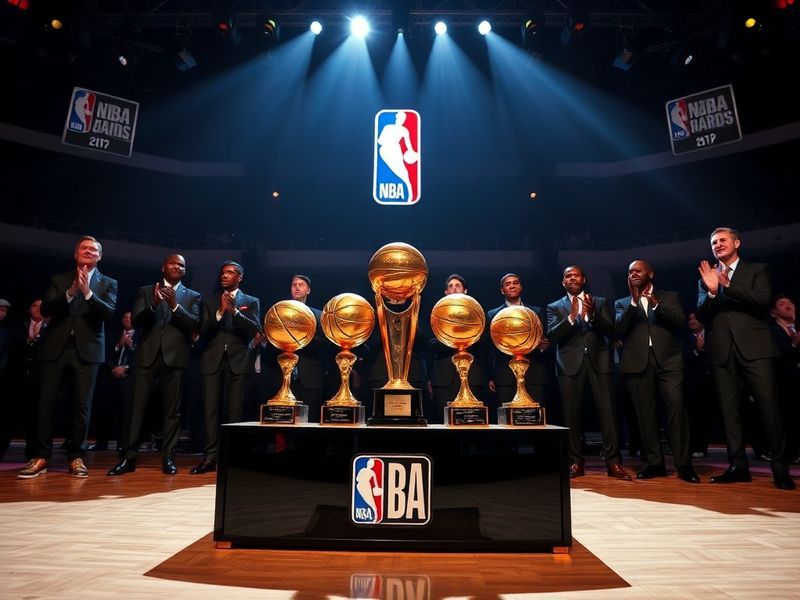
The NBA season culminates in a series of awards that honor the league’s top performers, from the Most Valuable Player to the Defensive Player of the Year. These accolades not only recognize individual excellence but also shape legacies and influence Hall of Fame considerations. While some awards are decided by a panel of media members, others rely on fan votes, creating a mix of objectivity and subjectivity in the process.
The MVP: Basketball’s Highest Individual Honor
The Maurice Podoloff Trophy, awarded to the NBA Most Valuable Player, stands as the league’s most prestigious individual accolade. Since its inception in 1955-56, the award has been dominated by legends like Kareem Abdul-Jabbar, Michael Jordan, and LeBron James, each claiming the honor multiple times. The criteria for MVP has evolved over the decades, shifting from statistical dominance to a more holistic evaluation of a player’s impact on winning.
Recent years have seen a trend toward positionless basketball influencing MVP voting. Players like Nikola Jokić and Giannis Antetokounmpo have redefined the award by excelling in unconventional ways. Jokić’s 2021-22 MVP season, where he became the first center to lead the league in both assists and win shares since Wilt Chamberlain, demonstrated how versatile big men could reshape traditional narratives.
Voting for the MVP remains a contentious process, with critics arguing that media members often favor players on winning teams or those with flashy statistics. The 2020-21 race between Nikola Jokić and Joel Embiid highlighted this debate, as Jokić’s Nuggets finished with the second-best record in the West, while Embiid’s 76ers had a slightly worse record but boasted a stronger supporting cast. Ultimately, Jokić claimed the award, reigniting discussions about whether the MVP should be an “all-around great player” award or strictly a “best player on the best team” honor.
Defensive Player of the Year: The Unsung Hero Award
The Defensive Player of the Year (DPOY) award often flies under the radar compared to the MVP, but its significance cannot be overstated. Instituted in 1982-83, the award recognizes the league’s most impactful defensive players, a category that includes rim protectors, perimeter stoppers, and relentless hustlers. Recent winners like Rudy Gobert, Marcus Smart, and Jaren Jackson Jr. have embodied the evolving nature of defensive excellence in the modern NBA.
Gobert, a three-time DPOY winner, revolutionized the role of the traditional center by anchoring elite defenses with his shot-blocking and defensive positioning. His ability to deter shots without fouling has made him the gold standard for rim protection. Meanwhile, Marcus Smart’s 2021-22 DPOY win marked a shift toward valuing versatile perimeter defenders who can disrupt passing lanes and guard multiple positions.
One of the most intriguing debates surrounding the DPOY award is the balance between individual defensive metrics and team success. For instance, players like Kawhi Leonard and Giannis Antetokounmpo have claimed the award despite their teams not always ranking among the league leaders in defensive efficiency. This raises questions about whether the award should prioritize personal defensive impact or the overall team defensive performance.
Rookie of the Year and Most Improved Player: Celebrating Breakout Seasons
The NBA Rookie of the Year and Most Improved Player (MIP) awards celebrate the league’s rising stars and those who have made significant leaps in their development. The Rookie of the Year award has a storied history, with legends like Wilt Chamberlain, Larry Bird, and Shaquille O’Neal all claiming the honor early in their careers. In recent years, the award has become more unpredictable, with players like Ja Morant and Luka Dončić emerging as frontrunners despite not being the most statistically dominant rookies.
The Most Improved Player award, introduced in 1985-86, is often seen as a barometer for player growth and adaptability. Winners like Pascal Siakam, Victor Oladipo, and Brandon Ingram have demonstrated how hard work and refined skills can transform careers. The criteria for MIP has shifted over time, with voters now placing greater emphasis on players who have expanded their games beyond pure scoring, such as improved playmaking or defensive versatility.
One of the most compelling MIP stories in recent memory is that of Ja Morant, who went from a promising rookie to an All-NBA player in just two seasons. His 2021-22 campaign, where he averaged 27.4 points, 5.7 rebounds, and 6.7 assists per game, showcased his rapid development and cemented his status as one of the league’s brightest young stars. Meanwhile, players like De’Aaron Fox and Jaylen Brown have also been recognized for their meteoric rises, proving that the MIP award is not just for role players but can also highlight future superstars.
The Sixth Man and Coach of the Year: Recognizing Impact Beyond the Starters
The Sixth Man of the Year award honors the league’s best bench player, a role that has become increasingly vital in the modern NBA. Players like Jamal Crawford, Lou Williams, and Manute Bol have carved out legendary careers as super subs, proving that impact can extend beyond the starting lineup. The award often goes to players who provide scoring bursts, defensive intensity, or playmaking off the bench, such as Tyler Herro in 2019-20 or Jordan Clarkson in 2020-21.
The Coach of the Year award is another critical honor that recognizes the strategic and motivational prowess of NBA coaches. Recent winners like Tom Thibodeau, Nick Nurse, and Monty Williams have demonstrated how coaching can elevate a team’s performance, even when the roster lacks superstar talent. Thibodeau’s 2020-21 award, for instance, came after he guided the New York Knicks to the playoffs for the first time since 2013, showcasing his ability to maximize a team’s potential.
One of the most underrated aspects of the Coach of the Year award is its ability to highlight innovative strategies. Nick Nurse’s 2018-19 win was a testament to his creative play-calling, which included the development of a guard-heavy lineup that propelled the Toronto Raptors to an NBA championship. Similarly, Erik Spoelstra’s 2019-20 award recognized his ability to adapt to the challenges of the COVID-19 season, leading the Miami Heat to the NBA Finals.
The Evolution of NBA Awards in the Modern Era
The NBA awards have evolved alongside the league itself, reflecting changes in playing styles, analytics, and fan engagement. The introduction of the Kia MVP Award in 2016, for example, coincided with a shift toward valuing versatility and efficiency. Meanwhile, the All-NBA Team selections have become more data-driven, with advanced metrics like Player Efficiency Rating (PER) and Win Shares playing a larger role in voting.
The league has also experimented with fan voting, particularly for awards like the All-Star Game and the All-NBA Team. While fan engagement has increased, critics argue that it can sometimes overshadow the more objective measures of player performance. The NBA has attempted to strike a balance by incorporating a mix of media votes, player votes, and statistical analysis for certain awards.
Another notable trend is the rise of international players in the award landscape. From Dirk Nowitzki to Giannis Antetokounmpo, European players have become increasingly prominent in MVP and All-NBA discussions. This globalization of the NBA has not only enriched the league’s talent pool but also expanded the cultural reach of its awards.
The Impact of Awards on Player Legacies
NBA awards play a crucial role in shaping player legacies, often influencing Hall of Fame considerations and historical narratives. For example, Michael Jordan’s five MVP awards and six Finals MVPs are central to his GOAT status, while LeBron James’ four MVP awards and three Finals MVPs cement his place among the greatest of all time. Meanwhile, players like Steve Nash and Dirk Nowitzki, who won back-to-back MVP awards, have seen their legacies bolstered by these honors.
The awards also serve as a barometer for a player’s prime years. For instance, Tim Duncan’s two MVP awards and three Finals MVPs highlight his dominance during the San Antonio Spurs’ championship runs. Similarly, Kobe Bryant’s 2008 MVP award is often cited as a key moment in his transition from a high-scoring guard to a complete two-way player.
However, not all awards carry equal weight in legacy discussions. The Sixth Man of the Year award, for instance, is often viewed as less prestigious than the MVP or DPOY, despite its importance to team success. This discrepancy underscores the subjective nature of awards and their varying impact on how players are remembered.
Conclusion: The Enduring Significance of NBA Awards
NBA awards represent more than just individual accolades; they are a reflection of the league’s history, evolution, and cultural impact. From the MVP to the DPOY, each award tells a story about the players who have shaped the game and the eras they played in. As the NBA continues to evolve, so too will the criteria and significance of these honors, ensuring that they remain a vital part of basketball’s narrative.
The debates surrounding these awards—whether about the balance between statistics and team success, the role of analytics, or the influence of fan voting—highlight the complexity of recognizing excellence in a team sport. Yet, despite these challenges, the NBA awards continue to captivate fans and players alike, serving as a testament to the enduring appeal of the game.
For fans looking to dive deeper into the history and impact of NBA awards, resources like Dave’s Locker Sports offer in-depth analysis and coverage of the league’s most compelling stories. Whether you’re a casual fan or a die-hard enthusiast, the NBA awards provide a fascinating lens through which to view the game’s greatest moments and players.