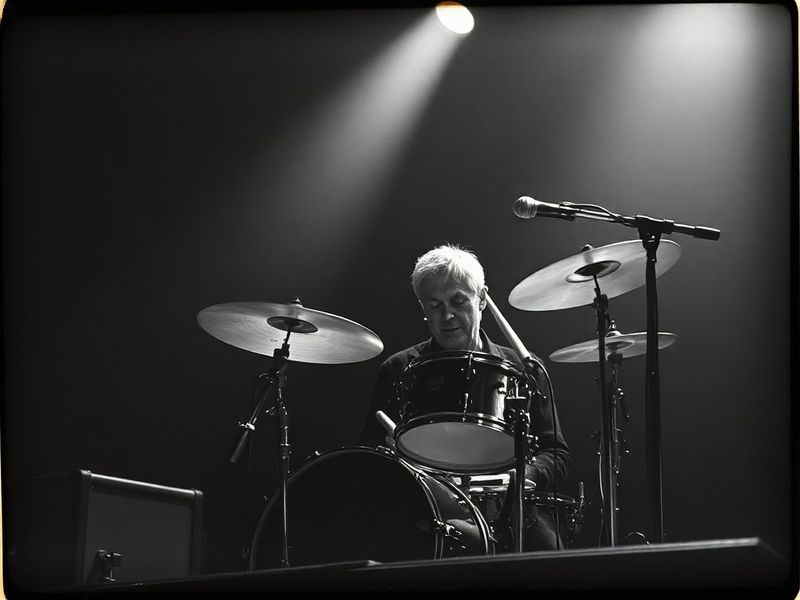
Few musicians have reshaped the sound of their instrument as definitively as Stewart Copeland. Over a career spanning more than five decades, Copeland has established himself not just as a drummer, but as a composer, bandleader, and sonic innovator whose influence echoes across rock, jazz, world music, and film scoring. His work with The Police in the late 1970s and early 1980s redefined rhythmic complexity in rock music, blending punk energy, reggae syncopation, and jazz precision into a signature style that remains instantly recognizable.
The Police Era: A Rhythmic Revolution
Copeland’s rise to prominence came as the drummer for The Police, formed in London in 1977. Alongside Sting and Andy Summers, he crafted a sound that fused punk’s raw intensity with reggae’s laid-back groove and jazz’s harmonic sophistication. Copeland’s drumming was unconventional by rock standards—he used a stripped-down kit, emphasized off-beat accents, and often played with brushes, creating a lighter, more melodic texture.
Songs like “Message in a Bottle,” “Walking on the Moon,” and “Every Breath You Take” owe much of their hypnotic pull to Copeland’s rhythmic creativity. His use of rimshots, tom-toms, and syncopated hi-hat patterns gave The Police a groove that was both mechanical and organic. This approach was revolutionary at the time, helping to define the post-punk and new wave movements.
The band’s 1983 album Synchronicity became a global phenomenon, topping charts worldwide and earning Copeland a reputation as one of the most innovative drummers of his generation. His drumming was not just supportive—it was central to the music’s identity, often carrying the melody and defining the song’s emotional arc.
Signature Style and Technique
Copeland’s style is marked by several distinctive traits. He frequently employed a “clicky” snare sound with a high tuning and tight head, producing a sharp, staccato attack. His bass drum work was minimal but deliberate, often favoring single strokes over double-kick patterns, which was unusual in hard rock and metal of the era. This gave his playing a sense of space and clarity that complemented Sting’s bass lines.
He also integrated world music influences, particularly from Africa and the Middle East, into his grooves. This was evident in tracks like “Don’t Stand So Close to Me” and “Wrapped Around Your Finger,” where polyrhythms and asymmetrical phrasing added depth and intrigue.
- Unconventional Kit Setup: Copeland often used a small kit—sometimes just a bass drum, snare, one tom, and cymbals—prioritizing feel and dynamics over volume.
- Brush Work: On slower songs, he preferred brushes, creating a whispery, atmospheric texture.
- Dynamic Contrast: He excelled at shifting between explosive fills and subtle, understated grooves within the same song.
- Melodic Approach: His drumming often functioned as a melodic voice, interacting with Sting’s bass lines in a call-and-response fashion.
Beyond The Police: A Diverse and Prolific Career
While The Police defined Copeland’s early legacy, his post-band career has been equally remarkable. He has composed scores for over 60 films, including Rumble Fish (1983), The King of Comedy (1982), and Wall Street (1987), often blending orchestral arrangements with electronic textures. His score for Rumble Fish, directed by Francis Ford Coppola, is particularly celebrated for its haunting, minimalist use of percussion and strings.
Copeland also explored world music through collaborations with artists like Indonesian gamelan musicians and Senegalese sabar drummers. In 2005, he formed the band Oysterhead with Trey Anastasio of Phish and Les Claypool of Primus, blending progressive rock, funk, and psychedelia. The group’s live performances and 2001 album The Grand Pecking Order showcased Copeland’s versatility and willingness to push boundaries.
In addition to performance and composition, Copeland has been a vocal advocate for drumming education. He has conducted masterclasses, written instructional books, and even developed a line of signature drumsticks and cymbals. His 2018 memoir, Strange Things Happen: Life with The Police, Polo, and Pygmies, offers a candid look at his life, filled with adventure, humor, and insight into the creative process.
Innovation in Film and Television Scoring
Copeland’s film scores are notable for their rhythmic inventiveness. For The King of Comedy, he used a combination of orchestral strings and minimalist percussion to mirror the film’s tension and irony. In Wall Street, his score underpins the film’s themes of greed and ambition with a mix of brass fanfares and electronic pulses.
He has also scored for television, including the theme for the long-running animated series The Simpsons (though the iconic main theme was composed by Danny Elfman, Copeland contributed to several episodes). His ability to blend genres—from classical to rock to world music—has made him a sought-after composer in both film and television.
Legacy and Influence
Stewart Copeland’s impact on music is immeasurable. He helped redefine what a rock drummer could be, proving that percussion could be as melodic and expressive as any other instrument. His influence can be heard in the work of modern drummers like Chad Smith of Red Hot Chili Peppers, who has cited Copeland as a key inspiration, and in the progressive and experimental rock scenes, where his rhythmic complexity is widely studied.
Copeland’s legacy extends beyond technique. He embodies the spirit of the musician-as-innovator, constantly exploring new sounds and collaborations. Whether through his work with The Police, his film scores, or his solo projects, he has maintained a commitment to artistic integrity and rhythmic exploration.
Today, Copeland remains active, performing with The Police on reunion tours and continuing to compose. His 2021 album La Notte della Taranta, a fusion of Italian folk music and electronic beats, demonstrates his ongoing creativity. He also hosts drumming workshops and participates in charity events, further cementing his role as a mentor and cultural figure.
A Lasting Influence on Rhythm and Sound
What sets Copeland apart is his ability to make rhythm feel like storytelling. His drumming doesn’t just keep time—it breathes, evolves, and communicates. This approach has influenced generations of musicians, from punk rockers to jazz fusion artists, and even electronic producers who sample his grooves.
For those interested in exploring his work further, Dave’s Locker Music Education offers resources on rhythmic theory and drumming techniques inspired by Copeland’s style. His Entertainment section also features articles on legendary musicians and their creative processes.
As we look back on his career, it’s clear that Stewart Copeland didn’t just play the drums—he redefined them. His fusion of genres, rhythmic daring, and relentless innovation have left an indelible mark on music, ensuring his place among the greats.