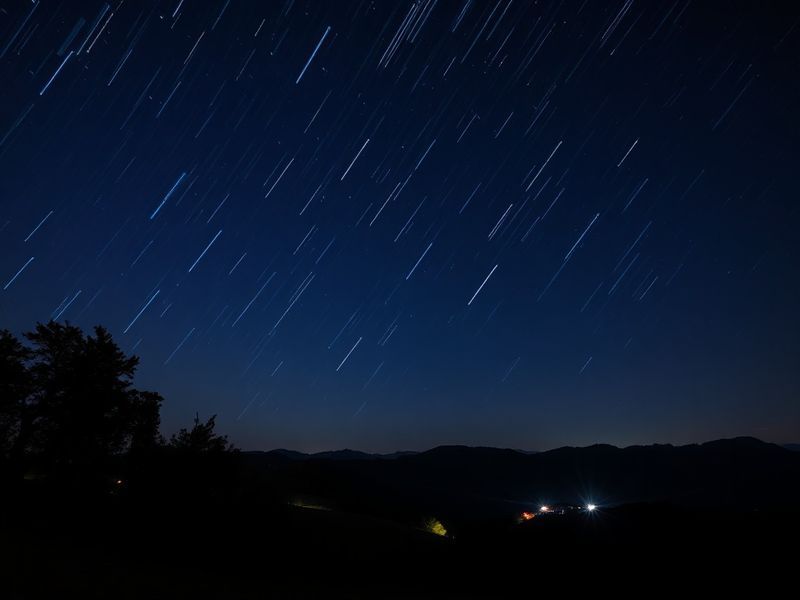
The Lyrid meteor shower is one of the oldest known annual meteor showers, with records dating back nearly 2,700 years. Unlike more sporadic celestial events, the Lyrids occur predictably every April, offering stargazers worldwide a reliable spectacle. This year’s display peaks in the early hours of April 22 and 23, providing an opportunity for millions to witness streaking fireballs and fleeting trails across the night sky.
The shower is named after the constellation Lyra, from which the meteors appear to radiate. However, the meteors themselves are debris from Comet Thatcher, a long-period comet that last passed near Earth in 1861. As Earth orbits the sun, it intersects the comet’s dusty trail, causing particles to burn up in the atmosphere and create luminous streaks. While the Lyrids are not the most intense meteor shower—averaging 10 to 20 meteors per hour—they are known for their occasional outbursts, which can produce up to 100 meteors in an hour.
Historical and Cultural Significance
The Lyrids have been observed by civilizations across the globe, each interpreting the celestial event through cultural and religious lenses. In ancient China, records from 687 BCE describe the Lyrids as “stars that fell like rain,” a poetic reference to their intensity. Meanwhile, the Greeks associated the Lyrids with the myth of Orpheus, the musician whose lyre was placed in the sky after his death. The constellation Lyra, home to Vega—the shower’s radiant point—was believed to hold divine significance.
Indigenous cultures in the Americas also revered the Lyrids. The Navajo, for instance, considered meteor showers as messages from the spirit world, while the Inuit of Alaska viewed them as the spirits of the dead dancing across the sky. In Hindu tradition, the appearance of meteors was sometimes linked to the god Indra, who wielded a thunderbolt that could manifest as a shooting star. These diverse interpretations highlight humanity’s enduring fascination with the night sky.
Astronomical Features and Viewing Tips
The Lyrids are known for their bright, fast meteors, some of which leave persistent trains—glowing trails that linger for several seconds after the meteor has passed. Occasionally, the shower produces fireballs, exceptionally bright meteors that can illuminate the ground. While the Lyrids are best viewed from the Northern Hemisphere, observers in the Southern Hemisphere can still catch a glimpse, particularly in the pre-dawn hours.
For optimal viewing, astronomers recommend finding a dark location away from city lights, ideally after midnight and before dawn. No special equipment is needed; the naked eye is sufficient to enjoy the show. The Lyrids’ radiant point, near the bright star Vega, rises in the northeast by late evening, making it easier to spot meteors as the night progresses. This year, the waxing crescent moon will set early in the evening, providing ideal dark skies for meteor watching.
Photographers hoping to capture the Lyrids should use a wide-angle lens, a tripod, and a long exposure setting—typically between 15 to 30 seconds—to gather enough light. Apps like PhotoPills or Stellarium can help plan the perfect shot by simulating the sky’s appearance at different times and locations.
Global Viewing Opportunities and Events
The Lyrid meteor shower is a unifying event, bringing together amateur astronomers, families, and curious onlookers across continents. In the United States, national parks such as Joshua Tree and Great Basin have hosted star parties, offering guided viewing sessions with telescopes and educational talks. Similarly, in Europe, organizations like the European Space Agency (ESA) and local astronomy clubs have organized public events, from rooftop gatherings in Berlin to remote observatories in the Canary Islands.
In Asia, Japan’s National Astronomical Observatory has promoted the Lyrids as part of its outreach programs, encouraging schools to participate in meteor-counting activities. Meanwhile, in Australia, where the Lyrids are visible but less prominent, astronomy enthusiasts have taken to social media to share their sightings, creating a global dialogue around the event. Apps like Technology and Star Walk have further democratized access, allowing users to track the shower in real time.
For those unable to venture outdoors, livestreams from observatories like the Slooh Community Observatory or NASA’s Marshall Space Flight Center provide a virtual alternative. These broadcasts often include expert commentary, enhancing the viewing experience with scientific context.
Why the Lyrids Matter Beyond the Spectacle
While the Lyrids are primarily a visual delight, they also hold scientific value. Studying meteor showers helps researchers understand the composition and behavior of comets, as well as the dynamics of Earth’s atmosphere. The Lyrids, in particular, offer insights into Comet Thatcher’s orbit and the distribution of debris in its trail. NASA’s All Sky Fireball Network, for example, tracks bright meteors to refine models of solar system evolution.
Beyond science, the Lyrids foster community and curiosity. In an era dominated by digital distractions, meteor showers remind us of the natural world’s grandeur. They encourage people to disconnect, look upward, and share the experience with others. Whether through a family camping trip or a virtual watch party, the Lyrids create moments of connection that transcend borders.
As light pollution continues to obscure the night sky for much of the global population, events like the Lyrids serve as a call to preserve dark skies. Organizations like the International Dark-Sky Association advocate for responsible lighting policies, ensuring that future generations can continue to witness such celestial wonders.
Conclusion: A Timeless Tradition
The Lyrid meteor shower is more than a fleeting astronomical event; it is a thread woven through human history, connecting ancient observers to modern stargazers. Its predictability offers a sense of continuity in an ever-changing world, while its occasional surprises—like outbursts or fireballs—remind us of the unpredictability of the cosmos.
This April, take a moment to step outside, lie back, and watch the sky. The Lyrids may be fleeting, but their legacy is eternal.