elizabeth ii
“`html
Queen Elizabeth II: A Reign That Defined Modern Monarchy
For 70 years, Queen Elizabeth II stood as the most visible symbol of continuity in a rapidly changing world. Her reign, which began in 1952, spanned the reigns of 15 British prime ministers, the decolonization of Africa, the Cold War, the digital revolution, and the United Kingdom’s fraught relationship with Europe. Unlike many monarchs whose legacies are debated in hushed tones, her impact was measured in public service, quiet resilience, and an unshakable sense of duty.
The Early Years and Accession to the Throne
Elizabeth Alexandra Mary Windsor was born on April 21, 1926, to the Duke and Duchess of York—later King George VI and Queen Elizabeth, the Queen Mother. She spent her childhood sheltered from public life, educated at home alongside her younger sister, Princess Margaret. The outbreak of World War II in 1939 reshaped her upbringing. At just 13, she delivered her first radio broadcast during the BBC’s Children’s Hour, a message of hope to evacuees. By 18, she joined the war effort as a subaltern in the Auxiliary Territorial Service, training as a mechanic and truck driver—roles that foreshadowed her lifelong commitment to public service.
Her life took an unexpected turn in 1936 when her uncle, King Edward VIII, abdicated to marry Wallis Simpson. Her father became king, and at age 10, Elizabeth became heir presumptive. She never expected to rule, but fate intervened. When she was just 25, her father died in his sleep on February 6, 1952. She was in Kenya with Philip at the time, ascending the throne as Queen Elizabeth II that same day. The coronation on June 2, 1953, was the first to be televised, bringing the monarchy into living rooms across Britain and the Commonwealth.
The Evolution of the Monarchy in a Changing World
The queen’s reign coincided with seismic shifts in global power. The British Empire dissolved, reshaping the Commonwealth into a voluntary association of nations. She navigated these changes with remarkable tact, visiting over 100 countries and meeting with world leaders from Nelson Mandela to Pope Francis. Her 2011 state visit to the Republic of Ireland—the first by a British monarch in a century—was a historic moment, signaling reconciliation between two nations long divided by conflict.
Domestically, the monarchy faced intense scrutiny, especially after the 1992 fire at Windsor Castle and the breakdown of three of her children’s marriages. The queen responded with rare public candor in a Christmas broadcast, calling 1992 an “annus horribilis.” Yet her popularity endured. She modernized the institution quietly: allowing the royal yacht to be decommissioned, opening Buckingham Palace to summer tours, and embracing social media, making her the first monarch to send an email in 1976 and a tweet in 2014.
Her relationship with the press was complex. She famously avoided giving interviews, yet understood the power of media. The 2021 Netflix series Queen Elizabeth II: The Crown and the 2022 film Spencer dramatized her life, proving that even in death, her cultural footprint remains vast. Yet she never succumbed to celebrity culture. Her silence was deliberate—a strategy that preserved the monarchy’s mystique in an age of oversharing.
Key Moments in Her Reign
- 1953: First televised coronation, watched by 277 million people globally.
- 1965: First state visit to West Germany, marking a step toward European reconciliation.
- 1977: Silver Jubilee celebrated with massive public events despite IRA threats.
- 1992: Publicly acknowledged the monarchy’s struggles in a rare speech, calling it an “annus horribilis.”
- 2002: Celebrated Golden Jubilee despite the deaths of Princess Margaret and the Queen Mother.
- 2012: Diamond Jubilee marked with a river pageant and global tours.
- 2020: Addressed the nation during the COVID-19 pandemic, echoing wartime broadcasts.
- 2022: Platinum Jubilee celebrated with four days of events, including a concert featuring Ed Sheeran and a holographic rendition of “Bohemian Rhapsody.”
The Queen’s Leadership Style: Quiet Authority and Unwavering Duty
Elizabeth II governed not through charisma, but through consistency. Her leadership was built on ritual, tradition, and an almost stoic restraint. She met weekly with the prime minister—13 in total—without revealing their conversations, a practice that earned respect across the political spectrum. While she had no formal executive power, her influence was felt in subtle ways: in the timing of royal tours, in the messages conveyed through body language, and in the moral authority she lent to national crises.
Her moral compass was rarely questioned, even as other institutions faltered. When scandals rocked the Church of England or the government, she remained above reproach. This impartiality was not accidental. It was cultivated through decades of discipline, reinforced by a belief in service over self. She once said, “I declare before you all that my whole life shall be devoted to your service.” And she lived by those words.
Yet her reign was not without controversy. Critics argued that the monarchy was an outdated relic, costing taxpayers millions while doing little to justify its existence. Others pointed to colonial-era injustices that persisted under her rule, such as the Mau Mau uprising in Kenya or the Windrush scandal. The queen expressed “sincere sorrow” for slavery during a 2021 Commonwealth tour, a rare acknowledgment of historical wrongs. Still, the monarchy’s role in perpetuating systemic inequalities remains a subject of debate.
Legacy and the Future of the Monarchy
Her death on September 8, 2022, marked the end of an era. She was 96. The outpouring of grief was global, with crowds gathering outside Buckingham Palace, flowers laid along the Thames, and world leaders paying tribute. Flags flew at half-mast. Social media erupted with tributes, not just from Britons, but from millions who had never known a world without her.
Her legacy is complex. She preserved the monarchy during a time when most European monarchies collapsed. She provided stability during crises, from the Suez Canal to Brexit. She embodied duty in an age of instant gratification. Yet her reign also highlighted the contradictions of a modern monarchy: a 21st-century institution rooted in medieval tradition, a global symbol with limited constitutional power, a family institution that often struggled with its own dysfunction.
Her son, King Charles III, now faces the challenge of redefining the monarchy for a new generation. The late queen’s greatest strength was her ability to adapt without surrendering her core identity. Whether her successors can replicate that balance remains to be seen. But one thing is certain: Elizabeth II’s reign set a standard for leadership that transcends politics, celebrity, and time.
She was not just a queen. She was a living institution—a reminder that in a world of fleeting power, some things endure through quiet strength and unwavering principle.
For more on the evolution of modern institutions and their cultural impact, visit our Culture and Entertainment sections.
—
METADATA—
{
“title”: “Queen Elizabeth II: How Her 70-Year Reign Shaped Modern Britain”,
“metaDescription”: “Queen Elizabeth II’s 70-year reign bridged empires and technology. Discover how she redefined monarchy in a changing world.”,
“categories”: [“Culture”, “News”],
“tags”: [“British monarchy”, “Queen Elizabeth II”, “modern royalty”, “British history”, “royal legacy”],
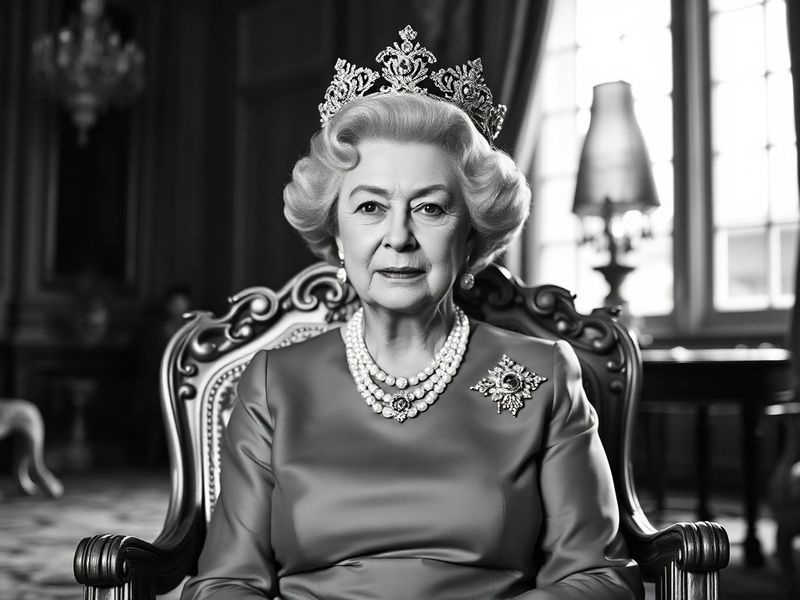
“imageDescription”: “A dignified portrait of Queen Elizabeth II in her later years, wearing the Imperial State Crown and royal robes, standing in Buckingham Palace with a soft golden light illuminating her face. The background includes subtle Union Jack motifs and a faint outline of Windsor Castle in the distance, capturing both grandeur and quiet reflection.”
}
—END METADATA—
“`