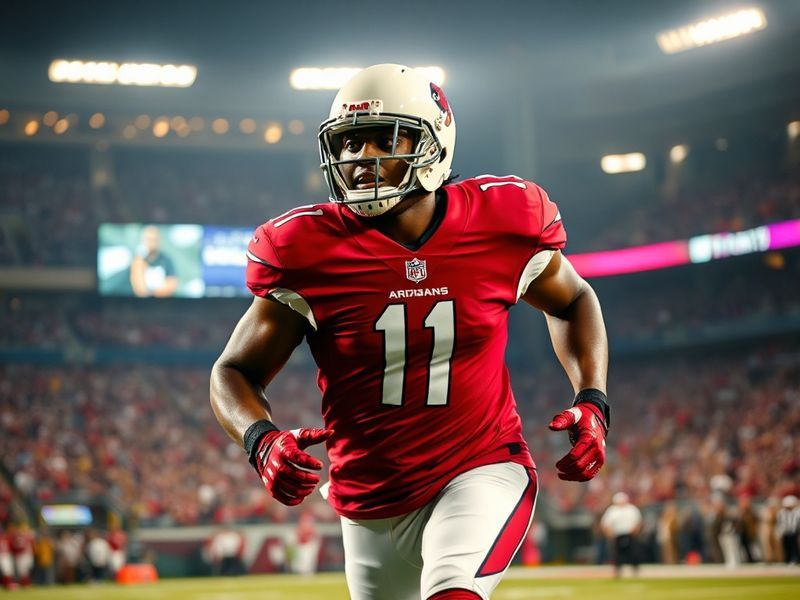
Larry Fitzgerald’s Legacy: A Hall of Fame Career Beyond the NFL
“`html
Larry Fitzgerald: A Career of Consistency and Class in the NFL
Larry Fitzgerald has long stood as one of the most respected figures in professional football. For nearly two decades, he dominated the NFL as one of the game’s most reliable receivers and a model of professionalism. His career, marked by consistency, leadership, and a deep connection with fans, transcended the sport itself, leaving an imprint on American culture and beyond.
The Rise of a Pro Football Icon
Born in Minneapolis, Minnesota, in 1983, Fitzgerald’s journey to the NFL began far from the gridiron spotlight. His father, Larry Fitzgerald Sr., was a sportswriter who covered the Minnesota Vikings, exposing young Fitzgerald to the game early. However, it was in high school at the prestigious Academy of Holy Angels in Richfield that Fitzgerald began to shine.
His talent drew attention from top college programs, and he chose to play for the University of Pittsburgh under coach Walt Harris. During his college career, Fitzgerald emerged as one of the most dynamic receivers in the nation. In 2003, he set an NCAA record with 11 games of at least 100 receiving yards, finishing the season with 97 catches for 1,672 yards and 22 touchdowns—a performance that earned him consensus All-American honors and the Fred Biletnikoff Award as the nation’s top receiver.
His college dominance positioned him as a top prospect for the 2004 NFL Draft. The Arizona Cardinals selected him with the third overall pick, a move that would define both his career and the franchise’s trajectory. Fitzgerald’s arrival in the desert marked the beginning of a new era for the Cardinals, a team long overshadowed in a competitive division.
Redefining Excellence at the Wide Receiver Position
Fitzgerald’s rookie season in 2004 was nothing short of extraordinary. He caught 59 passes for 780 yards and eight touchdowns, earning NFL Offensive Rookie of the Year honors. Over the next decade, he became the face of the Cardinals franchise, forming a legendary partnership with quarterback Kurt Warner and later with Carson Palmer.
His 2008 season remains one of the most iconic in NFL history. Fitzgerald led the Cardinals to their first-ever Super Bowl appearance, posting 96 receptions for 1,431 yards and 12 touchdowns. Though Arizona fell to the Pittsburgh Steelers in Super Bowl XLIII, Fitzgerald delivered a masterclass in clutch performance, including a memorable 64-yard touchdown catch in the fourth quarter.
What set Fitzgerald apart was not just his physical gifts—elite route-running, body control, and hands—but his football IQ and work ethic. He studied defenses meticulously, rarely made mental errors, and maintained peak physical condition well into his 30s. Even as the league evolved with faster, more athletic receivers, Fitzgerald adapted, proving that success in the NFL is as much about preparation as it is about natural ability.
His statistics speak volumes. At retirement, Fitzgerald ranked second all-time in NFL receptions (1,432) and receiving yards (17,492), trailing only Jerry Rice. He was a 11-time Pro Bowl selection, a two-time First-Team All-Pro, and the 2009 Walter Payton NFL Man of the Year, an award given for excellence on and off the field.
Global Influence: More Than Just an Athlete
While Fitzgerald’s on-field achievements are well-documented, his impact extended far beyond the United States. As one of the NFL’s most recognizable international ambassadors, he played a key role in growing the league’s global footprint during the 2000s and early 2010s—a period when the NFL actively sought to expand its brand overseas.
Fitzgerald’s professionalism and humility made him a natural fit for international outreach. He participated in NFL-sponsored tours to Europe, Japan, and Mexico, engaging with fans, conducting clinics, and promoting the game in new markets. His partnership with the league’s International Player Pathway Program also helped nurture global talent, demonstrating a commitment to the sport’s worldwide growth.
In Africa, where American football has traditionally struggled to gain traction, Fitzgerald became a symbol of possibility. His visits to schools and community centers in countries like Nigeria and South Africa inspired young athletes to pursue their dreams, regardless of their background. His story—of hard work, discipline, and respect—resonated deeply in cultures where education and personal development are highly valued.
Beyond his role as a global ambassador, Fitzgerald used his platform to address social issues. He was vocal about education reform, youth mentorship, and athlete activism, often emphasizing the importance of giving back to the community. His “Larry Fitzgerald First Down Fund,” established in 2003, supports underserved youth in Arizona and Minnesota through education, sports, and leadership programs.
A Legacy of Leadership and Sportsmanship
Fitzgerald’s retirement in 2023 was met with widespread tributes from players, coaches, and fans alike. Unlike many stars who leave on declining performance, Fitzgerald exited the game on his own terms—still effective, still respected, and still revered. His final season saw him catch 55 passes for 552 yards and four touchdowns, a quiet but fitting conclusion to a legendary career.
What may be Fitzgerald’s most enduring legacy is his reputation as a class act. In an era where player behavior and public image often dominate headlines, Fitzgerald maintained a level of dignity and professionalism that earned him admiration across the league. He was never involved in off-field controversies, and his interviews were always thoughtful, measured, and insightful.
He leaves behind a blueprint for how to succeed in the NFL—not just as a player, but as a person. His mentorship of younger players, including current stars like DeAndre Hopkins, underscores his commitment to the next generation. Fitzgerald often spoke about the importance of “leaving the game better than you found it,” a philosophy that guided his post-playing career as well.
Today, Fitzgerald remains active in the football world as an analyst for ESPN and a special advisor to the Cardinals. He also continues his philanthropic work, focusing on education and youth development. His transition from player to thought leader reflects a rare ability to evolve while staying true to his values.
Reflections on a Global Sports Icon
From Minnesota to Arizona, from high school standout to NFL legend, Larry Fitzgerald’s career reflects the values of perseverance, respect, and excellence. But his influence extended beyond statistics and trophies. He became a cultural touchstone—a figure who transcended sports to represent integrity in a world often defined by fleeting fame.
In an era where social media amplifies both achievement and controversy, Fitzgerald’s measured presence offered a counterpoint. He showed that greatness isn’t measured solely by touchdowns or highlight-reel catches, but by the impact one has on others. His work in global football development, youth mentorship, and community service cemented his status as a true ambassador of the game.
As the NFL continues to grow globally, Fitzgerald’s legacy serves as a reminder of what it means to represent the sport with honor. Whether in the United States or on the other side of the world, his story resonates because it is rooted in authenticity. Larry Fitzgerald didn’t just play football—he inspired others to strive for greatness in all aspects of life.
For fans, especially the next generation, his career is a testament to the power of consistency, preparation, and respect. In a league known for its volatility, Fitzgerald stood out as a steady force—a player who defined an era not with flash, but with substance.
—