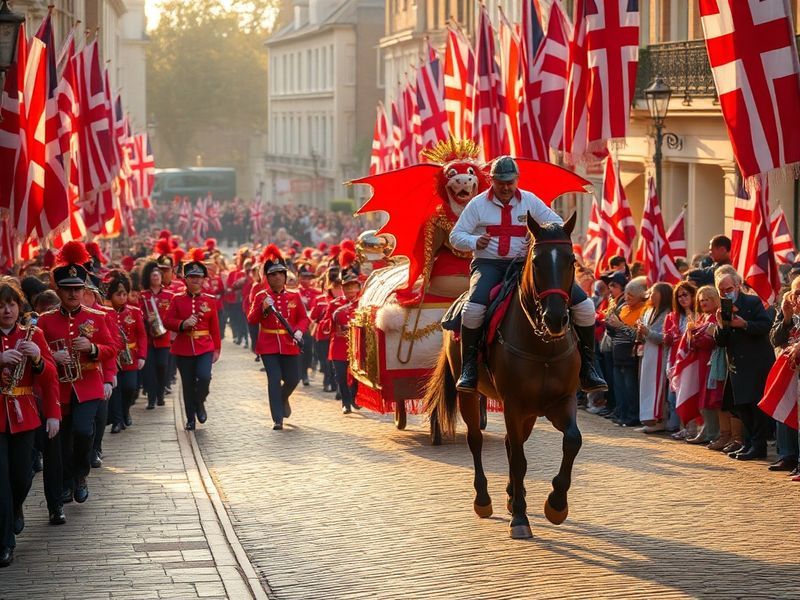
st georges day
“`html
St George’s Day: A Celebration of English Identity and Tradition
Every year on April 23rd, England pauses to honor its patron saint through cultural observances that blend history, folklore, and national pride. St George’s Day is more than a historical footnote—it’s a living tradition that has evolved across centuries, adapting to political climates while retaining its symbolic power. From medieval pageantry to modern street festivals, this day offers a lens into England’s shifting relationship with identity, heritage, and global influence.
Unlike St Patrick’s Day in Ireland or St Andrew’s Day in Scotland, St George’s Day has never been a public holiday in England. Yet its cultural footprint remains deep. The flag of St George—emblazoned with a red cross on a white background—has become a potent symbol, flying at football matches, political rallies, and local parades. This contrast—between official status and popular resonance—reveals much about England’s complex sense of self, especially as debates over nationalism and multiculturalism intensify.
The Historical Roots of St George
St George was not originally an English figure. A 3rd-century Roman soldier from modern-day Turkey, he was venerated in medieval Europe as a martyr who refused to renounce his Christian faith. His legend—particularly the tale of slaying a dragon to save a princess—gained traction in the 13th century through the Golden Legend, a popular collection of saints’ lives. By the time of the Crusades, English knights had adopted him as their patron, linking him to chivalry and crusading zeal.
Edward III formalized this connection in 1348 when he established the Order of the Garter, placing St George at the heart of England’s royal and military identity. The saint’s feast day became a moment of national unity, especially during periods of war or crisis. During World War I, for example, St George’s Day was used to rally support for the war effort, with posters depicting the saint as a warrior defending home soil.
Yet George’s origins outside England have also sparked reinterpretations. In the 20th century, as England grappled with post-colonial identity, some communities began to celebrate St George not as a symbol of English exceptionalism, but as a figure of shared heritage. This shift reflects broader trends in how nations redefine their pasts in multicultural contexts.
Modern Celebrations: From Tradition to Innovation
Today, St George’s Day is marked by a patchwork of observances, ranging from traditional to avant-garde. In some towns, medieval-style fairs recreate the atmosphere of a 15th-century market, complete with Morris dancers, falconry displays, and archery contests. These events often emphasize continuity with the past, drawing families into a shared historical narrative.
Other celebrations take a more contemporary approach. In London, the Mayor’s office has hosted multicultural festivals featuring food stalls, live music, and poetry readings that explore what Englishness means today. These gatherings often highlight the contributions of immigrant communities, challenging the idea that St George’s Day is solely about Anglo-Saxon heritage. The inclusion of Caribbean jerk chicken, Polish pierogi, or South Asian samosas alongside roast beef and ale signals a broader, more inclusive vision of English culture.
Sport plays a significant role in modern observances. The England football team, which wears the St George’s Cross on its kit, often marks the day with matches or community events. This connection underscores how sports can function as a secular form of national ritual, uniting diverse crowds under a common emblem. Even in sports journalism, the day is noted for its ability to spark conversations about patriotism, identity, and belonging.
Meanwhile, younger generations have embraced St George’s Day through digital culture. Social media campaigns using hashtags like #StGeorgesDay and #EnglandDay showcase everything from historical reenactments to modern interpretations of the dragon myth. These online expressions reflect how tradition adapts to new platforms, ensuring the day remains relevant to those who may not attend a physical event.
St George’s Cross: Symbol of Pride or Division?
The St George’s Cross is one of the most recognizable flags in the world, yet its meaning is contested. For some, it represents centuries of English resilience and cultural achievement. For others, particularly in communities with histories of marginalization, it evokes exclusion or even racism. This duality was starkly illustrated during the 2016 EU referendum, when the flag became a potent symbol for both Leave and Remain campaigns.
In response, many organizations have sought to reframe the flag’s significance. The Campaign for an English Parliament, for instance, promotes St George’s Day as a moment to advocate for greater devolution within the UK, arguing that English identity has been overshadowed by Scottish and Welsh nationalism. Meanwhile, anti-racism groups have used the day to challenge far-right appropriations of the flag, organizing events that promote inclusivity.
The debate over the St George’s Cross mirrors broader tensions in English society. Is national identity something fixed and inherited, or fluid and constructed? Can a flag represent both pride in heritage and openness to change? These questions are unlikely to be resolved, but St George’s Day offers a yearly opportunity to confront them.
A Global Perspective: How Other Nations View St George
While St George is primarily associated with England, he holds significance in other cultures as well. In Catalonia, St George’s Day (Diada de Sant Jordi) is a major cultural holiday celebrated on April 23rd. Unlike in England, it is a day of gift-giving, where roses and books are exchanged between lovers and friends. This tradition, dating back to the 15th century, reflects Catalonia’s distinct identity within Spain and has become a symbol of literary pride, coinciding with World Book Day.
In Georgia, St George is the patron saint of the country, and his feast day is marked with religious processions and feasts. The connection between Georgia and St George is so strong that the country’s highest military award is named after him. This demonstrates how a single saint can embody different national narratives, depending on the context.
Even in non-Christian countries, St George’s legend has found resonance. In Lebanon, where he is revered by both Christians and Muslims, the saint is seen as a symbol of bravery and protection. This cross-faith veneration highlights how legends can transcend religious boundaries, becoming part of a shared cultural heritage.
For England, this global tapestry offers a chance for reflection. St George’s Day is not just about asserting Englishness; it’s about recognizing how that identity has been shaped by interactions with the wider world. Whether through migration, trade, or conflict, England’s story is one of exchange and adaptation. Celebrating St George provides an opportunity to acknowledge this complexity.
Why St George’s Day Still Matters
In an era of rapid globalization, the relevance of national days like St George’s Day might be questioned. Why cling to symbols of the past when the future seems to demand borderless cooperation? Yet these observances endure because they fulfill a fundamental human need: the desire to belong. St George’s Day offers a moment of pause in an increasingly fast-paced world, a chance to reflect on shared history and values.
Moreover, the day serves as a reminder that national identity is not monolithic. England, like any nation, is a mosaic of regional, ethnic, and cultural identities. St George’s Day can be a space where these differences are acknowledged rather than erased. Whether through food, music, or storytelling, the day becomes a canvas for expressing what it means to be English in the 21st century.
Of course, challenges remain. The commercialization of national days can dilute their meaning, turning them into opportunities for retailers rather than moments of reflection. There is also the risk that celebrations become exclusionary, emphasizing a narrow vision of Englishness. Yet the adaptability of St George’s Day suggests that it can evolve with the times. By embracing inclusivity and innovation, the day can continue to thrive as a symbol of both tradition and progress.
As England looks to the future, St George’s Day remains a touchstone. It connects the past to the present, the local to the global, and the individual to the collective. In a world where identities are increasingly fluid, it offers a rare constant—a day when the nation, in all its diversity, comes together to remember, celebrate, and imagine what comes next.
Whether through a quiet moment of reflection or a lively street festival, St George’s Day invites everyone to consider their place in the story of England. And in doing so, it reminds us that national days are not just about where we come from—they’re about where we’re going.
—
METADATA
{
“title”: “St George’s Day: History, Celebrations and Cultural Significance”,
“metaDescription”: “Explore the origins, modern celebrations, and global perspectives of St George’s Day, England’s patron saint festival.”,
“categories”: [“Culture”, “News”],
“tags”: [“St George’s Day”, “English culture”, “national identity”, “patron saint”, “flag symbolism”],
“imageDescription”: “A vibrant street festival scene on St George’s Day featuring Morris dancers in traditional costumes, a large St George’s Cross flag waving in the background, and a multicultural crowd enjoying food stalls and live music under spring sunshine.”
}
—END METADATA—
“`