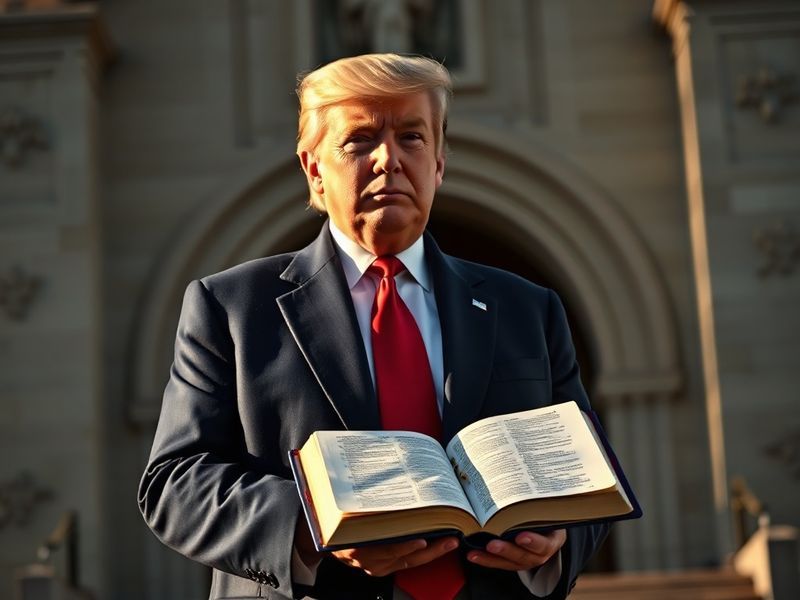
The image of former President Donald Trump holding a Bible outside St. John’s Episcopal Church in Washington, D.C., on June 1, 2020, remains one of the most scrutinized photographs in modern political history. Taken during a period of nationwide protests following the killing of George Floyd, the photo was staged shortly after police used force to clear peaceful demonstrators from Lafayette Square. Trump’s raised Bible, coupled with his public remarks and the militarized backdrop, fueled immediate backlash and became a defining visual of his presidency’s intersection with religion.
The Context Behind the Image
The photograph was captured as Trump walked from the White House to the church, accompanied by senior administration officials and law enforcement. Attorney General William Barr had previously authorized the use of federal forces to disperse protesters, a decision that drew sharp criticism from civil rights leaders, clergy, and Democratic lawmakers. The Episcopal Diocese of Washington condemned the use of the church as a political backdrop, calling Trump’s visit “hypocritical” given his administration’s policies on immigration, racial justice, and healthcare.
Critics argued the image was a calculated attempt to project moral authority and religious devotion at a moment of national crisis. Supporters, however, viewed it as a symbolic reaffirmation of faith in the face of civil unrest. The moment became a flashpoint in ongoing debates about the role of religion in American politics, particularly when wielded by high-profile leaders.
Key Moments Surrounding the Photo
- June 1, 2020: Trump walks to St. John’s Church after Lafayette Square is cleared by police using tear gas, pepper spray, and rubber bullets.
- Bishop’s Response: The Right Rev. Mariann Budde, bishop of the Episcopal Diocese of Washington, stated, “We are a peaceful church that has welcomed all people for over 200 years. To use one of our churches in such a prop, to help prop up a message that is antithetical to the teachings of Jesus, is a profound contradiction.”
- White House Defense: Press Secretary Kayleigh McEnany later said Trump was “standing in solidarity with all those who seek justice and peace.”
- Ongoing Fallout: The photo resurfaced during Trump’s 2024 presidential campaign, reigniting discussions about his relationship with evangelical voters.
Why the Image Resonates Beyond Politics
The photograph transcended its immediate political context to become a symbol of deeper cultural tensions. For many Americans, it crystallized concerns about the instrumentalization of faith—how religious symbols and institutions are used to advance political agendas. The act of holding a Bible, a text revered across Christian denominations, carries immense weight. When performed in a charged setting like a protest zone, it can feel less like devotion and more like a calculated statement.
Religious scholars have noted that Trump’s presidency forced a reckoning within American Christianity itself. Evangelical leaders, who overwhelmingly supported Trump in 2016 and 2020, found themselves defending their alliance with a president whose personal behavior and rhetoric often clashed with traditional Christian ethics. Polls from Pew Research and PRRI consistently showed that white evangelicals remained Trump’s most loyal voting bloc, despite concerns about his moral character.
This dynamic highlights a paradox: the more a leader invokes religious imagery, the more scrutiny falls on whether their actions reflect the values they claim to uphold. The Bible photo, in particular, became a visual shorthand for this tension—one that continues to influence how voters perceive the intersection of faith and governance.
Broader Implications for American Politics and Religion
The fallout from the photo extends into several critical areas of public life. First, it underscored the increasing polarization of religious identity in politics. While conservative Christians often frame their political engagement as a defense of Christian values, critics argue this framing excludes or marginalizes non-Christian and secular Americans. The photo’s message—whether intended or not—was inaccessible to many citizens who do not share the same theological framework.
Second, the incident raised questions about the role of law enforcement in political messaging. The militarized response to protesters, followed by a presidential photo op, sent a message about the state’s role in both public order and public worship. This has had lasting effects on community trust in local governments and police departments, particularly in cities with large minority populations.
Third, the episode became a touchstone in discussions about media representation and political optics. Photographers and journalists who captured the moment became central figures in the narrative, with some accusing press outlets of selective framing or bias in how the photo was disseminated. The Associated Press, for example, chose not to run the image on its wire, citing ethical concerns over its use as propaganda.
Long-Term Consequences
- Evangelical Realignment: Some younger evangelicals and Christians of color have distanced themselves from partisan politics, forming groups like Christians Against Christian Nationalism.
- Policy Shifts: The photo contributed to increased scrutiny of federal policing tactics and calls for police reform, particularly regarding the use of force during protests.
- Cultural Memory: The image remains a reference point in debates about leadership, morality, and the appropriate use of religious symbolism in governance.
- Media Ethics: News organizations continue to grapple with how to cover moments where politics and religion intersect, especially when images can be weaponized.
Ultimately, the photograph is more than a moment frozen in time. It is a mirror reflecting America’s ongoing struggle to reconcile faith with justice, power with humility, and identity with citizenship. Whether viewed as a courageous stand or a cynical ploy, its legacy persists in the way we discuss religion, race, and leadership in the public square.
Looking Ahead: How This Moment Shapes Future Campaigns
As Trump and other political figures continue to invoke religious imagery, the lessons of 2020 remain relevant. Campaigns increasingly rely on visual storytelling—photographs, videos, and social media posts—to convey authenticity and values. Yet, when those images are staged in contentious settings, they risk backfiring, alienating key demographics, or reinforcing perceptions of insincerity.
For faith communities, the episode has forced introspection. Many denominations have re-examined their relationship with political power, emphasizing social justice, racial reconciliation, and environmental stewardship as core Christian responsibilities. This shift is evident in movements like the Poor People’s Campaign and in statements from Pope Francis and the Archbishop of Canterbury condemning political violence and economic inequality.
For political observers, the challenge lies in distinguishing between genuine expressions of faith and performative displays. The ability to read these visual cues—whether in a Bible photo, a prayer breakfast, or a campaign ad—requires media literacy and critical thinking. As deepfake technology and AI-generated images become more sophisticated, the task of verifying authenticity will only grow more complex.
In an era where symbols carry as much weight as policies, the 2020 Bible photo serves as a cautionary tale. It reminds us that the most powerful images are not just seen—they are interpreted, contested, and remembered. And in a democracy, those interpretations shape the future of both church and state.
For further reading on the intersection of politics and faith, visit our Politics and Culture sections, where we explore how cultural symbols influence public life.