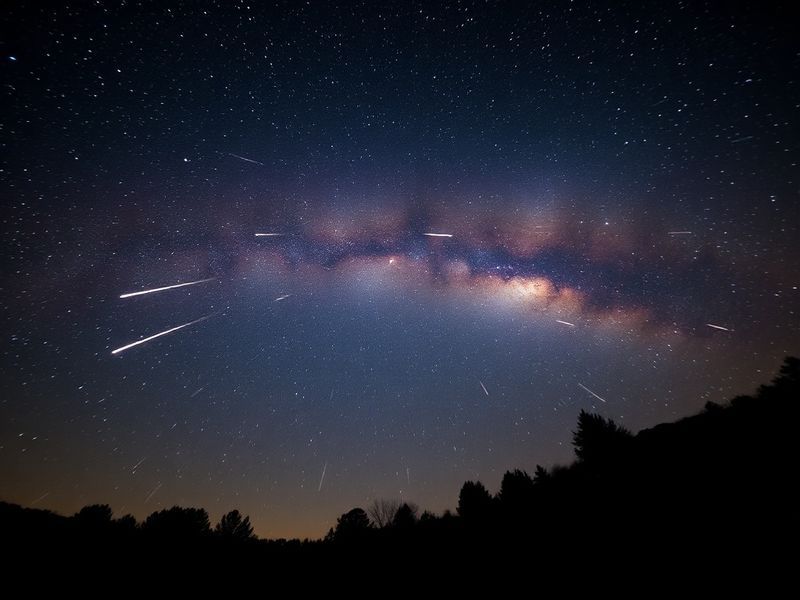
The Lyrid meteor shower, one of the oldest known annual meteor showers, offers stargazers a reliable celestial event each April. Unlike more unpredictable meteor showers, the Lyrids reliably produce bright, fast streaks across the night sky, making them a favorite for amateur astronomers and casual observers alike. This year’s display promises to be particularly accessible, with optimal viewing conditions expected in many regions.
The shower’s origins trace back to the comet C/1861 G1 (Thatcher), which leaves behind a trail of debris as it orbits the sun. When Earth passes through this debris field, typically around April 16-26, the particles burn up in our atmosphere, creating the dazzling light show we recognize as the Lyrids. Named after the constellation Lyra, where the meteors appear to radiate from, this event has been documented for over 2,600 years, with the first recorded sighting in 687 BCE by Chinese astronomers.
When and Where to Watch the Lyrids
The Lyrid meteor shower peaks over a single night or two, providing a concentrated burst of activity. In 2024, the peak is expected on the night of April 22 into the early morning of April 23. Unlike some meteor showers that require precise timing, the Lyrids offer a wide viewing window—often spanning several hours after midnight. This flexibility makes them ideal for both night owls and early risers.
Location plays a crucial role in visibility. The best viewing spots are areas far from urban light pollution, where the sky remains dark enough to spot even faint meteors. National parks, rural areas, and designated dark-sky preserves are excellent choices. The Lyrids are visible from both the Northern and Southern Hemispheres, though observers in the Northern Hemisphere typically see higher rates of meteors due to the radiant’s position in the sky.
For those planning to watch, here are key tips for maximizing the experience:
- Timing: Arrive at your viewing location at least an hour before the expected peak to allow your eyes to adjust to the darkness.
- Comfort: Bring a reclining chair or blanket to lie flat on, as looking straight up for extended periods can strain the neck.
- Equipment: While binoculars or telescopes aren’t necessary, they can enhance the experience if you want to observe other celestial objects like constellations or planets.
- Patience: Meteor showers are unpredictable. Allow at least an hour for observation to catch the full range of activity.
The Science Behind the Lyrids
The Lyrids are classified as a medium-strength shower, typically producing 10-20 meteors per hour at their peak. However, this number can vary significantly from year to year. Occasionally, the Lyrids surprise observers with sudden outbursts, producing up to 100 meteors per hour. Such events occurred in 1803, 1922, and 1982, leaving astronomers fascinated by the shower’s potential for unpredictability within its predictable cycle.
The meteors themselves are relatively fast, traveling at speeds of about 30 miles per second. This speed contributes to their brightness, as the particles burn up quickly and intensely in the Earth’s atmosphere. The Lyrids are also known for producing occasional bright fireballs, which leave persistent trails that can linger for several seconds.
Scientists study the Lyrids not only for their visual spectacle but also for the insights they provide into the composition of comet Thatcher. By analyzing the meteors’ light spectra, researchers can determine the chemical makeup of the debris, shedding light on the conditions present during the comet’s formation thousands of years ago. This data helps piece together the history of our solar system and the materials that contributed to its creation.
Broader Implications of Meteor Showers
Beyond their aesthetic appeal, meteor showers like the Lyrids play a role in public engagement with astronomy. Events like these inspire curiosity about space and encourage amateur astronomers to develop their skills in observation and astrophotography. Organizations like NASA and the International Astronomical Union often use meteor showers as opportunities to educate the public about celestial phenomena, hosting live streams, social media events, and community stargazing parties.
The Lyrids also serve as a reminder of Earth’s dynamic relationship with the cosmos. Each meteor is a tiny fragment of a distant comet, a relic from the early days of our solar system. This connection fosters a sense of wonder and humility, reinforcing the idea that we are part of a much larger, interconnected universe. For many, witnessing a meteor shower is a humbling experience that puts daily concerns into perspective.
Moreover, meteor showers contribute to the ongoing study of space debris and its potential impact on Earth. While the Lyrids pose no threat—burning up entirely in the atmosphere—they are part of a broader category of near-Earth objects (NEOs) that scientists monitor for potential hazards. Understanding the behavior of meteoroid streams like the Lyrids helps researchers refine models for tracking and predicting the paths of larger, more dangerous objects.
Cultural and Historical Significance
The Lyrids hold a special place in human history, with records of their observation dating back millennia. Ancient civilizations often interpreted meteor showers as omens or messages from the gods. In Chinese lore, the Lyrids were sometimes associated with the weeping of a legendary empress, while in Greek mythology, they were linked to the lyre of Orpheus, whose music could charm even inanimate objects.
Today, the Lyrids continue to inspire artists, writers, and filmmakers. Their fleeting yet brilliant appearance in the night sky makes them a powerful symbol of transience and beauty. Whether captured in a painting, a poem, or a photograph, the Lyrids evoke a sense of awe that transcends cultural boundaries.
For those interested in capturing the Lyrids on camera, the challenge lies in balancing technical skill with patience. A sturdy tripod, a wide-angle lens, and a long exposure setting are essential tools. Photographers often set their cameras to take continuous shots over several hours, hoping to catch that perfect streak of light. The resulting images not only document the event but also serve as a testament to the enduring allure of the night sky.
As we look ahead to the next peak of the Lyrids, take a moment to step outside and gaze upward. In a world often filled with noise and distraction, meteor showers offer a rare opportunity to reconnect with the natural world and the wonders beyond our planet. Whether you’re a seasoned astronomer or a first-time observer, the Lyrids provide a reminder of the beauty and mystery that still exist in the universe.
For more stargazing guides and celestial events, visit our Science and Entertainment categories on Dave’s Locker.