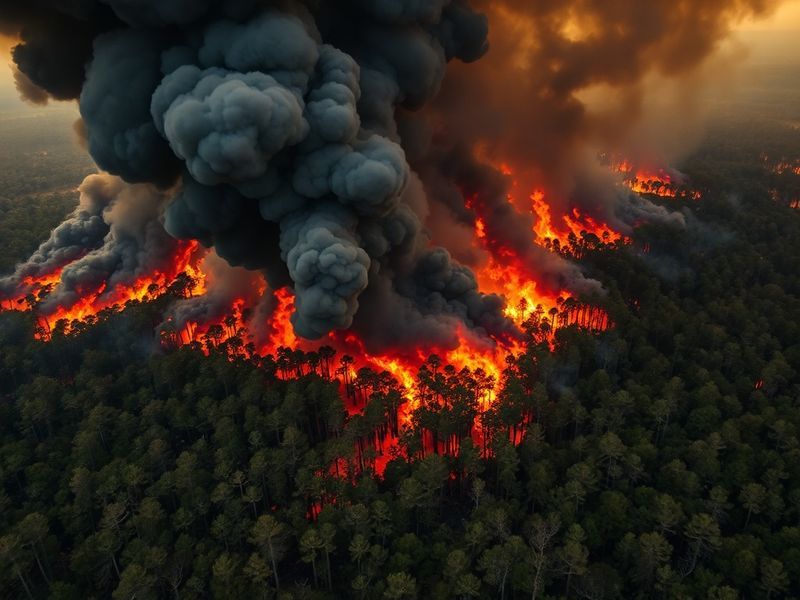
Georgia’s Wildfire Crisis: A Global Warning in the Caucasus
The lush forests of Georgia, a country straddling Europe and Asia, have become an unlikely focal point in the global wildfire crisis. While wildfires in the western United States or Australia dominate international headlines, the fires burning in Georgia’s highlands and Black Sea regions reveal a deeper, more troubling pattern. Climate change, land-use policies, and rural abandonment are converging to turn this small nation into a cautionary tale for the wider Caucasus and beyond.
Georgia’s wildfires are not just a local disaster; they are a microcosm of systemic environmental pressures reshaping landscapes from the Mediterranean to the Himalayas. In 2023 alone, over 50,000 hectares of Georgian forest were scorched—an area nearly twice the size of Washington, D.C.—according to the National Forestry Agency of Georgia. These fires have displaced wildlife, threatened water supplies, and exposed the vulnerabilities of communities that have lived in harmony with these forests for centuries.
The Roots of the Crisis: Climate, Abandonment, and Policy
The immediate trigger for Georgia’s wildfires is often dry weather and high temperatures, both exacerbated by climate change. The country has experienced a 1.5°C rise in average temperatures over the past three decades—twice the global average—according to the World Bank. This warming dries out vegetation, turning forests into tinderboxes. But the deeper issue lies in the way Georgia’s landscapes have been transformed by human activity and neglect.
During the Soviet era, rural areas in Georgia were densely populated, with collective farms and state forests maintained through intensive labor. After the collapse of the USSR, many rural communities collapsed alongside it. Young people migrated to cities like Tbilisi or abroad, leaving behind abandoned farmlands and unmanaged forests. Without regular clearing or controlled burns, undergrowth accumulated, creating perfect fuel for wildfires.
Government response has been uneven. While emergency services like the National Agency of the Environment and Forestry respond to fires with helicopters and ground crews, critics argue that prevention measures are underfunded. A 2022 audit by Georgia’s State Audit Office found that only 30% of designated forest fire prevention zones were adequately maintained. Meanwhile, illegal logging and land speculation continue to fragment forests, further increasing fire risk.
The situation reflects a broader regional trend. Across the Caucasus—from Armenia’s Syunik Province to Russia’s Krasnodar Krai—wildfires are intensifying due to similar pressures: rural depopulation, weak enforcement of environmental laws, and rising temperatures. Georgia, however, sits at a geopolitical crossroads, making its wildfire crisis a lens through which to view both environmental and social fragility in the post-Soviet space.
Cultural and Ecological Loss: What Georgia Stands to Lose
For Georgians, forests are not just ecosystems—they are repositories of identity and tradition. The country is home to ancient Colchic forests, some of the oldest in the world, dating back to the Jurassic period. These forests shelter endemic species like the Caucasian salamander and the elusive Caucasian lynx, both now threatened by recurring fires. The loss of these habitats is more than ecological; it’s a blow to Georgia’s cultural heritage.
Local communities, particularly in mountainous regions like Svaneti and Racha, have long depended on forests for firewood, mushrooms, and medicinal herbs. Wildfires disrupt these livelihoods, forcing families to migrate or rely on dwindling state support. In 2021, fires in the Borjomi-Kharagauli National Park—a UNESCO-listed biodiversity hotspot—destroyed over 1,200 hectares, including rare beech and pine forests. The park is a cornerstone of Georgia’s eco-tourism industry, which contributes over $1.2 billion annually to the economy. Its degradation signals a potential decline in one of the country’s most promising economic sectors.
Religious and historical sites are also at risk. Many Georgian Orthodox monasteries, built into forest cliffs or surrounded by sacred groves, now face encroachment from fire. The 11th-century Zedazeni Monastery, perched high in the Gombori Range, has seen its pine forests repeatedly scorched, prompting conservationists to warn of irreversible damage to its spiritual and architectural integrity.
This blend of cultural and ecological loss underscores a painful irony: Georgia’s wildfires are erasing the very landscapes that define its global image. In a country that markets itself as a haven of pristine nature and ancient tradition, the fires are exposing a gap between perception and reality.
Global Lessons: What Georgia Teaches the World
Georgia’s wildfire crisis is not an isolated event but a symptom of a planetary shift. Around the world, wildfires are growing in frequency, intensity, and unpredictability. In 2023, Canada experienced its worst wildfire season on record, with smoke drifting as far as New York City. In Greece, fires in the Attica region killed over 100 people in a single day. These disasters share common drivers: climate change, land mismanagement, and social inequity.
Georgia offers three key lessons for global policymakers and communities:
- Prevention over reaction: Most wildfire response budgets focus on firefighting, yet studies show that investment in fuel management and community preparedness reduces fire risk by up to 60%. Georgia’s prevention gaps highlight the need for long-term planning.
- The role of rural resilience: As young people leave rural areas, traditional fire management practices—like controlled burns by shepherds—are disappearing. Revitalizing these practices can restore ecological balance and economic stability.
- Cross-border cooperation: Wildfires do not respect borders. Georgia shares ecosystems with Turkey, Armenia, and Russia, yet fire response coordination remains limited. Regional agreements could improve early warning systems and resource sharing.
International organizations are beginning to take notice. The European Union, through its EU4Climate program, has pledged €5 million to support Georgia’s wildfire resilience initiatives. The United Nations Development Programme is funding reforestation projects in fire-affected zones. These efforts are vital, but critics argue they are too small and too slow in the face of accelerating climate change.
Meanwhile, Georgian activists are using art and media to raise awareness. Filmmakers like Salome Jashi have documented the human cost of wildfires in her 2022 short film The Forests of My Childhood, which premiered at the Batumi International Art House Film Festival. Her work connects local struggles to global audiences, positioning Georgia as both a victim and a voice in the climate crisis.
A Path Forward: Policy, Participation, and Persistence
There is no single solution to Georgia’s wildfire crisis, but a combination of policy reform, community engagement, and international cooperation offers a glimmer of hope. The Georgian government has taken steps, including the 2023 launch of a National Wildfire Management Strategy, which aims to improve early detection using satellite technology and drones. The strategy also includes provisions for hiring local rangers to monitor high-risk areas—a recognition that sustainable solutions require local buy-in.
At the community level, initiatives like the Sustainable Caucasus project are training farmers and shepherds in fire-safe land management. These grassroots efforts are crucial in a country where state resources are stretched thin. Meanwhile, environmental NGOs are pushing for stronger enforcement of logging bans and stricter penalties for illegal land conversion.
Globally, Georgia’s experience underscores the need for integrated climate and land-use policies. The European Green Deal and the UN’s Sustainable Development Goals both emphasize the protection of forests, yet implementation remains uneven. Georgia’s fires serve as a reminder that environmental protection is not just a technical challenge—it is a social and political one.
As the world grapples with the escalating wildfire threat, Georgia’s story is both a warning and a call to action. The fires burning in its mountains are not just destroying trees; they are eroding the foundations of culture, economy, and ecology. Yet within this crisis lies an opportunity—to rethink humanity’s relationship with nature, to rebuild rural communities, and to forge new alliances across borders. The question is whether Georgia—and the world—will seize it in time.
For those watching from afar, the lesson is clear: wildfires are not just disasters to be survived, but crises to be prevented. And prevention begins with listening to the voices of those who know the land best—the people who have guarded Georgia’s forests for generations, and who now watch as they burn.