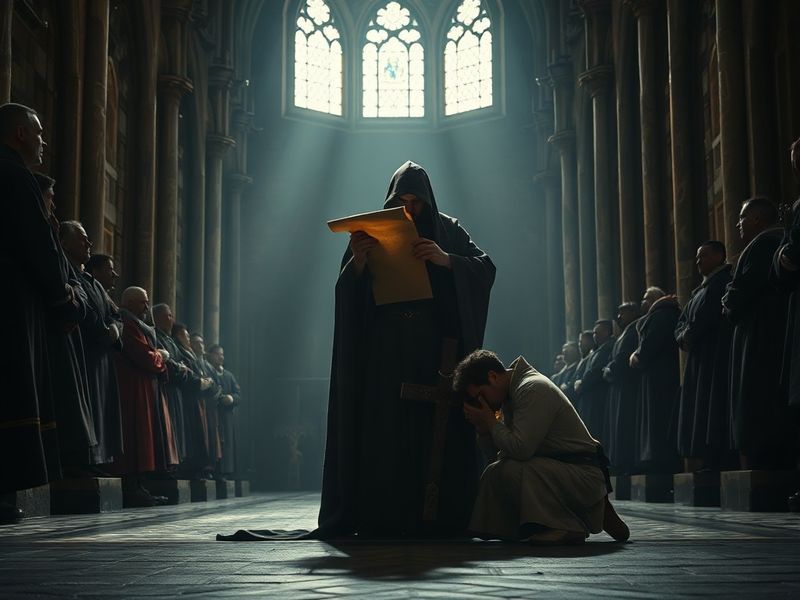
Excommunication: Power, Punishment, and the Cost of Religious Exclusion
“`html
What Is Excommunication? Understanding the Ancient Practice
Excommunication is one of the most severe disciplinary actions within organized religions, particularly in Christianity. At its core, it represents a formal exclusion from participation in religious rites and community life. The Catholic Church, for example, describes it as a medicinal penalty aimed at prompting repentance rather than permanent rejection. Historically, excommunication has been used to enforce doctrinal purity, maintain moral standards, and discipline clergy and laypeople alike.
Not all religious traditions practice excommunication in the same way. In Eastern Orthodox Christianity, similar mechanisms exist but are often less publicly enforced. Judaism has its own forms of exclusion, such as cherem, which historically isolated individuals from communal worship and social interaction. Islam, while not using the term “excommunication,” employs takfir, declaring a person an apostate and thus outside the faith community. These variations reveal how religious authority uses exclusion as a tool for maintaining boundaries and cohesion.
The Historical Role of Excommunication in Power and Politics
Throughout history, excommunication wasn’t just about spiritual consequences—it was a political weapon. In medieval Europe, popes and bishops wielded excommunication to challenge kings and emperors. The most famous example is the 1054 East-West Schism, when mutual excommunications between the Pope and the Patriarch of Constantinople solidified the split between Roman Catholicism and Eastern Orthodoxy. This wasn’t merely a theological dispute; it reshaped empires, influenced alliances, and dictated who could be trusted in matters of state.
Another pivotal moment occurred in 1521, when Pope Leo X excommunicated Martin Luther after his refusal to recant his 95 Theses. This act didn’t silence Luther—it ignited the Protestant Reformation. Excommunication, in this case, failed to suppress dissent and instead became a symbol of resistance against papal authority. The practice thus highlights how religious censure can backfire, fueling movements that challenge the very institutions that impose it.
Modern Uses of Excommunication: When and Why It Still Happens
While excommunication is less common today, it hasn’t disappeared. The Catholic Church still uses it, though more sparingly and with greater emphasis on pastoral accompaniment. In 2019, the Vatican excommunicated a Brazilian bishop who publicly supported a schismatic group aligned with traditionalist views. This case underscored how excommunication remains a tool for addressing internal division, especially when doctrinal loyalty is questioned.
Other religious groups also practice forms of exclusion. The Jehovah’s Witnesses, for instance, employ a process known as disfellowshipping, which involves shunning former members. This practice has drawn criticism for its psychological and social impact, particularly on families divided by religious boundaries. In ultra-Orthodox Jewish communities, get refusal—denying a religious divorce—can functionally excommunicate women, trapping them in marital limbo. These modern applications reveal how exclusion persists not only as a spiritual penalty but as a social and familial rupture.
Even in secular contexts, exclusion carries weight. Some online communities and social media platforms have adopted “shadowbanning” or account suspensions that function like modern excommunication. While not religious, these actions control access to discourse and community, raising ethical questions about censorship and free expression.
Psychological and Social Consequences of Excommunication
The effects of excommunication extend beyond the spiritual realm. Research in social psychology shows that exclusion—whether religious, social, or digital—triggers responses similar to physical pain. Studies using fMRI scans reveal that being ostracized activates the same brain regions as physical trauma. For individuals excommunicated from tight-knit religious communities, the loss of identity and support can lead to depression, anxiety, and even suicide in extreme cases.
Families often bear the brunt of these consequences. Children raised in communities where excommunication is a real threat may grow up in fear of expulsion. In some ultra-Orthodox Jewish communities, families have been torn apart when one member is excommunicated, with parents forced to choose between loyalty to their child or their faith. Similarly, former Jehovah’s Witnesses report enduring isolation, job loss, and fractured relationships after disfellowshipping. These personal stories highlight the human cost of institutional exclusion.
Yet, excommunication isn’t universally negative. For some, it becomes a catalyst for reinvention. Former members of restrictive religious groups often rebuild their lives, finding new communities and identities. The rise of ex-Mormon and ex-evangelical support groups online demonstrates how individuals reclaim agency after exclusion. This duality—destruction and rebirth—is a defining feature of excommunication’s legacy.
Can Excommunication Ever Be Justified?
The morality of excommunication hinges on intent and outcome. Proponents argue that it protects the integrity of belief systems by removing disruptive influences. In cases of abuse or heresy, exclusion may serve as a necessary boundary. The Catholic Church, for example, excommunicated priests involved in sexual abuse scandals only after years of inaction, suggesting that institutional reform sometimes requires drastic measures.
Critics, however, view excommunication as an abuse of power. They point to historical examples where exclusion was used to silence reformers, suppress women, or maintain oppressive hierarchies. The excommunication of feminist theologians like Sister Margaret McBride in 2010 for approving an abortion to save a mother’s life sparked outrage. Such cases reveal how institutional authority can overshadow compassion and justice.
Ultimately, the justification of excommunication depends on whether it heals or harms. A healthy religious community should balance accountability with mercy. When exclusion becomes a tool for control rather than correction, it risks losing its moral authority entirely.
Navigating Exclusion in a Changing World
As society becomes more secular and individualistic, the role of excommunication is evolving. Younger generations often view religious institutions with skepticism, making exclusion less effective as a deterrent. Meanwhile, digital communities are creating new forms of belonging—and new forms of exclusion. Social media platforms now act as de facto religious authorities, banning users for perceived heresy or moral violations.
For religious institutions, the challenge is clear: adapt or risk irrelevance. The Catholic Church’s recent emphasis on dialogue and accompaniment suggests a shift away from punitive measures. Other groups may follow, redefining exclusion not as a final sentence but as a call to reconciliation. In an era of polarization, the principles behind excommunication—boundaries, accountability, and community—remain relevant, even if the practice itself is fading.
Whether seen as a relic of the past or a necessary tool, excommunication forces us to confront fundamental questions: Who controls the boundaries of belief? What happens when you’re cut off from the community that shaped your identity? And can exclusion ever lead to healing, or does it only deepen division?
One thing is certain: the legacy of excommunication will continue to shape religious life, social structures, and personal identities for generations to come.
To explore more about how religious practices intersect with modern life, visit our Culture section. For deeper analysis on institutional power, check out our Analysis page.