<!DOCTYPE html>
<html lang="en">
<head>
    <meta charset="UTF-8">
    <meta name="viewport" content="width=device-width, initial-scale=1.0">
    <title>Understanding the Pantheon: History, Architecture, and Legacy</title>
</head>
<body>
    <article>
        <h1>The Pantheon: A Monument to Human Ingenuity and Divine Ambition</h1>

        <p>The Pantheon in Rome stands as one of the most enduring symbols of ancient architectural brilliance. Completed in 126 AD under Emperor Hadrian, this temple-turned-church has survived nearly two millennia, weathering political upheavals, religious transformations, and the relentless passage of time. Its massive dome, still the world's largest unreinforced concrete dome, continues to inspire architects and historians alike.</p>

        <p>Beyond its structural marvels, the Pantheon represents a fascinating intersection of Roman engineering, religious syncretism, and political messaging. Originally commissioned by Marcus Agrippa during Augustus's reign, the current structure reflects Hadrian's vision—a testament to Rome's capacity for reinvention and grandeur. The building's name, derived from Greek roots meaning "all the gods," hints at its original purpose as a sanctuary for Roman deities.</p>

        <h2>The Architectural Revolution of the Pantheon</h2>

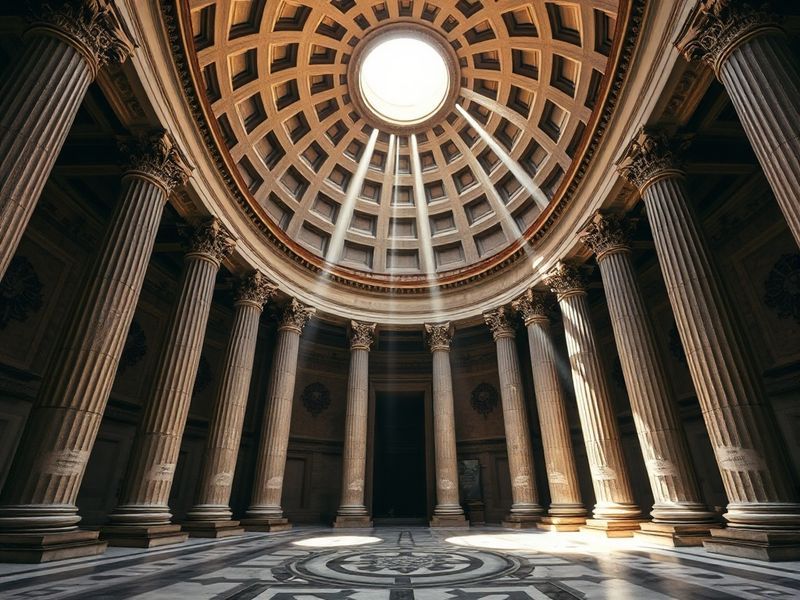
        <p>The Pantheon's most striking feature remains its unreinforced concrete dome, a marvel of ancient construction. Spanning 43.3 meters (142 feet) in diameter, the dome's base is 21.3 meters (70 feet) thick, gradually thinning to just 1.2 meters (4 feet) at the apex. This structural innovation allowed for an oculus at the top—an open 8.7-meter-wide circular skylight that remains the building's only source of natural light.</p>

        <p>What makes this dome particularly remarkable is its construction technique. Roman concrete, formulated with volcanic ash (pozzolana), lime, and aggregate, gains strength over time rather than deteriorating. The aggregate used in the Pantheon's dome varies in density, with heavier stones at the base and lighter pumice toward the top, creating an elegant balance between structural integrity and material efficiency.</p>

        <p>The building's interior follows a perfect sphere, with the dome's height equaling the diameter of the rotunda. This mathematical precision wasn't accidental—it reflected Roman architects' understanding of geometry and their desire to create a space that felt both divine and mathematically perfect. The coffered ceiling, with its recessed panels, not only reduced the dome's weight but also created a mesmerizing pattern of squares that draws the eye upward toward the oculus.</p>

        <h3>Materials and Construction Techniques</h3>

        <p>The Pantheon's construction involved a sophisticated supply chain across the Roman Empire. The primary materials included:</p>

        <ul>
            <li>Travertine stone from Tivoli for the portico columns</li>
            <li>Ottocento marble from Carrara for interior decorations</li>
            <li>Volcanic aggregates from the Bay of Naples for the concrete mixture</li>
            <li>Gold leaf for decorative elements (now largely replaced)</li>
        </ul>

        <p>Workers likely used a massive wooden framework to shape the dome during construction. The process would have taken years, with the concrete curing slowly over time—a testament to Roman patience and precision. The building's portico, with its eight Corinthian columns made of Egyptian granite, originally stood 15 meters (49 feet) high, though the ground level has risen over centuries due to urban sedimentation.</p>

        <h2>From Pagan Temple to Christian Church</h2>

        <p>The Pantheon's religious significance evolved dramatically after Rome's conversion to Christianity. In 609 AD, Pope Boniface IV consecrated the building as a church dedicated to the Virgin Mary and all martyrs, effectively saving it from destruction during the Christianization of Rome. This transformation preserved the structure when many other pagan temples were demolished or repurposed.</p>

        <p>The building's new Christian identity required modifications, though many original features remained intact. The oculus, previously associated with the sun god Sol, became a connection to the Christian heaven. The niches that once held statues of Roman gods were gradually filled with Christian relics and icons. The most significant alteration came in the 17th century when Pope Urban VIII ordered the removal of the original bronze ceiling of the portico, which was melted down to cast Bernini's baldacchino in St. Peter's Basilica.</p>

        <p>This adaptive reuse demonstrates a recurring theme in architectural history: buildings often outlast their original purposes. The Pantheon's survival through religious transitions reflects its status as a cultural palimpsest, where each era leaves its mark while preserving fragments of the past.</p>

        <h2>The Pantheon's Cultural and Historical Influence</h2>

        <p>Beyond its architectural achievements, the Pantheon has played a crucial role in intellectual and artistic history. During the Renaissance, it became a pilgrimage site for architects studying its proportions and techniques. Brunelleschi studied the Pantheon's dome before designing Florence's Duomo, while Michelangelo reportedly visited frequently to sketch its details. The building's harmonious proportions influenced Palladian architecture and subsequent neoclassical movements across Europe and America.</p>

        <p>The Pantheon has also served as a final resting place for Italy's most illustrious citizens. Since the Renaissance, it has housed the tombs of figures like Raphael, King Vittorio Emanuele II, and Queen Margherita. These burials transformed the building from a mere monument into a secular shrine, reinforcing its status as a symbol of Italian identity and continuity.</p>

        <p>In modern times, the Pantheon has become a site of both tourism and scholarship. Archaeologists continue to study its construction techniques, while conservationists work to preserve its deteriorating materials. The building's status as a UNESCO World Heritage Site since 1980 has helped fund these efforts, though challenges remain in balancing preservation with public access.</p>

        <h3>Modern Preservation Challenges</h3>

        <p>Maintaining the Pantheon presents unique difficulties due to its age and exposure to modern environmental factors. Key challenges include:</p>

        <ol>
            <li><strong>Air pollution:</strong> The building's travertine and marble surfaces are eroded by particulate matter from Rome's traffic and heating systems.</li>
            <li><strong>Tourist footfall:</strong> Over 6 million visitors annually contribute to wear on the ancient floors and surfaces.</li>
            <li><strong>Climate change:</strong> Increased rainfall and temperature fluctuations accelerate material degradation.</li>
            <li><strong>Structural stress:</strong> Vibrations from nearby construction and subway systems pose potential risks to the dome's integrity.</li>
        </ol>

        <p>Conservation efforts have employed advanced techniques, including laser cleaning and anastylosis (reassembling original fragments). The Vatican, which manages the site, has installed subtle environmental monitoring systems to track changes in humidity and temperature. These measures aim to preserve the Pantheon for future generations while maintaining its authenticity.</p>

        <h2>Why the Pantheon Still Matters Today</h2>

        <p>The Pantheon endures not just as a relic of the past, but as a living testament to human creativity and adaptability. Its survival across millennia speaks to the universal human impulse to create enduring monuments. In an age of disposable architecture, the Pantheon reminds us of the value in building to last—both physically and culturally.</p>

        <p>Architects continue to draw inspiration from its proportions and engineering. The building's oculus, while originally a structural necessity, has become a poetic symbol of connection between earth and sky. In an era of climate crisis, its passive cooling systems—dependent on the thermal mass of its thick walls and the natural ventilation through the oculus—offer lessons for sustainable design.</p>

        <p>For Romans and visitors alike, the Pantheon remains a place of awe. Standing beneath its dome, one experiences the same sense of wonder that ancient visitors must have felt. The building's ability to evoke this emotion after nearly 2,000 years suggests that its power lies not just in its physical attributes, but in its capacity to connect us across time to the aspirations of those who came before us.</p>

        <p>As we continue to grapple with questions of heritage preservation and sustainable design, the Pantheon offers both a challenge and an inspiration. It challenges us to build with the same attention to material and form that its creators demonstrated. And it inspires us to consider what we might create that could endure with equal grace.</p>
    </article>

    <!-- Metadata section -->