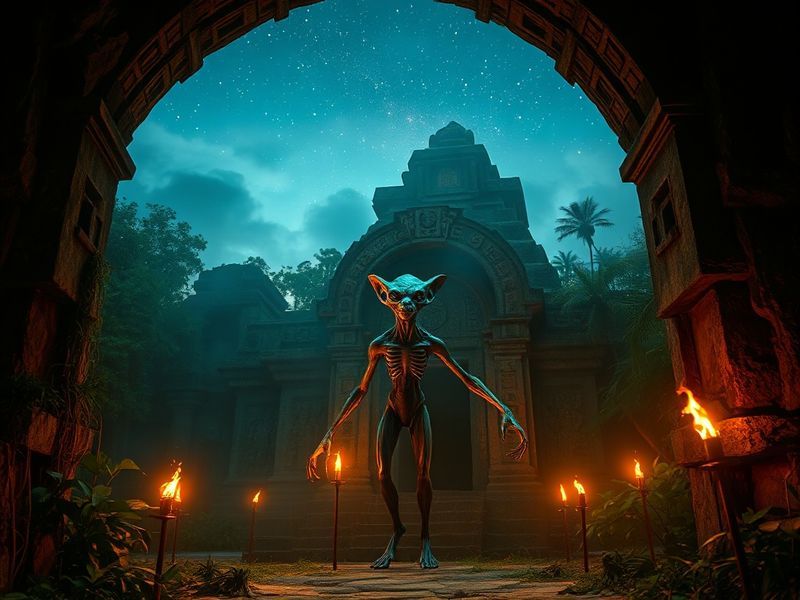
The idea that extraterrestrial beings visited Earth in antiquity and influenced human civilization has captivated imaginations for decades. Popularized by television shows, documentaries, and a bestselling series of books, the ancient aliens theory blends archaeology, mythology, and speculative science into a compelling narrative. While mainstream academia remains skeptical, the theory persists as a cultural touchstone, inspiring both rigorous investigation and fringe speculation.
Proponents of the ancient aliens hypothesis argue that certain ancient structures, artifacts, and texts contain evidence of advanced technology or visitors from beyond Earth. They point to anomalies in historical records, unexplained architectural feats, and patterns in global mythology as potential clues. Critics, however, dismiss these claims as pseudoscience, attributing them to misinterpretation, coincidence, or deliberate hoaxes. The debate raises important questions about how we interpret the past—and what we’re willing to believe.
The Origins of the Ancient Aliens Narrative
The modern ancient aliens theory owes much of its momentum to Swiss author Erich von Däniken, whose 1968 book Chariots of the Gods? became an international sensation. Von Däniken argued that ancient monuments like the pyramids of Egypt, the Moai statues of Easter Island, and the Nazca Lines in Peru were built with the help of extraterrestrial technology. He suggested that many ancient myths—including those of gods descending from the sky—were distorted memories of alien encounters.
Von Däniken’s work was not entirely original. Earlier writers, such as 19th-century occultist Helena Blavatsky and 20th-century astronomer Immanuel Velikovsky, had proposed similar ideas. But von Däniken’s accessible prose and provocative claims reached a mass audience, launching a genre that continues to thrive today. His follow-up books, along with a wave of television specials and documentaries, cemented the ancient aliens narrative in popular culture.
Yet the theory’s roots stretch even further back. Ancient civilizations themselves often described their origins in terms of divine or celestial intervention. The Sumerian King List, for example, attributes the founding of cities to beings called the Anunnaki, whom some interpret as extraterrestrials. Similarly, the Hindu Vedas contain references to vimanas, or flying machines, which some speculate were advanced technology.
The Case for Ancient Visitors: Key Arguments
Advocates of the ancient aliens theory present several recurring arguments to support their claims. One of the most frequently cited is the precision of ancient architecture. The Great Pyramid of Giza, for instance, aligns with remarkable accuracy to true north, and its internal chambers contain features that some argue could not have been achieved without advanced tools or knowledge. Skeptics counter that these feats were accomplished through human ingenuity, accumulated over generations.
Another common claim involves ancient texts and artworks that depict humanoid figures with headgear resembling modern helmets or masks. The Palpa Lines in Peru, geoglyphs etched into the desert floor, are sometimes interpreted as landing strips for alien spacecraft. Similarly, the Puma Punku stone ruins in Bolivia feature intricate stonework that some find difficult to explain with pre-industrial technology. Critics, however, argue that such interpretations rely on pareidolia—the tendency to see patterns where none exist.
Proponents also point to global flood myths, which appear in cultures as diverse as the Mesopotamians, the Maya, and the Aboriginal Australians. Some suggest these stories could be distorted recollections of cataclysmic events, possibly even linked to an ancient comet impact. While the idea remains speculative, it underscores how ancient narratives often share surprising commonalities across continents.
The Skeptical Perspective: Science vs. Speculation
Mainstream archaeologists and historians overwhelmingly reject the ancient aliens theory, citing a lack of empirical evidence. They argue that the theory relies on cherry-picked examples, ignores the context of ancient cultures, and misrepresents the capabilities of prehistoric societies. For instance, the precision of the Great Pyramid is often overstated; while impressive, it aligns with the magnetic north of its time, not true north, and was likely achieved through trial and error over decades.
Skeptics also highlight the logical fallacies embedded in ancient alien claims. The “ancient astronauts as gods” argument, for example, assumes that ancient people were too primitive to develop complex religious ideas on their own. This perspective smacks of ethnocentrism, ignoring the rich mythological traditions of cultures like the Egyptians, who saw their pharaohs as divine without requiring extraterrestrial intervention.
Moreover, many supposed “ancient alien artifacts” have been debunked. The Antikythera mechanism, a 2,000-year-old Greek device often hailed as an “ancient computer,” is a prime example. While remarkable for its time, it was an entirely human invention, designed for astronomical calculations. Similarly, the Baghdad Battery, a clay jar with copper and iron components, is more likely a galvanic cell used for electroplating rather than an alien power source.
Ancient Aliens in Pop Culture and Media
The ancient aliens theory has become a staple of popular media, transcending niche interest to enter the mainstream. The History Channel’s long-running series Ancient Aliens, which premiered in 2009, has done more than any other program to popularize the concept. The show, hosted by Giorgio A. Tsoukalos, presents a mix of expert interviews, speculative theories, and dramatic reenactments, often framing ancient mysteries as solvable only through an extraterrestrial lens.
The series has faced criticism for its sensationalism and lack of rigorous sourcing. Episodes frequently rely on anecdotal evidence, and the show’s contributors often include fringe researchers rather than mainstream scholars. Yet its popularity is undeniable. With over 250 episodes and numerous spin-offs, Ancient Aliens has cultivated a devoted fanbase and inspired countless memes, parodies, and debates online.
Beyond television, the ancient aliens theory has seeped into other forms of entertainment. Films like Stargate (1994) and Prometheus (2012) explore similar themes, blending ancient mythology with sci-fi adventure. Video games, too, have embraced the concept. Titles like Assassin’s Creed Origins and XCOM 2 feature ancient alien conspiracies as central plot devices, further embedding the idea in contemporary storytelling.
This cultural ubiquity raises questions about why the ancient aliens narrative resonates so strongly. Some psychologists suggest it satisfies a deep-seated human desire to feel special—to believe that we are not alone in the universe and that our past is more extraordinary than we realize. Others argue that the theory serves as a modern myth, offering a framework for understanding the unexplained in an increasingly complex world.
Where Do We Go From Here? The Future of the Debate
As technology advances, the ancient aliens debate shows no signs of fading. New discoveries in archaeology, astronomy, and genetics continue to reshape our understanding of the past—and occasionally fuel speculation. For instance, the recent decoding of the genomes of ancient humans has revealed unexpected connections between populations, while space missions like NASA’s Perseverance rover keep the question of extraterrestrial life in the public eye.
Meanwhile, the rise of citizen science and digital archives has democratized access to historical data. Amateur researchers can now scrutinize ancient texts, artifacts, and satellite imagery with tools that were once the domain of professionals. This has led to both breakthroughs and dead ends, but it has also kept the ancient aliens conversation alive in unexpected ways. Online forums, YouTube channels, and podcasts dedicated to the topic attract millions of viewers, proving that the allure of the unknown is as strong as ever.
For those interested in exploring the ancient aliens theory further, a balanced approach is essential. Engaging with primary sources—such as the original texts of von Däniken or the scholarly critiques of his work—can provide a more nuanced perspective. Similarly, visiting archaeological sites or attending lectures by experts in ancient history can ground the discussion in reality. And for the truly curious, the field of astrobiology offers a scientific lens through which to consider the possibility of extraterrestrial life.
Ultimately, the ancient aliens theory may never be fully resolved. It exists in a liminal space between myth and science, where evidence is often ambiguous and interpretation is subjective. But that ambiguity is part of its appeal. Whether viewed as a fascinating thought experiment or a cautionary tale about the limits of human knowledge, the idea of ancient visitors from the stars continues to challenge us to think differently about our place in the universe.
For those who enjoy diving into mysteries that blend history, science, and speculation, the Trending section of Dave’s Locker offers a curated selection of articles that explore similar themes. From unsolved historical puzzles to cutting-edge research, these pieces invite readers to question the narratives we take for granted.
And if you’re drawn to the intersection of ancient history and modern curiosity, don’t miss our Science category, where we examine the latest discoveries and debates shaping our understanding of the past—and the future.