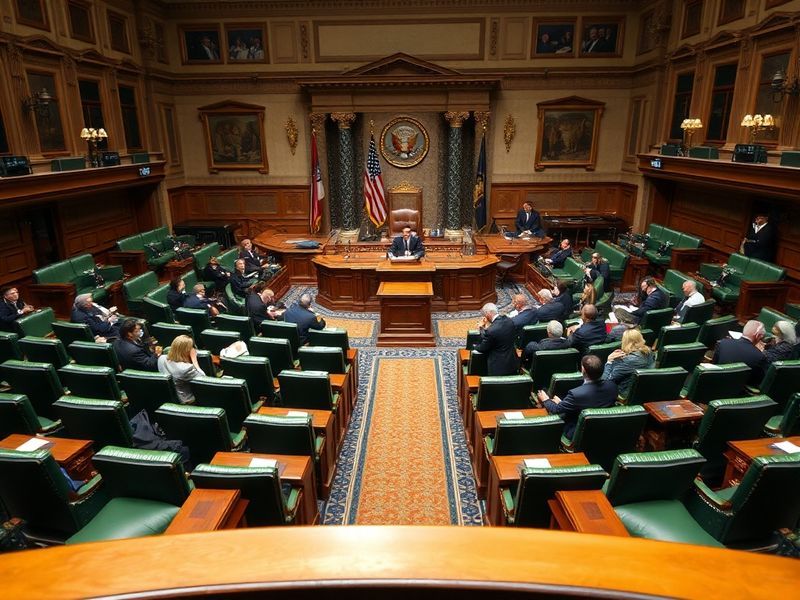
The United States House of Representatives stands as one of the two chambers of Congress, alongside the Senate, forming the legislative branch of the federal government. With 435 voting members—each elected to two-year terms—the House plays a pivotal role in shaping American policy, balancing power, and reflecting the will of the electorate. Unlike the Senate, which emphasizes stability and deliberation, the House operates with a faster pace, often responding swiftly to public sentiment and pressing national issues.
The Founding Fathers designed the House to be the most directly representative body in government. This principle is enshrined in the Constitution, which mandates that seats be apportioned among the states based on population. Every decade, following the national census, congressional districts are redrawn to ensure fair representation—a process that has become increasingly contentious in modern politics.
The Structure and Organization of the House
The House operates under a hierarchical structure designed to streamline decision-making and maintain order. At the top is the Speaker of the House, second in the presidential line of succession after the Vice President. The Speaker is elected by the full House and wields significant influence over legislative priorities, committee assignments, and floor procedures. Historically, this role has been a powerful platform for shaping national policy and advancing party agendas.
Beneath the Speaker, party leadership includes the Majority and Minority Leaders, as well as Whips who ensure party discipline. The Majority Leader, currently a key figure in advancing the current administration’s agenda, works closely with committee chairs to move legislation forward. Meanwhile, the Minority Leader serves as the principal spokesperson for the opposition, crafting strategies to challenge majority proposals and highlight alternative priorities.
The House is divided into 20 standing committees, each specializing in areas such as appropriations, foreign affairs, or judiciary matters. These committees conduct hearings, draft legislation, and oversee federal agencies—functions that allow for detailed scrutiny of government operations. Subcommittees further refine proposals before they reach the full chamber, ensuring expertise informs every step of the legislative process.
Leadership Dynamics and Partisan Tensions
Leadership in the House is not merely administrative; it is intensely political. The Speaker’s role has evolved into a high-stakes balancing act between advancing party goals and maintaining unity. Recent years have seen dramatic shifts in House leadership, including the historic election of Rep. Kevin McCarthy as Speaker in 2023, following an unprecedented three-week standoff among House Republicans. This episode underscored the fragility of consensus within a deeply polarized chamber.
Partisan tensions often manifest in procedural battles, such as attempts to amend or delay legislation through procedural motions. The House Rules Committee, controlled by the majority party, plays a crucial role in shaping the terms of debate for each bill. By setting strict limits on amendments, the majority can prevent rival proposals from gaining traction—a tactic that frustrates minority parties but ensures legislative efficiency.
Powers and Constitutional Role
The House’s constitutional powers are expansive and uniquely designed to check the other branches of government. Under Article I, Section 8, the House shares authority with the Senate over federal taxation, spending, and the power to declare war. However, the Constitution grants the House exclusive prerogatives, most notably the power of the purse. All revenue bills must originate in the House, giving it significant leverage over fiscal policy and government funding.
Another critical power is the authority to impeach federal officials, including the President. This process begins with a simple majority vote in the House, after which the Senate conducts a trial to determine removal from office. The House’s impeachment power serves as a constitutional safeguard against abuse of power, though it remains a rarely used and politically charged tool.
The House also plays a key role in oversight, using subpoenas and hearings to investigate executive branch actions. Recent investigations into issues such as the January 6 Capitol attack or the Biden family’s business dealings have highlighted the chamber’s investigative powers. While these efforts are often framed as partisan tools, they also fulfill the constitutional duty to hold the executive accountable.
Legislative Process and Gridlock
Despite its powers, the House frequently faces gridlock, particularly when control is split between parties. For a bill to become law, it must pass both chambers in identical form and receive the President’s signature. Even when the House approves legislation, Senate filibusters or presidential vetoes can derail progress. This dynamic was evident during the 117th Congress, when House Democrats passed sweeping bills like the Build Back Better Act, only for them to stall in the Senate.
The legislative process in the House typically unfolds through several stages:
- Introduction: A member introduces a bill, which is assigned a number and referred to committee.
- Committee Review: The bill is debated, amended, and either advanced or rejected by the relevant committee.
- Floor Debate: If approved, the bill moves to the House floor for debate under rules set by the Rules Committee.
- Vote: The full House votes on the bill. A simple majority is required for passage.
- Senate Action: The bill is sent to the Senate, where it undergoes a similar process.
- Conference Committee (if needed): If the Senate alters the bill, a conference committee reconciles differences.
- Final Approval: Both chambers must pass the identical bill before it goes to the President.
This process is designed to ensure thorough scrutiny but often becomes bogged down in partisan disputes. The rise of ideological factions within both parties has further complicated negotiations, making bipartisan compromise increasingly rare.
Electoral Dynamics and Representation
The House’s composition reflects the nation’s demographic and political diversity, though critics argue the system disproportionately advantages certain groups. The 2020 census triggered a redistricting cycle that reshaped congressional maps in many states, with partisan gerrymandering often determining which communities gain or lose representation. States like Texas and North Carolina saw contentious battles over district boundaries, with courts intervening in several cases to block unconstitutional gerrymanders.
Demographically, the House has made strides toward better reflecting the American population. A record number of women, racial minorities, and LGBTQ+ individuals now serve in Congress. For instance, the 117th Congress included the first Muslim women elected to the House—Rep. Ilhan Omar and Rep. Rashida Tlaib—as well as the first openly gay Black congressman, Rep. Ritchie Torres. These milestones highlight progress, though advocates continue to push for greater diversity in leadership roles.
Turnout in House elections also varies widely, with midterm elections typically drawing lower participation than presidential contests. This disparity can skew representation toward older, wealthier, and more politically engaged voters. Efforts to expand voting access, such as automatic voter registration and mail-in ballots, aim to address these imbalances, but results remain uneven across states.
The Role of Incumbency and Campaign Finance
Incumbency in the House confers significant advantages, including name recognition, fundraising networks, and access to constituent services. Over 90% of incumbents win re-election, a trend that has led to concerns about entrenched power and reduced competition. The cost of running for Congress has skyrocketed, with candidates often spending millions to secure victory. In 2022, the average cost of a winning House campaign exceeded $2 million, with some races surpassing $10 million.
Campaign finance laws allow candidates to raise unlimited funds through political action committees (PACs) and individual donors. While these contributions fuel competitive races, they also raise ethical questions about the influence of wealthy donors and corporate interests. Reforms such as the DISCLOSE Act have been proposed to increase transparency, but partisan divisions have stalled progress.
Looking Ahead: Challenges and Opportunities
The House faces mounting challenges in the coming years, from addressing climate change to managing technological disruption. The chamber’s ability to adapt will depend on its capacity to bridge divides and prioritize governance over partisan posturing. Recent reforms, such as term limits for committee chairs or stricter ethics rules, have been debated as potential solutions to restore trust in Congress.
For voters, the House offers a direct line to influence policy, whether through contacting representatives, participating in town halls, or voting in primary elections. The 2024 elections will determine which party controls the chamber, with high-stakes races in battleground districts likely to shape the legislative agenda for years to come.
As the nation grapples with polarization and institutional distrust, the House remains a critical forum for debate and decision-making. Its future will hinge on whether lawmakers can reclaim the chamber’s role as a responsive and representative institution—or whether gridlock and partisanship will further erode its credibility.
For those interested in exploring more about political structures in the U.S., visit our Politics and Analysis categories for deeper insights.