<!DOCTYPE html>
<html lang="en">
<head>
    <meta charset="UTF-8">
    <meta name="viewport" content="width=device-width, initial-scale=1.0">
    <title>Tesla Cybertruck: The Electric Pickup That Divides Opinion</title>
</head>
<body>
    <article>
        <h1>Tesla Cybertruck: The Electric Pickup That Divides Opinion</h1>

        <p>The Tesla Cybertruck arrived with a thud—and not just the sound of its controversial stainless-steel exoskeleton hitting the pavement. Since its 2019 unveiling, the angular electric pickup has become one of the most polarizing vehicles in automotive history. Love it or hate it, the Cybertruck isn’t just another EV. It’s a statement, a technological experiment, and a rolling billboard for Tesla’s uncompromising vision of the future.</p>

        <p>More than four years after its dramatic debut—complete with a window-smashing stunt gone wrong—the Cybertruck finally entered production in late 2023. With deliveries beginning in November, Tesla is positioning the truck as a flagship for its expanding lineup. But can a vehicle built on controversy and unproven engineering truly redefine the pickup segment?</p>

        <h2>The Design: Love It or Fear It</h2>

        <p>The Cybertruck’s design is unlike anything else on the road. Sharp, angular lines dominate its exterior, from the trapezoidal windshield to the flat, V-shaped front end. Even its wheels are hexagonal. This is no accident. Tesla’s goal was to create a vehicle that looks like it rolled straight out of a science-fiction film—specifically, one inspired by <em>The Spy Who Loved Me</em> or <em>Blade Runner</em>.</p>

        <p>But the aesthetic isn’t just for show. Tesla claims the stainless-steel exoskeleton offers unparalleled durability and resistance to dents and corrosion. The body is also said to be scratch-resistant, though early owners have already reported issues with paint adhesion and panel gaps. The truck’s most controversial feature, however, remains its fixed-glass windows. Despite the infamous 2019 incident where Franz von Holzhausen’s window shattered during a live demo, Tesla insists the glass is now reinforced and capable of withstanding impacts.</p>

        <p>Inside, the Cybertruck embraces minimalism to an extreme. A single 17-inch touchscreen dominates the dashboard. There are no physical buttons, no analog dials—just a clean, almost sterile environment. The seating is futuristic, with a center console that doubles as a storage space and charging pad. The cabin also features a panoramic glass roof, though its benefits are somewhat muted by the truck’s overall angular aesthetic.</p>

        <h2>Performance and Capabilities: Breaking the Mold</h2>

        <p>Tesla has always prioritized performance, and the Cybertruck is no exception. The truck is available in three configurations: a single-motor rear-wheel-drive model, a dual-motor all-wheel-drive version, and a tri-motor Cyberbeast variant. The latter promises 0-60 mph in under 2.6 seconds, making it one of the quickest production trucks ever made.</p>

        <p>The Cybertruck’s towing and payload capacities are equally impressive. Tesla claims the truck can tow up to 11,000 pounds and carry a payload of 3,500 pounds. The suspension system, featuring adaptive air suspension, allows drivers to raise or lower the ride height for better ground clearance or aerodynamics. The truck’s range varies by configuration, with estimates ranging from 250 miles (single-motor) to 340 miles (tri-motor) on a full charge.</p>

        <p>One of the Cybertruck’s most talked-about features is its four-wheel steering. This system allows the rear wheels to turn in the opposite direction of the front wheels at low speeds, improving maneuverability in tight spaces. At higher speeds, the rear wheels turn in the same direction as the front, enhancing stability and reducing the risk of rollovers.</p>

        <p>But the Cybertruck isn’t perfect. Early owners have reported issues with build quality, including panel gaps, misaligned parts, and inconsistent panel fit. Tesla has acknowledged some of these issues and is reportedly working to address them, but the problems have already tarnished the truck’s reputation before it has truly entered the mainstream.</p>

        <h3>Off-Roading: Built for Adventure</h3>

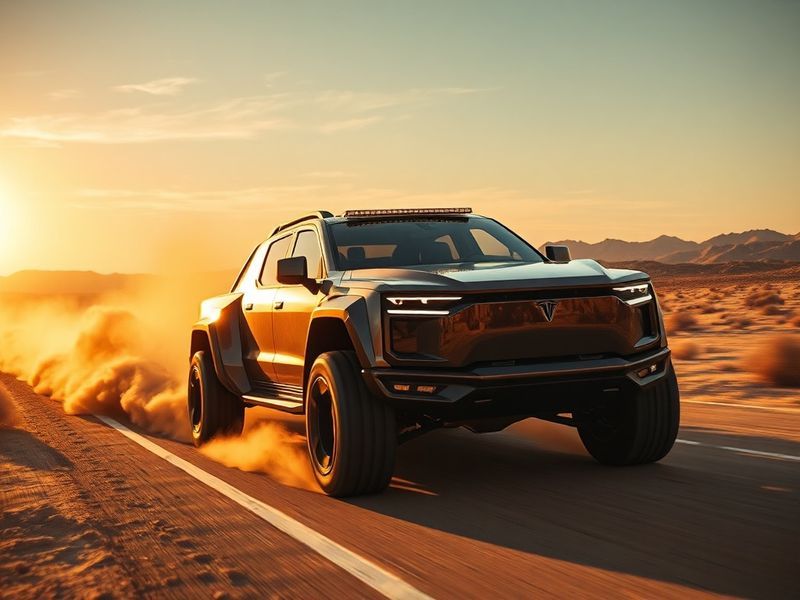
        <p>The Cybertruck isn’t just a city slicker—it’s designed to tackle rough terrain. With up to 17 inches of ground clearance, a wading depth of 3.5 feet, and an adaptive air suspension that can raise the ride height by up to 4.5 inches, the truck is more than capable of handling off-road challenges. The stainless-steel body is also resistant to rock chips and scratches, though its sharp edges could pose a risk to pedestrians and other vehicles in an accident.</p>

        <p>Tesla has also equipped the Cybertruck with an advanced traction control system, a locking rear differential, and a suite of off-road modes. These modes adjust the truck’s power delivery, suspension settings, and even the steering response to optimize performance in sand, mud, or snow. The truck’s large wheels and low-profile tires further enhance its off-road prowess.</p>

        <h2>Market Impact and Competition</h2>

        <p>The Cybertruck enters a crowded and rapidly evolving market. Traditional automakers like Ford, General Motors, and Ram have all launched electric pickup trucks in recent years, including the Ford F-150 Lightning, the GMC Hummer EV, and the Ram 1500 REV. These trucks offer more conventional designs, proven reliability, and established dealer networks—something Tesla still lacks in many regions.</p>

        <p>But Tesla has always played by its own rules, and the Cybertruck is no exception. While competitors focus on blending electric power with familiar truck aesthetics, Tesla has doubled down on innovation, even at the cost of practicality. The Cybertruck’s polarizing design and unproven long-term reliability make it a high-risk, high-reward proposition for buyers.</p>

        <p>For now, the Cybertruck is a niche product aimed at early adopters and Tesla enthusiasts. But if Tesla can address its build quality issues and prove its durability, the truck could carve out a significant share of the electric pickup market. The company has already secured over 1.5 million reservations for the Cybertruck, a testament to the brand’s cult-like following.</p>

        <h3>Pricing and Availability</h3>

        <p>The Cybertruck’s pricing starts at $60,990 for the rear-wheel-drive model, making it more affordable than many of its competitors. The dual-motor all-wheel-drive version starts at $79,990, while the tri-motor Cyberbeast tops out at $99,990. Tesla has also introduced a Founders Series version, limited to 1,000 units and priced at $300,000. This ultra-exclusive model includes premium features like a custom interior, a sound system designed by Tesla’s audio team, and a unique paint finish.</p>

        <p>As of mid-2024, Tesla is ramping up production at its Gigafactory in Texas, though supply chain constraints and manufacturing challenges have slowed deliveries. The company has also expanded its Supercharger network to support long-distance travel with the Cybertruck, though charging times for the truck’s massive battery pack remain a concern for some buyers.</p>

        <h2>The Future of the Cybertruck</h2>

        <p>The Tesla Cybertruck is more than just a truck—it’s a symbol of the brand’s relentless pursuit of innovation. Whether it succeeds or fails will depend on a variety of factors, from Tesla’s ability to improve build quality to the truck’s long-term reliability and resale value. But one thing is certain: the Cybertruck has already made its mark on the automotive world.</p>

        <p>For those who embrace its unconventional design and cutting-edge technology, the Cybertruck is a dream come true. For skeptics, it remains a risky gamble with more style than substance. Love it or hate it, the Cybertruck is forcing the industry to rethink what a pickup truck can be. And in an era where electric vehicles are becoming the norm, that alone makes it a vehicle worth watching.</p>

        <p>As Tesla continues to refine the Cybertruck and expand its production, the truck’s legacy will be shaped by how well it delivers on its promises. Will it live up to the hype, or will it become another cautionary tale of ambition outpacing execution? Only time will tell. But one thing is clear: the Tesla Cybertruck isn’t just another electric vehicle—it’s a statement.</p>
    </article>

    <!-- Metadata Section -->