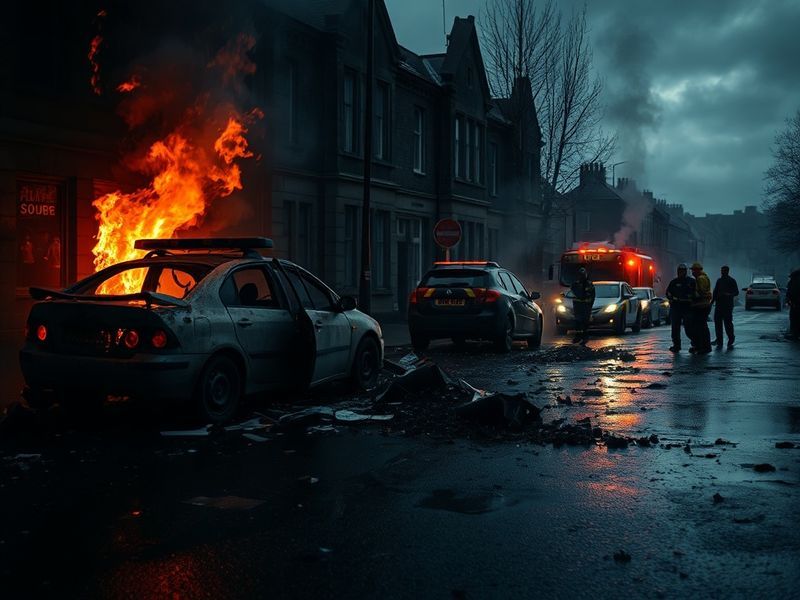
The morning of March 10, 1989, began like any other in the quiet suburban area of Dunmurry, on the outskirts of Belfast. But by 7:15 AM, the routine of the day was shattered by a massive explosion outside Dunmurry Police Station. The car bomb attack, claimed by the Irish Republican Army (IRA), left one officer dead, several people injured, and a community traumatized. It was one of the most audacious attacks of the Troubles, targeting a heavily fortified police station in broad daylight.
The blast occurred in a residential area, sending shockwaves through the neighborhood. Windows were shattered in homes up to a mile away, and the force of the explosion was felt blocks from the scene. The target, Dunmurry Police Station, was a base for the Royal Ulster Constabulary (RUC), the police force in Northern Ireland at the time. The attack highlighted the vulnerability of security forces even in areas they considered controlled.
The Attack: How It Unfolded
The car bomb was parked just 50 meters from the police station’s entrance. According to eyewitness accounts and later investigations, the vehicle—a stolen Ford Escort—was left in a loading bay area frequented by civilians, including children on their way to school. The bomb contained approximately 1,500 pounds of explosives, making it one of the largest detonated during the Troubles.
The explosion killed Constable Patrick Joseph Morris, a 33-year-old father of three from County Antrim. Morris was on duty outside the station when the bomb detonated. Several other officers and civilians were injured, some critically. The blast destroyed the station’s facade and damaged nearby properties, including a row of shops and a community center. Emergency services were overwhelmed, with ambulances and fire trucks arriving within minutes to treat the wounded and secure the area.
Security footage later showed the stolen car being driven to the scene and abandoned just minutes before the explosion. The IRA claimed responsibility, stating it was retaliation for the RUC’s crackdown on nationalist communities. The attack was part of a broader campaign of violence that included bombings, shootings, and ambushes targeting police, military, and civilians.
The Aftermath: Political and Community Reactions
The attack on Dunmurry Police Station drew immediate condemnation from political leaders across the spectrum. British Prime Minister Margaret Thatcher called it a “sickening and cowardly act,” while Irish Taoiseach Charles Haughey condemned the violence as “pointless and barbaric.” Locally, the attack deepened divisions in Dunmurry, a predominantly nationalist area with strong ties to the IRA’s political wing, Sinn Féin.
For the RUC, the attack was a stark reminder of their vulnerability. Despite heavy security measures, including armored vehicles and checkpoints, the IRA had struck in a location the police considered relatively safe. The incident led to increased militarization of RUC stations across Northern Ireland, with some facilities being relocated or rebuilt to withstand bomb blasts.
The attack also had a profound impact on the Dunmurry community. Many residents, caught in the crossfire, expressed frustration at the constant violence. Some nationalist residents distanced themselves from the IRA, while others remained sympathetic to the group’s goals. The bombing fueled debates about the effectiveness of British security policies and the role of paramilitary groups in the conflict.
Controversies and Conspiracy Theories
Like many high-profile attacks during the Troubles, the Dunmurry bombing was surrounded by conspiracy theories. Some republicans claimed the British security forces had prior knowledge of the attack but allowed it to proceed to justify harsher crackdowns. Others suggested the RUC had failed to act on intelligence that could have prevented the explosion. These theories were never substantiated, but they persisted in nationalist circles.
In the years following the attack, investigations by the Royal Ulster Constabulary and later the Police Ombudsman for Northern Ireland did not result in any prosecutions. The case remains officially unsolved, though it is widely accepted that the IRA was responsible. The lack of closure has left many families of victims and survivors grappling with unanswered questions.
Legacy and Lessons from Dunmurry
The Dunmurry Police Station bombing is a grim reminder of the human cost of the Troubles. It was one of over 2,000 bombings that occurred in Northern Ireland between 1969 and 1998, each leaving behind a trail of destruction and grief. The attack on Dunmurry stands out not only for its scale but also for its timing—coming during a period of relative calm in the conflict, when hopes for peace were beginning to emerge.
Today, Dunmurry Police Station no longer exists in its original form. The building was demolished in the early 2000s as part of a broader effort to modernize police facilities and move away from the militarized architecture of the Troubles era. The site is now home to a new police station, designed with community safety in mind rather than fortification against attack.
The attack also serves as a case study in counter-terrorism and urban security. Security experts have analyzed the blast to understand how paramilitary groups exploit civilian areas to carry out attacks. The lessons learned from Dunmurry have informed security protocols in other conflict zones, where police and military bases are often targeted in densely populated areas.
Remembering the Victims
Constable Patrick Morris was the only fatality in the attack, but his death left a lasting impact on his family and colleagues. Morris, a 13-year veteran of the RUC, was remembered as a dedicated officer who had joined the force during a time of escalating violence. His funeral was attended by hundreds of officers and dignitaries, including then-Northern Ireland Secretary Peter Brooke.
For the injured and their families, the physical and emotional scars of the attack lingered for years. Many required extensive medical treatment, and some never fully recovered. The bombing also left psychological wounds, with survivors and witnesses experiencing symptoms of post-traumatic stress disorder (PTSD) long after the event.
In recent years, there have been efforts to commemorate the victims of the Troubles in Dunmurry and across Northern Ireland. Memorials, oral history projects, and educational initiatives aim to ensure that the stories of those affected by violence are not forgotten. The Dunmurry bombing, though overshadowed by larger events of the conflict, remains a poignant example of the human toll of political violence.
Where to Learn More
For those interested in exploring the broader context of the Troubles and its impact on communities like Dunmurry, there are several resources available:
- News archives covering key events of the Troubles, including bombings, shootings, and political developments.
- Analytical pieces examining the strategies of paramilitary groups and the response of security forces during the conflict.
- Books such as Making Sense of the Troubles by David McKittrick and The Politics of the Provisional IRA by Matthew J. Crosston, which provide in-depth context on the conflict.
- Documentaries like The Troubles: A Secret History (BBC), which delve into the covert operations and political maneuvering behind the violence.
The story of the Dunmurry car bomb is more than a historical footnote—it is a testament to the resilience of communities caught in the midst of conflict. While the violence of the Troubles has largely subsided, the memories of those lost and injured endure. Understanding these events is crucial to ensuring that the mistakes of the past are not repeated.
This article was researched and written by the editorial team at Dave’s Locker. For more historical analyses and news coverage, visit our homepage.