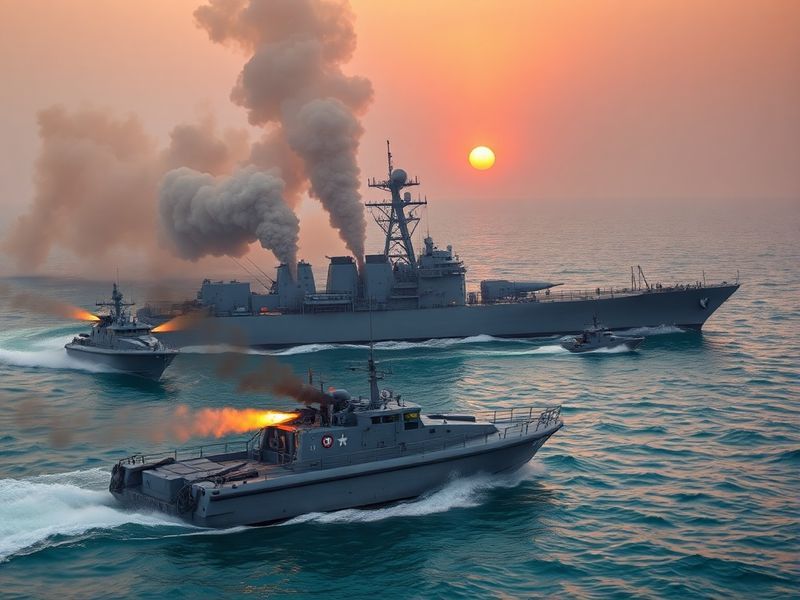
The Strait of Hormuz has long been one of the world’s most critical chokepoints for maritime trade, particularly for oil. Roughly 20% of the world’s oil passes through this narrow waterway between Oman and Iran. Yet in recent years, the strait has become a focal point of geopolitical tension, with Iran frequently flexing its military and political influence in the region. The implications stretch far beyond the Persian Gulf, affecting global energy markets, diplomatic relations, and military strategies.
This article examines the strategic importance of the Strait of Hormuz, Iran’s role in shaping the narrative of control and deterrence, and the broader consequences for international trade and security.
The Strait of Hormuz: A Vital Artery for Global Oil
The Strait of Hormuz is not just a waterway; it is the jugular vein of the global economy. Connecting the Persian Gulf to the Gulf of Oman and, by extension, the Arabian Sea, it serves as the primary route for oil exports from Saudi Arabia, Iraq, the UAE, Kuwait, and Iran itself. On an average day, some 21 million barrels of oil—nearly a quarter of the world’s daily consumption—pass through these narrow waters.
This concentration of energy flow makes the strait a prime target for disruption. Any prolonged closure or significant disruption could send shockwaves through global oil markets, triggering price spikes and threatening energy security for importing nations. The U.S. Energy Information Administration has warned that even a temporary disruption could lead to a supply shortfall that would be difficult to offset quickly.
The Geography of Power
The strait is less than 21 nautical miles wide at its narrowest point, with shipping lanes only two miles wide in each direction, separated by a two-mile buffer zone. This geography makes the waterway inherently vulnerable to interdiction or blockade. Iran, which borders the strait to the north, has repeatedly emphasized its ability to close the waterway in response to perceived threats—particularly from the U.S. and its Gulf allies.
Iran’s military posture in the region includes a mix of conventional forces, asymmetric capabilities, and proxy networks. The Islamic Revolutionary Guard Corps (IRGC) operates fast-attack boats, anti-ship missiles, and naval mines—tools that give Tehran both deterrent and coercive options. In 2019, attacks on oil tankers near the strait, attributed to Iran by the U.S. and its allies, underscored the vulnerability of maritime traffic and the risks of escalation.
Iran’s Strategy: Deterrence Through Denial
Iran’s approach to the Strait of Hormuz is rooted in a doctrine of “deterrence through denial.” Rather than seeking to control the strait outright, Tehran aims to make any attempt to close or restrict it so costly that potential adversaries—especially the U.S. and Saudi Arabia—would hesitate to provoke such a crisis. This strategy leverages Iran’s geographic advantage, asymmetric military tools, and the high stakes of global oil markets.
In practice, this has meant periodic shows of force. Iran has conducted naval drills simulating the closure of the strait. It has also seized commercial vessels—most notably in 2019, when British-flagged tankers were detained in response to the detention of an Iranian oil tanker by Gibraltar. These actions are not isolated incidents but part of a broader pattern of calibrated pressure designed to signal resolve and influence behavior.
Asymmetric Warfare in a Narrow Sea
Iran’s asymmetric warfare capabilities are well-suited to the confined waters of the Strait of Hormuz. The IRGC’s naval branch operates small, agile boats equipped with rockets, torpedoes, and mines. These forces are difficult to detect and can strike quickly before retreating, making them ideal for harassment or disruption. Mines, in particular, pose a persistent threat, as they can remain dormant and undetected for long periods.
The U.S. Fifth Fleet, based in Bahrain, maintains a significant presence in the region to counter such threats. However, the presence of American forces also serves as a potential trigger for Iranian escalation. The 2020 U.S. drone strike that killed IRGC Quds Force commander Qasem Soleimani was followed by Iranian ballistic missile attacks on U.S. bases in Iraq—and threats to close the strait in retaliation. While full-scale war was avoided, the episode highlighted the fragility of the status quo.
Global Repercussions: Energy Markets and Diplomatic Fallout
The stakes of any conflict or disruption in the Strait of Hormuz extend far beyond the Persian Gulf. Oil prices are highly sensitive to perceived supply risks. Even rumors of a potential closure can lead to speculative buying and price volatility. During periods of heightened tension in 2019, Brent crude prices briefly surged by nearly 20% in a single week after attacks on tankers and Saudi oil facilities.
This volatility has prompted major oil importers—including China, India, and Japan—to diversify their supply chains. Some countries have increased strategic petroleum reserves or sought alternative routes, such as pipelines from Iraq to Turkey or expanded use of the Bab el-Mandeb route around the Horn of Africa. Yet no alternative fully compensates for the volume and efficiency of Hormuz transit.
Diplomatic Gridlock and Shifting Alliances
The geopolitical fallout from Hormuz tensions has also reshaped regional alliances. Gulf states like Saudi Arabia and the UAE, long reliant on U.S. security guarantees, have pursued closer ties with other powers—including Russia and China—to hedge against American retrenchment. The 2023 China-brokered Iran-Saudi Arabia rapprochement, for instance, was partly driven by shared interests in stabilizing the Gulf, even as underlying rivalries persisted.
Meanwhile, the U.S. has maintained a dual approach: deterring Iranian aggression while avoiding direct military conflict. Washington has strengthened maritime security initiatives, such as the International Maritime Security Construct (IMSC), which includes allies like the UK, Australia, and Bahrain. Yet the effectiveness of such coalitions remains uneven, and Iran continues to exploit gaps in enforcement.
What’s Next? Scenarios and Strategic Considerations
The future of the Strait of Hormuz hinges on several key variables: Iran’s domestic stability, the trajectory of U.S.-Iran relations, and the evolving energy landscape. Below are several plausible scenarios and their implications:
- Controlled Escalation: Iran continues periodic shows of force to deter attacks or regime change, but avoids actions that would trigger a full-scale military response. This scenario maintains tension but avoids direct war.
- Accidental Escalation: A miscalculation—such as a naval skirmish or mistaken strike—could spiral into a larger conflict, especially if either side misjudges the other’s red lines.
- Diplomatic De-escalation: A sustained backchannel dialogue, potentially facilitated by third parties like Oman or Qatar, could lead to temporary understandings on maritime security and nuclear-related sanctions relief.
- Economic Adaptation: As importing nations reduce dependence on Gulf oil, the strategic leverage of the strait may diminish over time, altering Iran’s calculus.
The Role of Proxy Forces
Iran’s use of proxy groups—such as Yemen’s Houthis, Iraqi militias, and Lebanese Hezbollah—adds another layer of complexity. These groups have launched missile and drone attacks on Saudi and Emirati infrastructure, often in response to strikes or perceived provocations. While Iran denies direct control, the IRGC’s Quds Force has been linked to training, funding, and equipping these groups. This network allows Iran to project power without direct confrontation, complicating any potential military response.
The risk is that a misstep by a proxy could drag Iran into a wider conflict. For example, a Houthi attack on an Israeli-linked tanker in the Red Sea in 2023 raised alarms about spillover into the Bab el-Mandeb strait, another critical chokepoint. Such incidents highlight the interconnected nature of Gulf security.
Conclusion: A Strait Under Strain
The Strait of Hormuz remains a flashpoint where geography, energy, and geopolitics collide. Iran’s strategy of deterrence through denial has so far prevented outright war, but it has also created a fragile equilibrium—one that could shatter under pressure. The global economy cannot afford prolonged disruption, yet the incentives for both Iran and its adversaries to maintain pressure remain strong.
Moving forward, the most viable path may lie in quiet diplomacy and confidence-building measures. Multilateral frameworks that include Gulf states, Iran, and external powers like China and Russia could help stabilize the region. Meanwhile, the international community must prepare for contingencies, from oil price stabilization to military de-escalation.
One thing is certain: as long as oil flows through the Strait of Hormuz, the world will remain tied to the fortunes—and follies—of this narrow but vital waterway.
For more on regional security and energy dynamics, visit our Politics and Business sections.