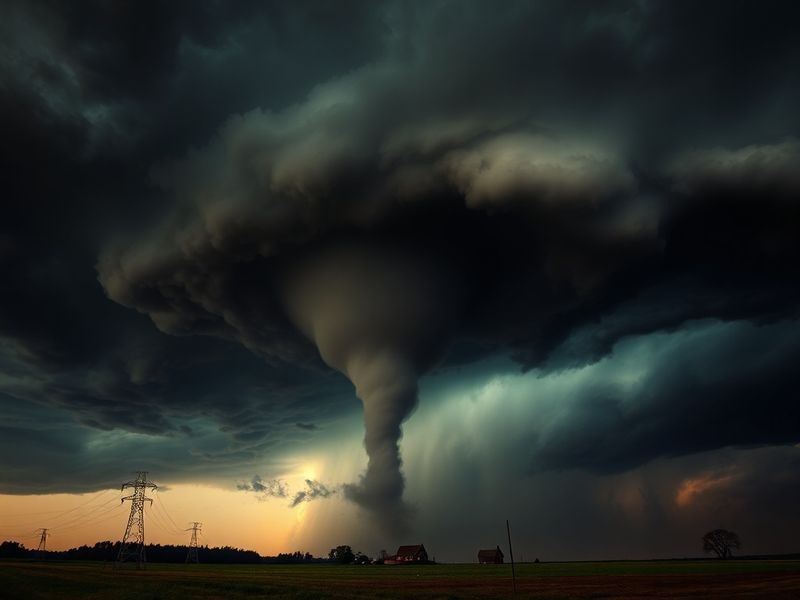
The National Weather Service issued a Particularly Dangerous Situation (PDS) Tornado Watch on April 27, covering parts of the Midwest and Southern United States. This rare classification signals an elevated threat of violent, long-track tornadoes capable of causing significant damage and posing serious danger to life and property. The watch area stretched from eastern Kansas through Missouri, Arkansas, and into portions of Illinois and Kentucky, putting millions in the crosshairs.
PDS watches are issued sparingly, typically when forecasters have high confidence in the development of tornadoes rated EF4 or EF5 on the Enhanced Fujita Scale. These storms can sustain winds over 200 mph and remain on the ground for extended periods, creating a dire situation for those in their path. The April 27 watch followed a pattern of severe weather that had already produced damaging storms earlier in the week, raising concerns about a prolonged period of instability.
What Makes a PDS Tornado Watch Different?
A standard Tornado Watch means conditions are favorable for tornadoes, but a PDS Tornado Watch elevates that threat to a critical level. The PDS designation is reserved for situations where forecasters believe there is a significant risk of multiple violent tornadoes. These watches are issued in less than 3% of all tornado watches, underscoring their rarity and severity.
Key characteristics of a PDS Tornado Watch include:
- High confidence in violent tornadoes: Forecasters use advanced modeling and observational data to predict the likelihood of tornadoes rated EF4 or EF5.
- Long-duration threats: The storms are expected to persist for hours, increasing the risk of exposure for those in affected areas.
- Widespread impact potential: The storms could affect densely populated regions, posing risks to urban and rural communities alike.
- Nighttime threats: PDS watches often include overnight hours, when tornadoes are harder to see and people are less likely to receive warnings.
Historically, PDS Tornado Watches have preceded some of the most destructive tornado outbreaks in U.S. history. The 2011 Super Outbreak, which produced 362 tornadoes and resulted in 324 fatalities, began with a PDS Tornado Watch. Similarly, the 2013 Moore, Oklahoma tornado—a catastrophic EF5 event—occurred within a PDS watch area. These precedents highlight the importance of taking such warnings seriously.
The Science Behind the PDS Designation
PDS Tornado Watches are not issued lightly. They require a convergence of atmospheric conditions that are both highly favorable for tornado development and exceptionally rare. Forecasters analyze several key factors when making the PDS designation:
- Instability and Shear: The atmosphere must contain a high degree of instability, where warm, moist air near the surface is overlaid by cooler, drier air aloft. This creates an environment where thunderstorms can rapidly develop and intensify. Additionally, strong wind shear—changes in wind speed and direction with height—is critical for rotating storms.
- Helicity and CAPE: Storm Relative Helicity (SRH) measures the potential for storm rotation, while Convective Available Potential Energy (CAPE) quantifies the energy available for storm updrafts. PDS watches often feature SRH values exceeding 300 m²/s² and CAPE values over 2,000 J/kg.
- Lift Mechanisms: A triggering mechanism, such as a cold front, dryline, or upper-level disturbance, is necessary to initiate thunderstorm development. These mechanisms provide the lift needed to break through any atmospheric capping, which can suppress storm formation.
- Moisture and Boundary Interactions: High dew points and the presence of boundaries (e.g., warm fronts, outflow boundaries) can enhance low-level rotation, increasing the likelihood of tornadoes.
Forecasters also rely on high-resolution models, such as the High-Resolution Rapid Refresh (HRRR) and the North American Mesoscale (NAM) model, to predict storm development. These models provide detailed simulations of storm structure, allowing meteorologists to assess the potential for supercells—rotating thunderstorms that are the most prolific producers of violent tornadoes.
Preparing for a PDS Tornado Watch
When a PDS Tornado Watch is issued, immediate action is required. Unlike a standard watch, which may prompt increased vigilance, a PDS watch demands a heightened state of readiness. Here’s what you should do:
- Identify your safe space: Basements, storm shelters, or interior rooms on the lowest floor of a sturdy building are the best options. Avoid windows and cover yourself with a mattress or heavy blankets to protect against flying debris.
- Stay informed: Monitor local news, weather radios, or reliable weather apps for real-time updates. Wireless Emergency Alerts (WEAs) on your phone can provide critical warnings, so ensure they are enabled.
- Have a plan: Know where you will go and how you will communicate with family members if a tornado warning is issued. Practice your plan with everyone in your household, including pets.
- Prepare an emergency kit: Include water, non-perishable food, medications, a flashlight with extra batteries, a first-aid kit, and copies of important documents. A portable charger for your phone can also be invaluable.
- Stay weather-aware: Tornadoes can form quickly, sometimes with little advance warning. If you see a rotating wall cloud, funnel cloud, or hear a loud roar (often described as the sound of a freight train), take shelter immediately.
For those in mobile homes or vehicles, the risks are even greater. Mobile homes are particularly vulnerable to tornadoes, and vehicles offer little protection. If you live in a mobile home, identify a nearby sturdy building where you can take shelter. If you are driving, do not attempt to outrun a tornado. Instead, seek sturdy shelter or, as a last resort, lie flat in a low-lying area and cover your head.
Broader Implications of PDS Tornado Watches
The issuance of a PDS Tornado Watch is not just a meteorological event; it has significant societal and economic implications. Violent tornadoes can disrupt communities for years, destroying homes, businesses, and critical infrastructure. The recovery process often involves not only rebuilding physical structures but also addressing the long-term mental health impacts on survivors.
Economically, the cost of tornado damage can run into the billions. The 2011 Super Outbreak alone resulted in an estimated $12 billion in damages. Insurance claims surge, and local economies can be crippled for months or even years. For farmers, tornadoes can devastate crops and livestock, further straining rural economies that are already vulnerable to weather extremes.
Climate change may be altering the frequency and intensity of severe weather events, including tornadoes. While the overall number of tornadoes in the U.S. has not increased significantly, research suggests that the window for severe weather may be expanding. Tornadoes are occurring earlier in the year and in regions where they were historically rare. This shift underscores the need for improved forecasting, early warning systems, and community preparedness.
For emergency responders, PDS Tornado Watches present unique challenges. The potential for multiple violent tornadoes requires a coordinated response from local, state, and federal agencies. Search and rescue operations, medical care, and infrastructure repairs must be prioritized, often under hazardous conditions. Training and resources for first responders are critical to ensuring an effective response.
Public awareness and education are equally important. Many people underestimate the danger of tornadoes or misunderstand the warnings issued by the National Weather Service. Campaigns to educate the public about the meaning of PDS watches, the importance of taking shelter immediately, and the steps to take after a storm passes can save lives. Schools, workplaces, and community organizations play a vital role in disseminating this information.
Conclusion
A PDS Tornado Watch is a serious warning that should never be ignored. It signals a heightened risk of violent, long-lasting tornadoes that can cause catastrophic damage and pose a direct threat to life. Understanding the science behind these watches, preparing your home and family, and staying informed are essential steps to mitigating the risks.
As severe weather events become more unpredictable and potentially more intense, the importance of preparedness cannot be overstated. Communities must work together to ensure that every individual knows how to respond when a PDS Tornado Watch is issued. By taking action now, we can reduce the toll of future tornadoes and build more resilient communities.
For more information on severe weather preparedness and real-time updates, visit Dave’s Locker Trending and Dave’s Locker News for the latest coverage.