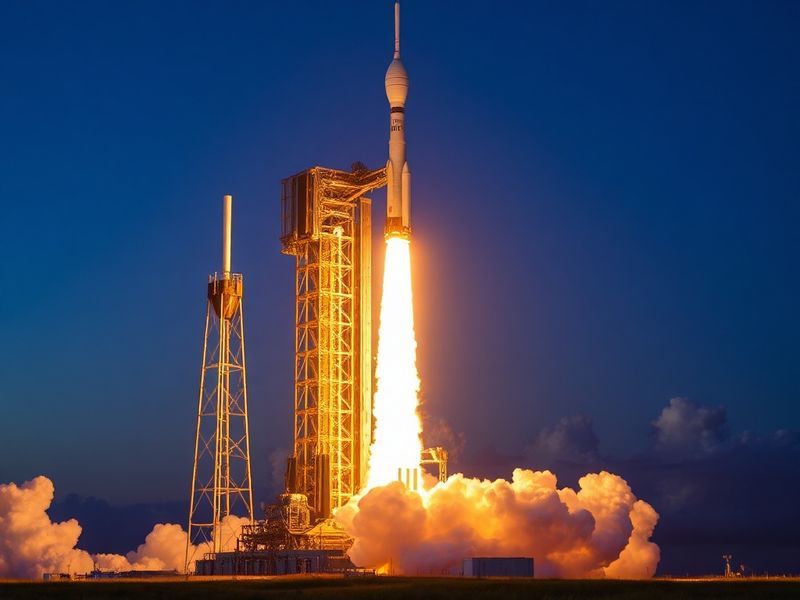
SpaceX Falcon Heavy Launch: How a Heavy-Lift Rocket is Reshaping Spaceflight
“`html
SpaceX’s Falcon Heavy Launch: Pushing the Boundaries of Spaceflight
SpaceX’s Falcon Heavy rocket has cemented its place in aerospace history as one of the most powerful operational launch vehicles ever built. Since its maiden voyage in 2018, the rocket has demonstrated capabilities that were once considered science fiction, reshaping the commercial space industry and rekindling public fascination with deep-space exploration. The Falcon Heavy’s unique architecture—combining three Falcon 9 rocket cores—allows it to lift payloads of up to 64 metric tons into low Earth orbit, making it a critical tool for both government and private sector missions.
The Evolution of a Heavy-Lift Rocket
Development of the Falcon Heavy began in 2011, with Elon Musk publicly unveiling ambitious plans to build a rocket capable of sending humans to Mars. Unlike traditional heavy-lift vehicles, which often rely on expendable stages, SpaceX designed the Falcon Heavy with reusability in mind. This approach drastically reduces the cost of space access, a core tenet of SpaceX’s long-term vision for interplanetary colonization.
The rocket’s first flight, conducted on February 6, 2018, was nothing short of spectacular. The launch from Kennedy Space Center’s historic Launch Complex 39A—once used for Apollo and Space Shuttle missions—drew over a million online viewers. The payload for that inaugural mission was unconventional: Musk’s personal Tesla Roadster, complete with a mannequin dubbed “Starman” seated in the driver’s seat. The car was sent on a trajectory toward Mars orbit, serving as both a marketing spectacle and a symbolic gesture toward the future of space travel.
Technical Innovations Behind the Rocket
The Falcon Heavy’s design leverages the proven reliability of the Falcon 9 while scaling up its capabilities. Its three-core configuration includes:
- Two side boosters: These are modified Falcon 9 first stages, each equipped with nine Merlin engines. After launch, they separate from the center core and perform synchronized landing burns, returning to Cape Canaveral or a drone ship in the Atlantic Ocean.
- Central core: The reinforced center stage fires all 27 Merlin engines simultaneously during liftoff, generating over 5 million pounds of thrust. After stage separation, it continues burning before returning to Earth for recovery.
- Second stage: Powered by a single Merlin engine optimized for vacuum conditions, this stage carries the payload to its intended orbit. It can reignite multiple times, enabling complex missions such as satellite deployments or deep-space trajectories.
This architecture not only enhances payload capacity but also introduces new challenges in aerodynamics and structural integrity. The rocket’s payload fairing, the largest in the industry at 13.1 meters (43 feet) tall, can accommodate oversized satellites or future lunar and Mars landers.
Mission Highlights and Commercial Impact
Since its debut, the Falcon Heavy has flown multiple missions, each expanding its reputation as a versatile and cost-effective launch provider. Notable flights include:
- Arabsat-6A (April 2019): The first commercial mission for the Falcon Heavy successfully delivered a Saudi Arabian communications satellite to geostationary orbit. Both side boosters and the central core were recovered, demonstrating the rocket’s reusability.
- STP-2 (June 2019): A Department of Defense mission carrying 24 research satellites, including NASA’s Deep Space Atomic Clock. The flight showcased the rocket’s ability to perform multiple engine restarts and deploy payloads into diverse orbits.
- USSF-44 (November 2022): A classified mission for the U.S. Space Force, highlighting the rocket’s role in national security launches. The mission also featured a new variant of the payload adapter, optimized for heavy payloads.
- Viasat-3 (April 2023): Though this launch ended in partial failure due to an upper-stage anomaly, it underscored the challenges of operating such a complex vehicle. SpaceX subsequently addressed the issue and returned the Falcon Heavy to flight status.
The rocket’s commercial success has attracted interest from a range of customers, including satellite operators, government agencies, and even deep-space mission planners. Companies like ViaSat and Inmarsat have relied on the Falcon Heavy to deploy next-generation communications satellites, while NASA has explored its potential for lunar missions as part of the Artemis program.
Broader Implications for Space Exploration
The Falcon Heavy represents more than just a technological achievement; it is a catalyst for broader changes in the space industry. Its low-cost, high-capacity design has forced competitors to rethink their own strategies, accelerating innovation across the sector. For instance, United Launch Alliance’s Vulcan rocket and Blue Origin’s New Glenn are both being developed with reusability and heavy-lift capabilities in mind, partly in response to SpaceX’s dominance.
One of the most significant implications of the Falcon Heavy’s success is its potential role in human spaceflight. While SpaceX’s Starship is intended to eventually replace the Falcon Heavy for deep-space missions, the rocket remains a critical interim solution. NASA’s Artemis program, which aims to return humans to the Moon, has considered the Falcon Heavy for secondary payload missions and lunar lander support. Additionally, the rocket’s ability to carry large payloads could enable ambitious science missions, such as telescopes or interplanetary probes that were previously too heavy for existing launchers.
The Falcon Heavy also underscores the growing role of private companies in space exploration. Unlike government-led programs of the past, SpaceX’s approach is driven by iterative development, rapid prototyping, and a willingness to take risks. This model has not only reduced the cost of access to space but has also inspired a new generation of entrepreneurs and engineers to pursue ambitious goals.
Challenges and Future Prospects
Despite its successes, the Falcon Heavy faces challenges. Competition from emerging heavy-lift rockets, such as NASA’s Space Launch System (SLS), poses a threat, particularly for government contracts. The SLS, while more expensive, is designed specifically for deep-space missions and enjoys strong political support. Additionally, the Falcon Heavy’s infrequent launch cadence—only six missions in five years—limits its revenue potential compared to more frequently flown vehicles like the Falcon 9.
Looking ahead, SpaceX has indicated that the Falcon Heavy will continue to play a role in its portfolio, particularly for missions requiring high thrust or large payload volumes. However, the company’s focus has shifted toward the fully reusable Starship, which promises even greater capabilities. If Starship proves successful, the Falcon Heavy may eventually be phased out in favor of a single, more advanced vehicle. Until then, it remains a vital asset in SpaceX’s arsenal and a symbol of the new era of spaceflight.
Conclusion: A Stepping Stone to the Stars
The Falcon Heavy is more than a rocket; it is a testament to human ingenuity and the relentless pursuit of the impossible. From its dramatic debut to its critical role in modern space missions, the vehicle has redefined what is achievable in aerospace engineering. While challenges remain, its legacy is already secure as a bridge between the era of traditional spaceflight and the future of interplanetary exploration. As SpaceX continues to push the boundaries of technology, the Falcon Heavy stands as a reminder that the sky is no longer the limit—it’s just the beginning.
For those eager to follow the next chapter in space exploration, keep an eye on Dave’s Locker Technology section for updates on Falcon Heavy missions and other groundbreaking developments in aerospace. The journey to the stars is far from over, and rockets like the Falcon Heavy are lighting the way.