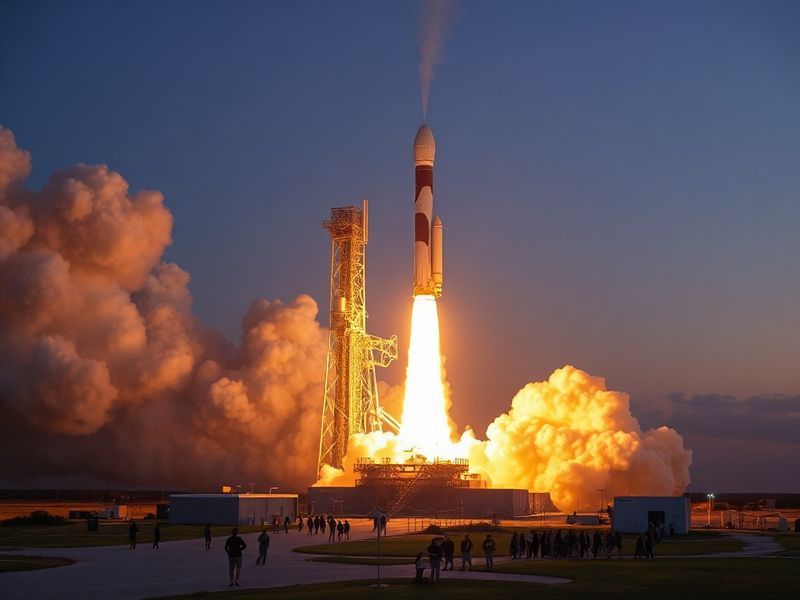
The SpaceX Falcon Heavy rocket, one of the most powerful launch vehicles ever built, has once again demonstrated its capabilities with its latest mission. This launch not only underscores the growing ambitions of private spaceflight but also signals a shift in how humanity approaches space exploration. Unlike traditional rockets, the Falcon Heavy combines three reusable boosters, allowing it to carry heavier payloads at a fraction of the cost of conventional systems.
The recent launch, which took place from NASA’s Kennedy Space Center in Florida, carried a classified payload for the U.S. Space Force. While details about the mission remain under wraps, the successful deployment of the payload highlights the rocket’s reliability and precision. This mission follows a series of high-profile launches, including the historic 2018 test flight that sent Elon Musk’s Tesla Roadster into orbit around the sun.
The Evolution of the Falcon Heavy
The Falcon Heavy is the brainchild of SpaceX, a company founded by Elon Musk with the goal of reducing space travel costs and enabling the colonization of Mars. First unveiled in 2011, the rocket made its debut in February 2018, becoming the most powerful operational rocket in the world at the time. With a lifting capacity of nearly 64 metric tons to low Earth orbit, it surpassed the Delta IV Heavy, NASA’s previous heavy-lift champion, by a significant margin.
What sets the Falcon Heavy apart is its reusability. Unlike disposable rockets, which become space debris after launch, the Falcon Heavy’s three booster cores are designed to return to Earth and land vertically. This innovation drastically reduces the cost of space missions, making it feasible for governments and private companies to pursue ambitious projects. The recent launch successfully demonstrated this capability, with all three boosters landing as planned.
- Reusability: The Falcon Heavy’s three booster cores can be recovered and reused, slashing mission costs.
- Payload Capacity: With the ability to carry nearly 64 metric tons to low Earth orbit, it is one of the most powerful rockets ever built.
- Precision Landing: The boosters return to Earth autonomously, ensuring minimal risk to populated areas.
- Cost Efficiency: By reusing components, SpaceX has reduced the price of heavy-lift launches to a fraction of traditional costs.
Broader Implications for Space Exploration
The success of the Falcon Heavy launch has far-reaching implications for the future of space exploration. For decades, space agencies like NASA relied on government-funded, single-use rockets that were prohibitively expensive. The Falcon Heavy, however, represents a paradigm shift by proving that private companies can achieve what was once the exclusive domain of nation-states. This opens the door to a new era of commercial spaceflight, where companies and researchers can send payloads into orbit—or beyond—without breaking the bank.
One of the most exciting possibilities is the potential for human missions to Mars. While SpaceX has not yet committed to a crewed mission using the Falcon Heavy, the rocket’s capabilities align closely with the requirements for such a journey. The ability to carry large payloads, including habitats and supplies, makes it a strong candidate for supporting a future Martian colony. Additionally, the rocket’s reusability could play a crucial role in establishing a sustainable transportation system between Earth and Mars.
Beyond Mars, the Falcon Heavy could also revolutionize satellite deployment. Traditional rockets struggle to carry multiple large satellites into orbit simultaneously, but the Falcon Heavy’s massive payload capacity allows for more efficient launches. This could accelerate the deployment of global internet constellations, such as SpaceX’s own Starlink network, which aims to provide high-speed internet access to remote areas of the world.
Challenges and Criticisms
Despite its achievements, the Falcon Heavy has faced its share of challenges and criticisms. One of the primary concerns is the environmental impact of frequent rocket launches. While the Falcon Heavy’s carbon footprint is smaller than that of traditional rockets due to its reusability, the sheer volume of fuel burned during each launch raises questions about long-term sustainability. SpaceX has not yet addressed these concerns in detail, leaving environmentalists wary of the company’s rapid expansion.
Another criticism revolves around the rocket’s reliability. While the recent launch was a success, SpaceX has encountered issues with its booster landings in the past. Failed landings, though rare, can result in significant financial losses and delays. Additionally, the classified nature of the Space Force payload has fueled speculation about the rocket’s intended use, with some questioning whether it could be adapted for military purposes.
Finally, competition in the space industry is heating up. Companies like Blue Origin and United Launch Alliance are developing their own heavy-lift rockets, such as the New Glenn and Vulcan Centaur, respectively. These competitors could challenge SpaceX’s dominance in the heavy-lift market, forcing the company to innovate further to maintain its edge.
The Road Ahead
The future of the Falcon Heavy looks promising, but it is not without uncertainty. SpaceX continues to refine its technology, with plans to increase the rocket’s payload capacity and reduce launch costs even further. The company has also hinted at using the Falcon Heavy for missions beyond Earth orbit, including trips to the moon and Mars. However, achieving these goals will require overcoming technical hurdles and securing additional funding.
For now, the Falcon Heavy remains a symbol of humanity’s growing ambition in space. Its successful launches inspire a new generation of engineers, scientists, and dreamers to push the boundaries of what is possible. As private companies take on a larger role in space exploration, the Falcon Heavy serves as a reminder that the final frontier is not just the domain of governments—it is a frontier for all of humanity.
For those interested in following the latest developments in space technology, Dave’s Locker Technology section offers in-depth coverage of breakthroughs and trends shaping the future of innovation. Additionally, for a broader perspective on how space exploration intersects with culture and society, visit our Culture category.