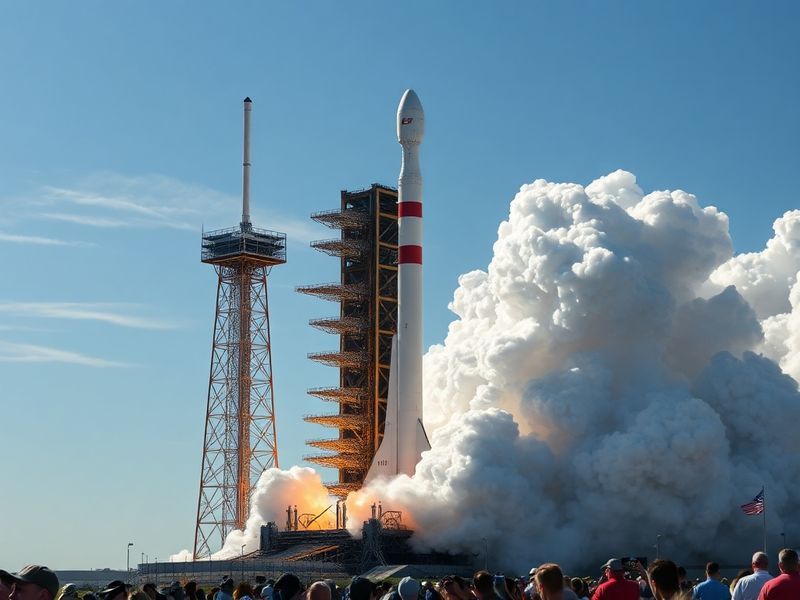
The SpaceX Falcon Heavy stands as a testament to human ingenuity in space exploration. Since its maiden launch in February 2018, this colossal rocket has pushed the boundaries of what’s possible in aerospace engineering. With its unparalleled lifting capacity and cost-effective design, the Falcon Heavy has redefined the commercial space industry and opened new frontiers for scientific discovery.
The Engineering Marvel Behind Falcon Heavy
The Falcon Heavy is essentially a triple-core version of SpaceX’s workhorse, the Falcon 9. Each core is a modified Falcon 9 first stage, equipped with nine Merlin engines. Together, these cores generate over 5 million pounds of thrust at liftoff—enough to carry a payload of up to 64 metric tons into low Earth orbit. This makes it one of the most powerful operational rockets in the world.
What sets the Falcon Heavy apart is its reusability. Unlike traditional rockets that are discarded after a single use, the Falcon Heavy’s side boosters and central core are designed to return to Earth for recovery and reuse. This innovation has dramatically reduced the cost of space missions, making space travel more accessible than ever before.
Key Features of the Falcon Heavy
- Triple-Core Design: Three Falcon 9 first stages combined to create a single, more powerful rocket.
- Reusability: All three cores are designed to land back on Earth for refurbishment and reuse.
- High Payload Capacity: Capable of carrying up to 64 metric tons to low Earth orbit, 26 metric tons to Mars, or 16 metric tons to Pluto.
- Cost Efficiency: SpaceX estimates the cost per launch at approximately $90 million, significantly lower than traditional rockets.
- Versatility: Suitable for a wide range of missions, including satellite deployment, deep-space exploration, and even crewed missions.
The Maiden Flight and Beyond
The Falcon Heavy’s first launch on February 6, 2018, was a spectacle watched by millions worldwide. The rocket carried SpaceX CEO Elon Musk’s personal Tesla Roadster into space, complete with a mannequin dubbed “Starman” seated in the driver’s seat. The launch was flawless, and the side boosters returned to Earth in a synchronized landing that captivated audiences. The central core, however, failed to land on the drone ship and crashed into the ocean.
Despite this setback, the Falcon Heavy has since completed multiple successful missions. In 2019, it launched the Arabsat-6A communications satellite, and in 2020, it deployed the U.S. Air Force’s Space Test Program 2 mission. These launches demonstrated the rocket’s reliability and versatility, solidifying its place in the commercial space industry.
The Broader Implications for Space Exploration
The Falcon Heavy is more than just a rocket; it represents a shift in how humanity approaches space exploration. By drastically reducing the cost of launches, the Falcon Heavy has made it feasible to undertake ambitious missions that were previously out of reach. This includes plans for crewed missions to the Moon and Mars, as well as the deployment of large-scale satellite constellations for global internet coverage.
One of the most exciting prospects is the potential for deep-space exploration. The Falcon Heavy’s high payload capacity allows it to carry heavy scientific instruments and supplies to distant planets. For example, NASA’s Psyche mission, which aims to explore a metallic asteroid, was launched aboard a Falcon Heavy in 2023. Such missions could unlock new scientific discoveries and expand our understanding of the solar system.
The Commercial Space Race
The success of the Falcon Heavy has intensified competition in the commercial space sector. Companies like Blue Origin and United Launch Alliance are developing their own heavy-lift rockets, such as the New Glenn and Vulcan Centaur, respectively. This competition is driving innovation and reducing costs across the industry, benefiting both private companies and government agencies alike.
Moreover, the Falcon Heavy has paved the way for new business models in space. Companies like SpaceX are now offering rideshare missions, where multiple small satellites can be launched on a single rocket. This has democratized access to space, allowing even small startups and research institutions to send their payloads into orbit.
The Future of the Falcon Heavy
Looking ahead, the Falcon Heavy is poised to play a critical role in several upcoming missions. SpaceX has announced plans to use the rocket for lunar missions, including the deployment of the Lunar Gateway, a key component of NASA’s Artemis program. Additionally, the Falcon Heavy could be instrumental in supporting the development of a permanent human presence on Mars.
However, the rocket faces challenges as newer, more advanced vehicles enter the market. The Starship, SpaceX’s next-generation rocket, is expected to surpass the Falcon Heavy in both payload capacity and reusability. Despite this, the Falcon Heavy remains a vital asset for the foreseeable future, offering a proven and reliable option for heavy-lift missions.
For enthusiasts and professionals alike, the Falcon Heavy represents a golden age of space exploration. Its achievements have inspired a new generation of engineers, scientists, and dreamers to push the limits of what’s possible. As we look to the stars, the Falcon Heavy stands as a symbol of human ambition and the relentless pursuit of discovery.
Why the Falcon Heavy Matters
The Falcon Heavy is more than just a technological achievement; it is a catalyst for change. By making space travel more affordable and accessible, it has opened doors to new opportunities and challenges. From scientific research to commercial ventures, the impact of the Falcon Heavy will be felt for decades to come.
As we continue to explore the cosmos, the lessons learned from the Falcon Heavy will shape the future of aerospace engineering. It serves as a reminder that with innovation, determination, and a bit of audacity, humanity can achieve the extraordinary.
For those interested in following the latest developments in space technology, be sure to explore more on Dave’s Locker Technology and Science pages. These resources offer deeper insights into the advancements driving the future of space exploration.