Weather Forecasting: How Science Predicts the Unpredictable
“`html
Weather Forecasting: How Modern Science Predicts the Unpredictable
Weather forecasting has evolved from ancient superstitions to a precise science that saves lives and drives economies. Today’s meteorologists rely on advanced technology, global collaboration, and decades of research to turn chaotic atmospheric data into actionable predictions. The stakes are high—accurate forecasts help farmers plan harvests, airlines adjust flight paths, and emergency services prepare for disasters.
The journey from observing cloud patterns to deploying supercomputers took centuries. Early civilizations studied the skies without instruments, interpreting bird flight or wind shifts as omens. By the Renaissance, scientists like Galileo and Torricelli laid the groundwork for modern meteorology, inventing tools such as the thermometer and barometer. The 20th century brought radar and satellites, revolutionizing how we track storms and pressure systems.
From Observations to Algorithms
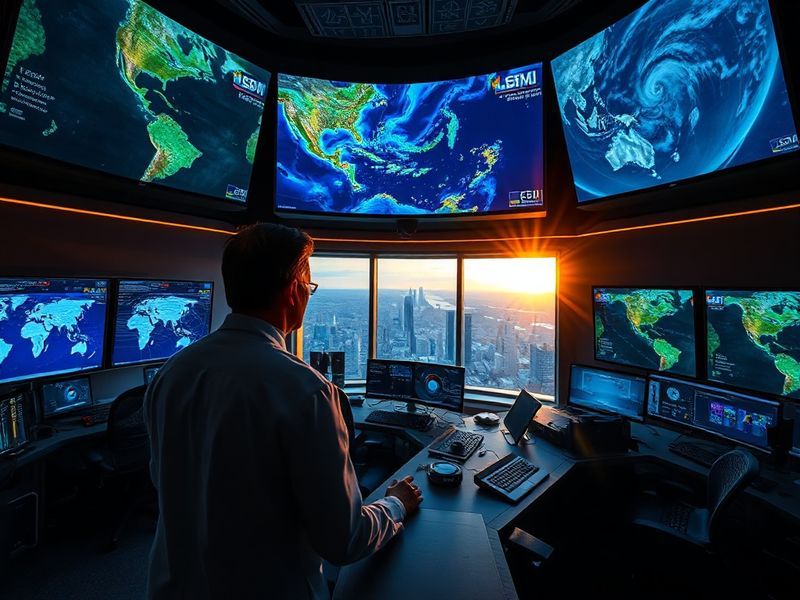
Modern forecasting begins with data collection. Thousands of weather stations, balloons, and buoys feed real-time information into global networks coordinated by organizations like the World Meteorological Organization. Satellites orbiting Earth capture images every few minutes, tracking cloud movements, ocean temperatures, and even wildfire smoke. Meanwhile, weather balloons ascend twice daily, carrying sensors that measure humidity, pressure, and wind at different altitudes.
The raw data is then fed into numerical weather prediction models—complex computer programs that simulate the atmosphere. These models divide the sky into a 3D grid, applying physics equations to predict how temperature, pressure, and moisture will change over time. Supercomputers at agencies like the National Weather Service perform quadrillions of calculations per second to generate forecasts. Yet even with this power, uncertainty remains. Small errors in initial data can lead to wildly different outcomes days later, a phenomenon known as the “butterfly effect.”
Forecasters mitigate this by running multiple models—each with slightly varied starting conditions—and comparing their results. Ensemble forecasting, as it’s called, provides a range of possible outcomes rather than a single prediction. This approach is especially critical for severe weather events like hurricanes or blizzards, where timing and intensity can mean the difference between safety and catastrophe.
The Role of Human Expertise
While algorithms handle the heavy lifting, human forecasters play an irreplaceable role. Meteorologists interpret model outputs, cross-checking them against historical patterns and local knowledge. A sudden temperature drop in a coastal region might seem minor to a computer, but an experienced forecaster recognizes it as a sign of an incoming cold front.
Technology has also democratized forecasting. Apps and websites now provide hyper-local predictions tailored to neighborhoods. Yet this abundance of data can overwhelm the public. Forecasters must distill complex models into clear, concise warnings—balancing urgency with accuracy. A single misplaced decimal in a forecast can lead to unnecessary panic or, worse, complacency before a storm hits.
Limitations and Challenges
Despite its sophistication, weather forecasting still faces hurdles. The atmosphere is a dynamic system, and even the best models struggle with long-range predictions beyond 10 days. Seasonal forecasts, like those predicting an El Niño winter, rely more on statistical trends than precise simulations. Climate change further complicates matters. Rising global temperatures alter historical patterns, making it harder to rely on past data.
Another challenge is data gaps. Remote regions, like the open ocean or polar areas, lack sufficient monitoring stations. Satellites help fill these voids, but their coverage isn’t uniform. Developing nations often lack the infrastructure to maintain weather networks, leaving populations vulnerable to extreme events. International efforts, such as the Global Weather Enterprise, aim to improve global data sharing and forecasting capabilities.
Human error also plays a part. Forecasters may misinterpret model outputs or overlook subtle atmospheric cues. In 2019, the European Centre for Medium-Range Weather Forecasts introduced a new model to address such gaps, but no system is foolproof. The best forecasts combine technology with human judgment, acknowledging that nature’s chaos can never be fully tamed.
The Future of Forecasting
The next frontier in weather prediction lies in artificial intelligence. Machine learning algorithms can process vast datasets faster than humans, identifying patterns invisible to traditional models. Projects like Google’s GraphCast and IBM’s Watson are experimenting with AI-driven forecasts that could reduce errors by up to 20%. These systems learn from past predictions, continuously improving their accuracy.
Another innovation is high-resolution modeling. Traditional global models divide the atmosphere into grid boxes spanning 10–20 kilometers. New “convection-permitting” models shrink this to 1–4 kilometers, capturing small-scale phenomena like thunderstorms or fog. The U.S. National Weather Service plans to implement such models nationwide by 2025, offering street-level forecasts. This precision could revolutionize industries from agriculture to renewable energy, where even minor weather variations impact operations.
Climate change is also driving demand for better forecasting. As extreme weather becomes more frequent, governments and businesses need reliable data to adapt. The insurance industry, for example, uses weather predictions to assess risk and set premiums. Cities use them to design flood defenses or heatwave response plans. Forecasting is no longer just about tomorrow’s rain—it’s about shaping resilient communities for decades to come.
How You Can Use Forecasts Effectively
For the average person, weather forecasts are tools for daily decisions. But interpreting them correctly requires context. Pay attention to the forecast’s time frame: a 7-day outlook is less reliable than a 3-day one. Watch for “probabilistic” forecasts, which indicate confidence levels. A 60% chance of rain means the event is more likely than not—but it’s not a guarantee.
Emergency alerts are another critical resource. The National Weather Service issues warnings via apps like Weather Underground or NOAA Weather Radio. These alerts bypass local forecasts to deliver urgent messages about tornadoes, flash floods, or hurricanes. Ignoring them can have deadly consequences.
Finally, consider the source. Government agencies like NOAA provide data-driven forecasts free of charge, while private companies may prioritize sensationalism. Cross-referencing multiple sources can help separate fact from hype.
Conclusion
Weather forecasting is a testament to human ingenuity—a blend of science, technology, and perseverance. From Galileo’s thermometer to today’s AI models, each advancement has brought us closer to understanding the skies. Yet the atmosphere remains a formidable puzzle, one that demands both precision and humility.
The future of forecasting promises even greater accuracy, with tools like machine learning and high-resolution modeling leading the charge. But technology alone isn’t enough. It must be paired with global cooperation, equitable data access, and a commitment to using forecasts for the public good. Whether you’re a farmer, pilot, or simply planning a picnic, reliable weather predictions are a cornerstone of modern life—one that connects us all to the ever-changing world around us.