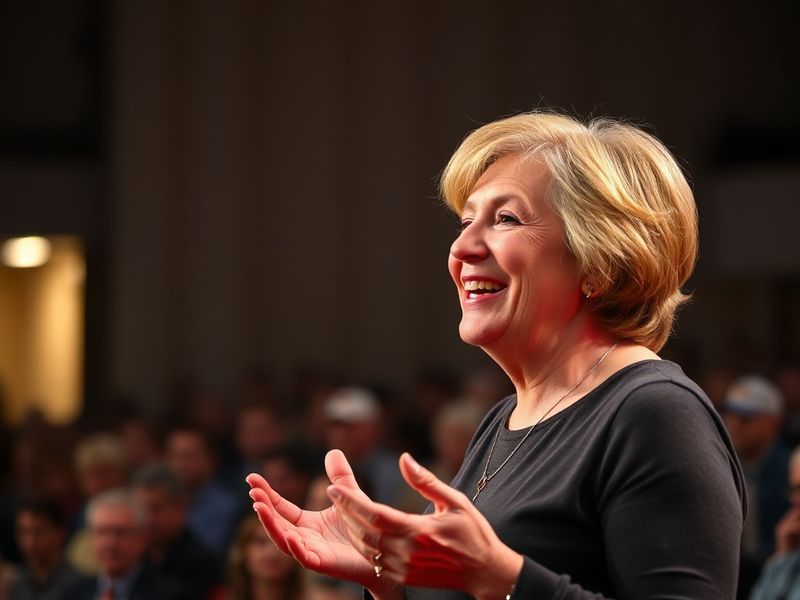
Who Is Brené Brown?
Brené Brown is a research professor at the University of Houston’s Graduate College of Social Work, where she has spent over two decades studying courage, vulnerability, shame, and empathy. Her work gained unexpected public attention in 2010 with a viral TED Talk, “The Power of Vulnerability,” which has since been viewed over 60 million times. Brown’s research challenges conventional notions of strength and leadership, arguing that true connection—whether in personal relationships, workplaces, or societies—requires embracing vulnerability rather than avoiding it.
Born in 1965 in San Antonio, Texas, Brown grew up in a culture that often equated vulnerability with weakness. This personal and academic tension shaped her career. “Shame is the most powerful, master emotion,” she once noted. “It’s the fear that we’re not good enough.” Her books, including Daring Greatly (2012) and The Gifts of Imperfection (2010), blend academic rigor with accessible storytelling, making complex psychological concepts relatable to a global audience.
How Her Work Transcends Borders
Brown’s influence extends far beyond American self-help circles. In cultures where emotional expression is often suppressed—such as parts of East Asia or conservative societies—her message about vulnerability as a strength has sparked quiet revolutions. In Japan, for example, the concept of “honne” (true feelings) versus “tatemae” (public façade) has historically discouraged open emotional sharing. Yet, Brown’s work has been cited in Japanese corporate training programs, encouraging leaders to model authenticity.
In Scandinavia, where social trust and collective well-being are prioritized, Brown’s emphasis on empathy resonates deeply. Nordic countries consistently rank among the happiest in the world, partly due to their focus on community and emotional support. Brown’s research on empathy as a skill—rather than an innate trait—has influenced public policy discussions there, particularly in mental health initiatives.
- Europe: Brown’s ideas have shaped leadership programs in the UK and Germany, where corporate burnout is a growing concern.
- Latin America: Her work on shame and gender has been adopted in feminist movements, particularly in Argentina and Mexico, where discussions about emotional labor in caregiving are expanding.
- Africa: South African organizations use her frameworks to address post-apartheid trauma and reconciliation.
The Cultural Shift Toward Vulnerability
Brown’s timing was impeccable. The rise of social media in the 2010s created a paradox: while platforms like Instagram and Facebook promised connection, they also amplified comparison and isolation. Her 2017 Netflix special, The Call to Courage, framed vulnerability as the antidote to digital-age loneliness. In India, where arranged marriages and societal expectations often stifle personal expression, Brown’s message about embracing imperfections has found an audience among young professionals navigating modern relationships.
Her concept of “wholehearted living”—a life guided by courage, compassion, and connection—has also influenced education systems. In Finland, a country renowned for its progressive schools, educators have integrated Brown’s ideas into curricula, teaching students emotional literacy alongside math and science. This reflects a global trend: as mental health awareness grows, societies are redefining strength to include emotional openness.
Brown herself has acknowledged the cultural nuances of her work. In a 2018 interview with Culture magazine, she remarked, “Vulnerability looks different in every culture. In some places, it’s about speaking up; in others, it’s about listening. The key is recognizing that we all carry shame, but we don’t have to let it define us.”
Criticism and Controversy
Despite her widespread acclaim, Brown’s work hasn’t been without detractors. Some academics argue that her research oversimplifies complex psychological phenomena, reducing them to soundbites. Others critique her emphasis on individual resilience in systems that perpetuate inequality. In 2020, during the COVID-19 pandemic, her advice to “lean into discomfort” was criticized by some as tone-deaf amid widespread grief and economic instability.
In corporate settings, Brown’s message has sometimes been co-opted into “hustle culture,” where employees are told to “dare greatly” while companies cut benefits or demand unpaid labor. This tension highlights a broader debate: Can vulnerability be a tool for systemic change, or does it risk becoming another management buzzword?
Brown has responded to these critiques by emphasizing context. “My work isn’t about toxic positivity,” she clarified in a 2021 podcast interview. “It’s about showing up as yourself, even when the system is broken. But we also have to ask: Who benefits when we’re all ‘daring greatly’ while the structures around us remain unchanged?”
A Lasting Legacy
Brené Brown’s impact is undeniable. She has sold millions of books, inspired countless leaders, and shifted cultural conversations about mental health. Yet her greatest contribution may be the quiet revolution she’s sparked: a global acknowledgment that vulnerability is not the opposite of strength, but a path to it.
As societies grapple with polarization, digital overload, and existential crises, Brown’s work reminds us that connection begins with honesty—with ourselves and with each other. In a world where performative perfection often trumps authenticity, her message is both radical and necessary.
Whether in boardrooms, classrooms, or living rooms, the invitation remains the same: dare to be seen. Not as a superhero, but as a human being—flaws, fears, and all.