How the Voting Rights Act Transformed Democracy—and Where It Stands Today
The Voting Rights Act of 1965 remains one of the most consequential pieces of legislation in American history. Signed into law by President Lyndon B. Johnson on August 6, 1965, it outlawed discriminatory voting practices that had long suppressed African American participation in elections, particularly in Southern states. At its core, the Act aimed to enforce the 15th Amendment, which had been ratified nearly a century earlier but remained largely ignored in practice.
Before its passage, Black citizens faced systemic barriers such as poll taxes, literacy tests, and outright intimidation. These tactics were not unique to the United States. Around the world, similar obstacles emerged in post-colonial nations where newly independent governments restricted voting rights based on ethnicity or class. The Voting Rights Act, therefore, became a global symbol of how legal frameworks could dismantle entrenched oppression.
The Legal Framework That Changed Everything
The Act’s most powerful provision was Section 5, which required certain jurisdictions—mostly in the South—to obtain federal approval before changing any voting laws. This “preclearance” process was designed to prevent states from reinventing discriminatory rules under new names. Over time, it expanded to cover language minorities, ensuring that Spanish-speaking and Native American voters also received fair representation.
Section 2 of the Act, which remains in effect, prohibits voting practices that discriminate based on race, color, or membership in a language minority group. This has allowed courts to challenge gerrymandering, at-large elections, and other structural barriers. Globally, nations like South Africa and Canada have looked to these protections when drafting their own electoral laws, adapting the principles to local contexts.
Yet the Act’s influence extended beyond legal boundaries. It shifted cultural narratives, forcing a reckoning with the nation’s history of racial exclusion. Documentaries, literature, and public discourse began to center Black political agency in ways that were previously unimaginable. Even today, its legacy shapes debates about representation in media, politics, and beyond.
The Erosion of Protections in Recent Decades
In 2013, the Supreme Court’s Shelby County v. Holder decision gutted Section 4, the formula used to determine which jurisdictions needed preclearance. Chief Justice John Roberts argued that the coverage formula was outdated, ignoring progress made in voter participation. Critics, however, saw this as a dangerous rollback. Within hours of the ruling, states like Texas and North Carolina moved to implement restrictive voter ID laws that had previously been blocked.
Since then, over 400 bills restricting voting access have been introduced across the country. Many target mail-in voting, early voting, and same-day registration—measures that disproportionately affect minority communities. The Brennan Center for Justice found that in 2021 alone, 19 states passed 34 laws making it harder to vote. This trend mirrors global backsliding in democratic norms, from Hungary’s crackdown on opposition parties to India’s revocation of Kashmir’s autonomy.
The Act’s weakening has coincided with a resurgence of voter suppression tactics that echo its pre-1965 era. In Georgia, for example, a 2021 law reduced the number of ballot drop boxes and criminalized handing food or water to voters waiting in line. These measures disproportionately target Black and Latino communities, where polling places are often sparse and lines are long. The parallels to apartheid-era South Africa or colonial-era restrictions are hard to ignore.
Global Lessons and the Fight for Universal Suffrage
While the U.S. struggles to preserve its voting rights legacy, other nations offer contrasting models. Australia’s mandatory voting system ensures near-universal participation, while New Zealand’s proportional representation system amplifies minority voices. In contrast, countries like Russia and Belarus have systematically dismantled opposition through legal and extralegal means, demonstrating how fragile electoral integrity can be without strong protections.
The Voting Rights Act’s global influence is evident in how international organizations address electoral fairness. The United Nations’ Sustainable Development Goal 16 calls for inclusive and participatory decision-making, directly referencing the principles embedded in the Act. Even in post-conflict societies like Rwanda, where ethnic tensions once fueled genocide, constitutional reforms have prioritized proportional representation to prevent future violence.
Yet challenges persist. In India, the world’s largest democracy, the Election Commission has faced criticism for failing to prevent intimidation of Muslim voters. Meanwhile, in Brazil, former President Jair Bolsonaro’s baseless claims of electoral fraud mirrored the rhetoric of U.S. election deniers. These examples show that the fight for voting rights is not confined to any one country—it is a universal struggle.
What’s Next for Voting Rights in America?
The future of the Voting Rights Act hinges on legislative and judicial action. The John Lewis Voting Rights Advancement Act, reintroduced in Congress multiple times, seeks to restore preclearance by updating the coverage formula. Advocates argue it’s a necessary step to counter the wave of restrictive laws sweeping state legislatures. However, partisan gridlock has thus far blocked its passage.
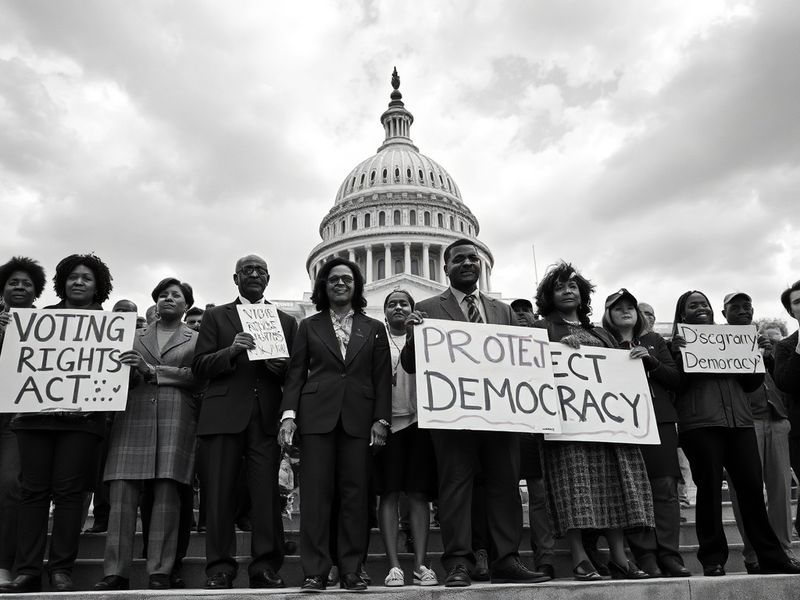
Grassroots movements are also playing a pivotal role. Organizations like the NAACP, Black Voters Matter, and the ACLU have sued states over discriminatory laws, while community groups conduct voter education drives in marginalized neighborhoods. Social media campaigns, such as #ProtectTheVote, have amplified stories of voter suppression, forcing mainstream media to cover the issue more closely.
For younger generations, the Act represents both a historical victory and a call to action. Many see the erosion of voting rights as a generational struggle, akin to the civil rights battles of the 1960s. Universities now offer courses on election law that dissect the Act’s impact, while films like Selma and All In: The Fight for Democracy bring its lessons to new audiences.
The Voting Rights Act’s journey—from a tool of liberation to a symbol of ongoing resistance—is far from over. Its story is a reminder that democracy is not a static achievement but a living process, constantly tested by those who seek to undermine it. As the world watches America’s struggles, the Act’s legacy continues to inspire movements for justice everywhere.