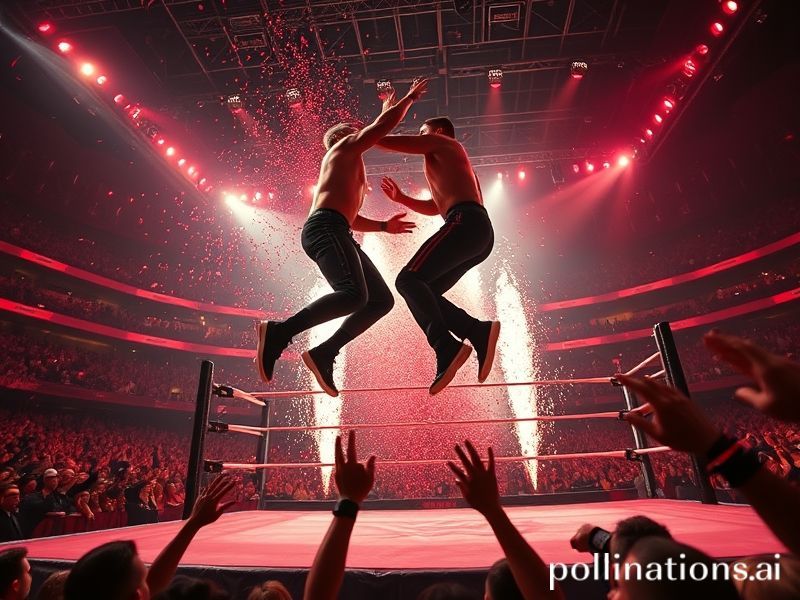
RAW in the Streets: How Monday Night’s Spandex Diplomacy Travels the Globe
By the time the first guitar riff hits in São Paulo, the toast is already burning in Lagos, and a bleary-eyed accountant in Mumbai is wondering why his VPN just died. WWE Raw, that weekly three-hour carnival of suplexes and soap opera, has quietly become the planet’s most reliable geopolitical barometer—an oddity considering its marquee performers still pretend to punch each other with the conviction of a hung-over intern.
From a satellite view, Raw looks like a low-orbit confetti cannon. The feed is beamed live or on tape delay to roughly 180 countries, translated into more than 25 languages, and pirated in the rest. In Manila, jeepney drivers huddle around cracked phone screens to watch Rey Mysterio’s knees attempt the geopolitical miracle of remaining attached to his legs. Meanwhile, in the United Arab Emirates, the same broadcast is stripped of anything that might offend—alcohol references, cleavage, the concept of independent women—leaving a product so neutered that the ring ropes might as well be dental floss.
This is soft power via sleeper hold. Washington has Voice of America; Stamford, Connecticut has Sami Zayn’s conspiracy rants. Analysts who track cultural imperialism usually obsess over K-pop or Netflix, yet Raw slips past customs without a visa, delivering the subtle message that all problems—border disputes, marital spats, existential dread—can be solved with a chair shot and a catchphrase. The irony, of course, is that the show is now less American than a UN cafeteria. Its men’s world champion is Nigerian-Canadian; its women’s division is a rotating exhibit of Pacific Rim excellence; and its most reliable merchandise mover is a Scotsman whose gimmick is literally being angry about Brexit.
Look closer and you’ll see Raw functioning as a global stress test for supply chains. When the crew landed in Riyadh for Crown Jewel, the props department had to source 400 pounds of glitter locally because Saudi customs deemed the original shipment “culturally ambiguous.” The pyrotechnics contractor in Glasgow once had to MacGyver a Roman-candle finale from leftover whiskey stills—an innovation now patented under “Highland Thunder Technology.” Meanwhile, the catering budget in Mexico City collapsed when lucha libre fans insisted on swapping catered turkey wraps for 600 feet of carnitas. Somewhere, Adam Smith is turning heel.
Financially, Raw is the cockroach of content: it survives recessions, wars, and the moral panic du jour. Rights fees keep rising because live eyeballs—especially angry, tribal ones—are the last thing advertisers can still bank on. India’s Sony Sports paid a king’s ransom for exclusive rights, then discovered that 40 percent of viewers were streaming via unlicensed TikTok mirrors hosted in Moldovan basements. Rather than sue, Sony cut a sponsorship deal: the streams now feature subtle product placement for a Delhi-based erectile-dysfunction clinic. Capitalism, like a steel chair, finds a way.
The moral calculus is uglier. In Myanmar, military junta officials have been spotted wearing nWo shirts while clearing villages; in Kyiv, a hospital ward decorated its children’s ward with Becky Lynch posters to remind shell-shocked kids that “The Man” isn’t always the one with the tank. The cognitive dissonance is deafening, yet somehow on brand: the same show that flirts with progressive storylines also sells action figures of police-brutality cosplayers. It’s Schrödinger’s Propaganda—both empowering and exploitative until you open the box and find it stuffed with $29.99 t-shirts.
And so, every Monday, the planet tilts slightly on its axis as 2 million airline miles’ worth of humanity screams in unison about scripted grievances. The commentators call it “the most must-see night in television,” which is marketing speak for “please ignore the melting ice caps outside your window.” But maybe that’s the point. In a world where real borders harden and real bodies fall, there’s a perverse comfort in watching oiled gladiators settle their differences with a folding table and a handshake backstage. The illusion is expensive, the stakes are imaginary, and the merch table never closes.
Which, come to think of it, makes Raw the perfect mirror for our age: loud, profitable, and just fake enough to keep us from rioting in the streets. For three hours a week, the globe agrees to pretend gravity is negotiable. After the credits roll, we fasten our seatbelts and descend back into reality—where the chairs are real, the pain is unpaid, and no one sells a branded foam finger for existential dread. Yet.