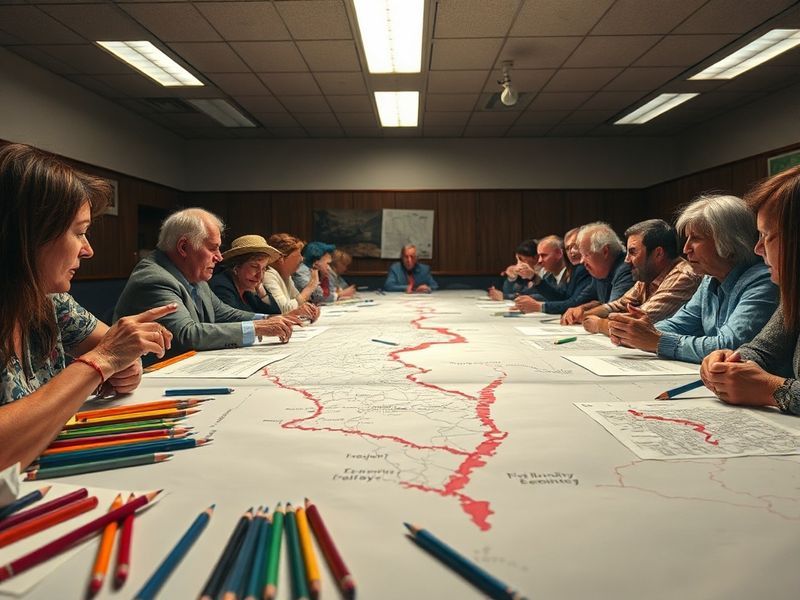
Redistricting: How Political Maps Shape Power in America
“`html
Redistricting: How Political Maps Shape Power in America
Every decade, a quiet but consequential process reshapes American politics. Redistricting—the redrawing of legislative district boundaries—determines who represents communities in Congress and state legislatures. While the mechanics may seem technical, the outcomes influence everything from election results to policy priorities. This process, driven by census data and political calculations, often becomes a flashpoint for debates over fairness, representation, and democracy itself.
Why Redistricting Matters
At its core, redistricting is about power. By adjusting district lines, lawmakers can concentrate or dilute voter blocs, effectively shaping election outcomes before a single ballot is cast. This practice, known as gerrymandering, has a long history in the United States, dating back to 1812 when Massachusetts Governor Elbridge Gerry signed a bill creating a district shaped like a salamander to benefit his party. The term “gerrymandering” was born from that moment, and the practice has evolved alongside political strategies.
The stakes of redistricting extend beyond partisan battles. Fairly drawn districts ensure communities of interest—whether geographic, racial, or economic—are represented in government. Conversely, skewed maps can marginalize voters, dilute minority voices, and create safe seats where incumbents face little competition. The Supreme Court has weighed in on these issues, most notably in Rucho v. Common Cause (2019), which ruled that federal courts cannot adjudicate partisan gerrymandering claims, leaving the issue largely to states and political processes.
The Legal and Political Landscape
Redistricting is governed by a mix of constitutional mandates and state laws. The U.S. Constitution requires that districts be roughly equal in population, a principle established by the Supreme Court in Baker v. Carr (1962). States must also comply with the Voting Rights Act of 1965, which prohibits racial discrimination in redistricting. However, enforcement of these rules has varied, leading to disputes over whether maps unlawfully suppress certain voters.
Political control plays a critical role in redistricting. In most states, the party in power draws the maps, creating an incentive to entrench its advantage. Some states have taken steps to depoliticize the process. For example, independent redistricting commissions in California and Arizona aim to remove partisan influence. Meanwhile, other states have seen legal challenges over maps that critics argue are racially or politically discriminatory. The 2020 redistricting cycle, following the 2020 census, saw a record number of lawsuits, reflecting heightened scrutiny of the process.
How Redistricting Works in Practice
The redistricting process typically unfolds in several stages. First, the Census Bureau releases population data, which states use to redraw district boundaries. This data is then analyzed by legislative staff, political operatives, or independent commissions, depending on the state. The proposed maps are subject to public comment, hearings, and sometimes legal challenges before taking effect.
Several key considerations shape how maps are drawn:
- Equal Population: Districts must be as close to equal in population as possible, ensuring each voter has roughly the same representation.
- Contiguity: Districts must be connected, without oddly shaped splits that could disenfranchise communities.
- Compactness: While not always strictly enforced, districts are ideally compact and geometrically simple.
- Community of Interest: Efforts are made to group communities with shared interests, such as ethnic neighborhoods or rural areas.
- Partisan and Racial Balance: Maps must not unlawfully dilute minority voting power or unfairly favor one party.
Despite these guidelines, the process often becomes contentious. Partisan mapmakers employ a variety of tactics to gain an edge, including “packing” opponents into a few districts to dilute their influence or “cracking” their support across multiple districts. These strategies can create stark disparities in representation, as seen in states like North Carolina and Wisconsin, where litigation has challenged partisan gerrymanders.
The Role of Technology
Technology has transformed redistricting into a data-driven exercise. Sophisticated software, such as the Dave’s Locker Politics section, allows mapmakers to analyze voter data, demographic trends, and election results with precision. This has both democratized and complicated the process. On one hand, independent groups can now propose alternative maps, giving voters more input. On the other, partisan actors can use data to fine-tune gerrymanders with surgical precision.
Algorithms and mapping tools have also made it easier to detect gerrymandering. Organizations like the Dave’s Locker Analysis section track redistricting efforts nationwide, highlighting problematic maps and advocating for transparency. These tools empower citizens to scrutinize the process and demand accountability from their representatives.
Broader Implications for Democracy
The consequences of redistricting ripple through the political system. When maps are drawn to entrench partisan majorities, they can reduce electoral competition, leading to more polarized legislatures. Safe seats, where incumbents face little threat of losing, discourage compromise and encourage ideological extremism. This dynamic has contributed to the gridlock and dysfunction seen in many statehouses and Congress.
Redistricting also intersects with broader issues of representation. Minority communities, in particular, have fought for maps that reflect their political power. The Voting Rights Act has been a critical tool in these battles, though its scope has been narrowed by recent Supreme Court rulings. For example, in Shelby County v. Holder (2013), the Court struck down a key provision of the Voting Rights Act, leading to a surge in restrictive voting laws and redistricting plans that critics argue suppress minority votes.
Beyond elections, redistricting influences policy outcomes. Legislators representing gerrymandered districts may prioritize the interests of their base over broader public needs. This can lead to policies that reflect narrow partisan agendas rather than the will of the electorate. For instance, states with heavily gerrymandered maps have seen battles over issues like healthcare, education, and climate change play out along starkly partisan lines.
Looking Ahead: Reform and the Future of Redistricting
As the 2030 redistricting cycle approaches, calls for reform are growing louder. Advocates argue for measures such as independent redistricting commissions, ranked-choice voting, and automatic voter registration to reduce the influence of partisan mapmaking. Some states are already moving in this direction. For example, Michigan voters approved an independent commission in 2018, and Virginia followed suit in 2020. These reforms aim to restore public trust in the process and ensure that districts reflect the will of voters, not just the interests of politicians.
The debate over redistricting is ultimately a debate over democracy itself. Fair maps are essential for a functioning representative government, where every vote carries equal weight. Yet the process remains vulnerable to manipulation, leaving communities to grapple with the consequences. As technology and data continue to evolve, so too must the safeguards that protect the integrity of our electoral systems.
For now, the battle over redistricting is far from over. Citizens, activists, and lawmakers will continue to push for transparency, fairness, and accountability in the drawing of political boundaries. The outcome of these efforts will shape not just the next decade of American politics, but the very nature of representation in a changing democracy.