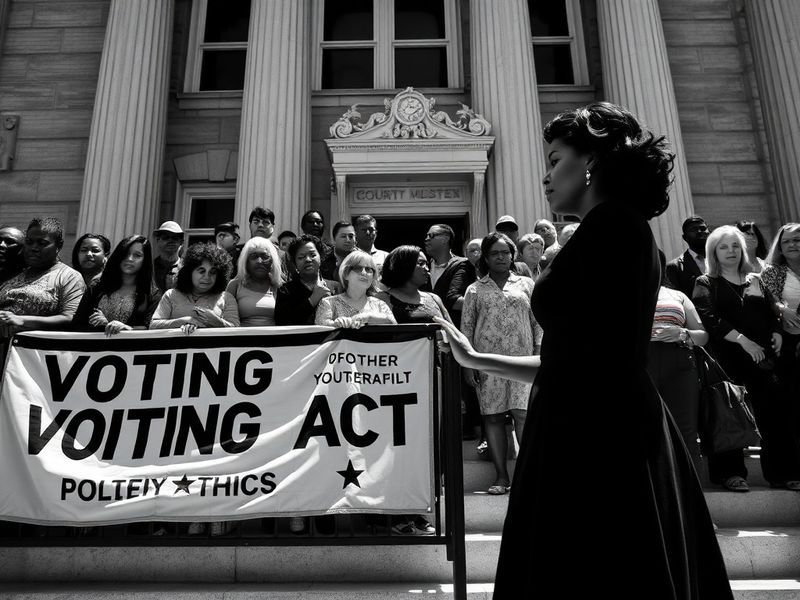
The Voting Rights Act: Protecting Democracy Since 1965
“`html
The Voting Rights Act: A Pillar of American Democracy
The Voting Rights Act of 1965 stands as one of the most consequential pieces of legislation in American history. Signed into law by President Lyndon B. Johnson on August 6, 1965, it outlawed discriminatory voting practices that had long disenfranchised racial minorities, particularly in the South. The Act followed a century of Jim Crow laws, poll taxes, literacy tests, and outright violence that systematically prevented Black Americans and other minorities from casting ballots.
The journey to its passage was fraught with resistance. Civil rights activists, including John Lewis and Martin Luther King Jr., organized marches and protests that culminated in the historic Selma to Montgomery marches in 1965. Images of peaceful marchers being beaten by state troopers on “Bloody Sunday” galvanized national outrage and pressured Congress to act. The Act’s immediate impact was transformative, leading to a surge in Black voter registration in Southern states.
The Legal Framework and Key Provisions
The Voting Rights Act consists of several critical sections that address different forms of discrimination. Section 2 prohibits voting practices or procedures that discriminate on the basis of race, color, or membership in a language minority group. This provision remains in effect nationwide and has been used to challenge discriminatory laws in courts across the country.
Sections 4 and 5 were particularly powerful tools for dismantling systemic barriers. Section 4 established a formula to identify jurisdictions with histories of discriminatory voting practices, while Section 5 required these “covered jurisdictions” to obtain federal approval, or “preclearance,” before changing any voting laws or practices. This preclearance process was designed to prevent states and localities from implementing new discriminatory measures under the guise of procedural changes.
The Act also included provisions to protect language minorities, ensuring that voters who spoke Spanish, Native American languages, and other non-English languages had access to ballots and election materials in their preferred language. This was a crucial step in recognizing the linguistic diversity of the United States and ensuring that all citizens could participate fully in the democratic process.
The Impact on Voter Participation and Representation
Before the Voting Rights Act, voter registration rates among Black Americans in the South were abysmally low. In Mississippi, for example, only 6.7% of eligible Black voters were registered in 1964. By 1969, that number had risen to 61%. Similar gains were seen in Alabama, Georgia, and Louisiana, where Black voter registration increased dramatically. The Act also led to the election of thousands of Black officials at the local and state levels, including the first Black members of Congress from the South since Reconstruction.
The Act’s impact extended beyond Black Americans. It also protected the voting rights of Hispanic Americans, Native Americans, and Asian Americans. In states like Texas and Arizona, where Spanish-speaking communities faced discrimination, the Act ensured that election materials were available in Spanish. This opened the door for greater political representation and advocacy for these communities.
One of the most visible outcomes of the Act was the increase in Black political representation. By the 1970s, Black mayors were elected in cities like Atlanta, Detroit, and Newark. In 1972, Barbara Jordan became the first Black woman from the South to serve in the U.S. Congress since Reconstruction. These milestones were not just symbolic; they reflected a fundamental shift in the political landscape of the United States.
Ongoing Challenges and the Fight for Voting Rights
Despite its successes, the Voting Rights Act has faced persistent challenges. In 2013, the Supreme Court’s decision in Shelby County v. Holder gutted Section 4, effectively ending the preclearance requirement. The Court ruled that the formula used to determine covered jurisdictions was outdated and that the federal government could no longer impose preclearance based on data from the 1960s and 1970s. This decision opened the floodgates for states to implement restrictive voting laws, including voter ID requirements, polling place closures, and gerrymandering.
Since the Shelby decision, over 20 states have enacted laws that make it harder to vote. These laws disproportionately affect minority communities, young voters, and low-income individuals. For example, a 2021 law in Georgia eliminated automatic voter registration and reduced the number of ballot drop boxes. In Texas, a 2021 law added new ID requirements for mail-in ballots and limited early voting hours in certain areas.
Advocates argue that these laws are not about election integrity but about suppressing the vote. Studies have shown that voter fraud is exceedingly rare, and the real purpose of these laws is to make it harder for certain groups to vote. The fight to restore and strengthen the Voting Rights Act has become a central issue in the broader struggle for racial justice and democracy.
Efforts to Restore and Strengthen the Act
In response to the Shelby decision, Congress has attempted to restore the preclearance requirement through legislation like the John Lewis Voting Rights Advancement Act. Named after the late civil rights leader and congressman, this bill aims to modernize the formula used to determine covered jurisdictions and expand the scope of federal oversight. However, the bill has faced significant opposition in Congress, with many Republican lawmakers arguing that it infringes on states’ rights.
Meanwhile, grassroots organizations like the NAACP, the American Civil Liberties Union (ACLU), and the Brennan Center for Justice have been at the forefront of challenging discriminatory voting laws in court. These organizations have used Section 2 of the Voting Rights Act to challenge gerrymandering, polling place closures, and other barriers to voting. Their efforts have resulted in several high-profile victories, including the striking down of discriminatory maps in states like North Carolina and Alabama.
The Biden administration has also taken steps to address voting rights. In 2021, the Department of Justice announced that it would double the number of lawyers dedicated to enforcing voting rights laws. The administration has also called on Congress to pass the Freedom to Vote Act, which includes provisions to expand early voting, make Election Day a federal holiday, and standardize voter ID laws across states.
Lessons from History and the Path Forward
The Voting Rights Act is a testament to the power of collective action and the importance of safeguarding democracy. Its passage was the result of decades of struggle by civil rights activists who risked their lives to demand justice. Yet, the fight for voting rights is far from over. The erosion of the Act’s protections in recent years has made it clear that the struggle for democracy is ongoing.
One of the key lessons from the history of the Voting Rights Act is that voting rights are not a given. They must be actively protected and expanded. This means not only restoring the protections of the Voting Rights Act but also addressing the structural inequalities that continue to disenfranchise millions of Americans. Gerrymandering, felony disenfranchisement, and voter suppression laws all contribute to a system that is not truly democratic.
Another lesson is the importance of coalition-building. The Voting Rights Act was the result of a broad coalition of civil rights organizations, faith leaders, labor unions, and elected officials working together. Today, the fight for voting rights requires similar coalitions to counter the coordinated efforts to suppress the vote. This includes building alliances between racial justice organizations, immigrant rights groups, and advocates for people with disabilities.
Finally, the history of the Voting Rights Act reminds us that progress is not linear. Just as the Act was a response to the injustices of the Jim Crow era, today’s voting rights struggles are a response to the backsliding we are witnessing. The lesson is clear: democracy is not a destination but a continuous process of struggle and renewal.
How You Can Get Involved
For those looking to support the fight for voting rights, there are many ways to get involved. Volunteering with organizations like Vote.org or the League of Women Voters can help register voters and ensure that everyone has access to the ballot box. Donating to organizations that challenge discriminatory voting laws, such as the ACLU or the Brennan Center, is another impactful way to contribute. Finally, staying informed and voting in every election—local, state, and federal—is one of the most powerful ways to uphold the principles of the Voting Rights Act.
The Voting Rights Act is more than a piece of legislation; it is a living testament to the idea that democracy must be continually fought for and defended. Its legacy challenges us to ensure that every American has the right to participate in the democratic process, free from discrimination and intimidation. The struggle for voting rights is a reminder that democracy is not just a system of government but a promise to be upheld by every generation.