Alabama Redistricting Under Kay Ivey: How New Maps Could Reshape 2026 Elections
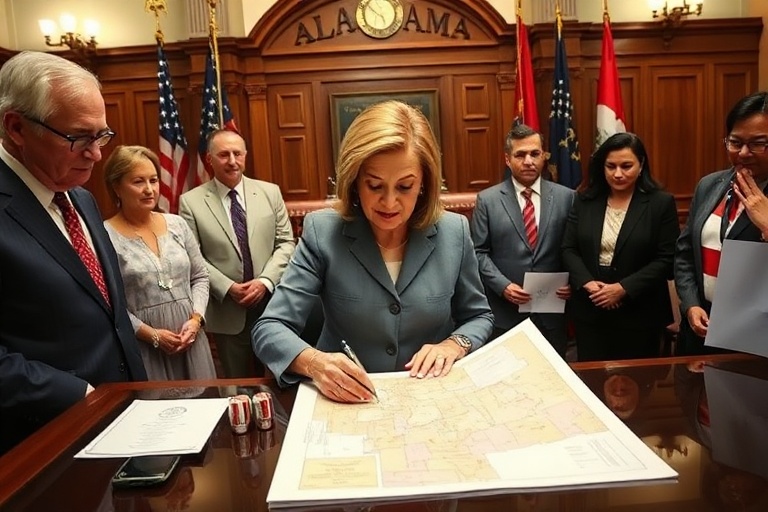
Alabama Governor Kay Ivey signed a new congressional redistricting plan into law this month, setting the stage for intense political battles ahead of the 2026 midterm elections. The move comes after years of legal challenges over the state’s congressional map, which critics argued diluted the voting power of Black residents. The new boundaries could reshape Alabama’s political landscape, potentially altering the balance of power in Washington.
The redistricting process began after the U.S. Supreme Court upheld a lower court’s ruling that Alabama’s previous congressional map likely violated the Voting Rights Act. The decision required the state to create a second district where Black voters could elect their preferred candidate. The new plan, which Ivey signed into law on October 1, creates a district encompassing parts of Montgomery, Birmingham, and Tuscaloosa, areas with significant Black populations.
The Legal and Political Battle Over Alabama’s Maps
Alabama’s redistricting saga has been one of the most contentious in recent years. After the 2020 census, the state legislature drew new congressional lines that maintained a single majority-Black district out of seven total. Civil rights groups and the U.S. Department of Justice sued, arguing the map diluted Black voting power in violation of the Voting Rights Act. The case reached the Supreme Court, which in June 2023 ruled 5-4 that Alabama’s map likely violated federal law.
The Supreme Court’s decision forced Alabama to redraw its maps, leading to a special session of the legislature in July 2023. The new plan, which includes a second majority-Black district, was met with resistance from some Republican lawmakers who argued it amounted to racial gerrymandering. However, Ivey signed the plan into law, citing the need to comply with the Supreme Court’s ruling while protecting Alabama’s interests.
The legal battles are not over. Groups like the Alabama State Conference of the NAACP and the National Redistricting Foundation have vowed to challenge the new map in court, arguing it still does not go far enough to ensure fair representation. Meanwhile, Republicans in the state legislature have defended the plan, insisting it complies with federal law and respects traditional districting principles.
How the New Map Could Shift Alabama’s Political Landscape
The new congressional map is expected to have significant implications for Alabama’s political future. With a second majority-Black district, the state could elect its first Black representative since 2011, when Alabama lost its seventh congressional district due to population shifts. The new district, which includes parts of Montgomery and Birmingham, is likely to favor Democrats, potentially giving the party a stronger foothold in Alabama’s congressional delegation.
For Republicans, the redistricting process has been a delicate balancing act. While the GOP controls the state legislature and governorship, the new map could make it harder to maintain their supermajority in Congress. Some analysts suggest that the changes could lead to more competitive races in 2026, particularly in districts that were previously considered safe for Republicans.
The political fallout from the redistricting plan is already being felt. Several high-profile Republicans, including U.S. Rep. Barry Moore, have announced their intentions to run in the new district, setting up a potential primary battle. Meanwhile, Democrats are eyeing the opportunity to expand their influence in Alabama, a state that has trended more conservative in recent years but remains competitive in certain urban areas.
Key Takeaways from Alabama’s Redistricting Process
- Legal Mandate: The Supreme Court’s ruling forced Alabama to redraw its maps to comply with the Voting Rights Act, creating a second majority-Black district.
- Political Implications: The new map could shift Alabama’s congressional delegation, potentially adding a second Democrat to the delegation.
- Ongoing Challenges: Civil rights groups have vowed to challenge the new map in court, arguing it does not go far enough to ensure fair representation.
- 2026 Elections: The changes could lead to more competitive races in 2026, particularly in districts that were previously considered safe for Republicans.
What’s Next for Alabama and Redistricting Nationwide
The outcome of Alabama’s redistricting battle could have ripple effects beyond the state. The Supreme Court’s 2023 decision in Allen v. Milligan set a precedent for future Voting Rights Act cases, signaling that federal courts may take a more aggressive stance against maps that dilute minority voting power. This could embolden civil rights groups to challenge redistricting plans in other states, particularly in the South, where minority voting rights have long been a contentious issue.
Nationally, redistricting remains a hot-button issue, with both parties jockeying for political advantage ahead of the 2024 elections. In states like Georgia, Texas, and Florida, legal battles over congressional maps are ongoing, with Democrats and Republicans alike seeking to shape the political landscape in their favor. Alabama’s experience could serve as a case study for how these battles play out in other states.
For Alabama, the next few months will be critical. The state’s primary elections are scheduled for March 2026, giving candidates and parties little time to adapt to the new map. The outcome of those elections could determine whether the new district leads to a more diverse congressional delegation or further entrenches Republican control.
As the legal and political battles continue, one thing is clear: Alabama’s redistricting saga is far from over. Whether the new map withstands court challenges or becomes the latest flashpoint in the nation’s ongoing debate over voting rights, its impact will be felt for years to come.
Conclusion: A Turning Point for Alabama and Beyond
Governor Kay Ivey’s decision to sign Alabama’s new congressional map into law marks a significant moment in the state’s political history. The redistricting process has exposed deep divisions over race, representation, and power, both in Alabama and across the country. While the new map may comply with the letter of the law, its fairness and effectiveness remain hotly debated.
For Alabama, the changes could lead to a more diverse congressional delegation, but the political fallout remains uncertain. For the rest of the nation, the state’s experience serves as a reminder of the ongoing struggle to balance electoral fairness with political strategy. As the 2026 elections approach, all eyes will be on Alabama to see how these new boundaries shape the state’s political future—and whether they set a precedent for other states grappling with similar issues.
The battle over Alabama’s maps is more than just a legal or political story. It is a reflection of the broader challenges facing American democracy, where the fight for fair representation continues to play out in courtrooms, statehouses, and voting booths across the country.