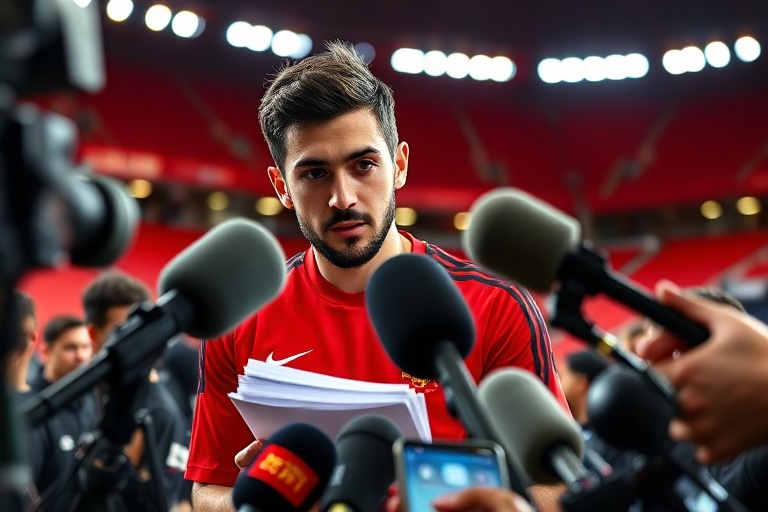
Bruno Fernandes continues to occupy a pivotal position in Manchester United’s midfield, even as the club navigates a complex transfer market. The Portuguese playmaker, who arrived in January 2020 for £47 million, has become the heartbeat of Ole Gunnar Solskjær’s system—and now Erik ten Hag’s—demonstrating elite creativity and leadership. Recent transfer rumors, particularly involving Jude Bellingham and other midfield targets, have sparked discussions about Manchester United’s long-term vision. Yet Fernandes remains untouchable in the eyes of supporters and pundits alike, despite intermittent contract negotiations.
His influence extends beyond statistics. Fernandes dictates tempo, unlocks defenses with pinpoint passing, and delivers moments of magic in high-pressure games. Whether it’s a last-minute winner against Aston Villa or a composed assist in the Champions League, his performance underpins United’s ambitions. As the January transfer window approaches, the question isn’t whether Fernandes is valued—it’s how United can build a sustainable squad around him.
The Transfer Window Context: What’s at Stake for Manchester United
Manchester United enter the January transfer window with a clear mandate: strengthen defensively while addressing midfield depth. The club’s transfer activity has been scrutinized following inconsistent form in the Premier League and European competitions. With injuries plaguing key defenders and midfielders, the urgency to bolster the squad has never been higher.
Yet any significant transfer activity must align with Fernandes’ role. Reports linking the club to Bellingham, a generational talent, underscore United’s ambition to compete at the highest level. However, Fernandes’ presence complicates such pursuits. If United sign a marquee midfielder, Fernandes could shift to a more advanced role—potentially as a false nine or second striker—where his goal threat and creativity would be maximized.
This scenario raises tactical questions. Could Fernandes thrive in a more fluid front three? Would a deeper midfield anchor allow him greater freedom? These are the strategic conversations unfolding behind closed doors at Old Trafford.
Key Factors Influencing Transfer Decisions
- Contract Status: Fernandes’ current deal expires in 2025, and contract talks have stalled. His wage demands and leadership ambitions may dictate United’s willingness to invest in other players.
- Squad Depth: Injuries to Lisandro Martínez, Harry Maguire, and Scott McTormney have exposed defensive vulnerabilities. Any new signings must address these gaps without compromising midfield cohesion.
- Tactical Fit: Ten Hag’s preferred 3-4-2-1 system requires versatile midfielders. Fernandes’ adaptability makes him indispensable, but the club may still pursue a profile like João Neves or Manuel Ugarte for balance.
- Financial Constraints: Despite their commercial revenue, United face scrutiny over FFP regulations. High-profile signings must be balanced with prudent financial management.
Broader Implications: What Fernandes’ Future Means for United’s Identity
Fernandes is more than a player; he’s a symbol of Manchester United’s modern era. His journey from Sporting CP to Old Trafford reflects the club’s shift toward technical, possession-based football. His leadership—both vocal and tactical—has stabilized a dressing room often criticized for its instability.
If Fernandes were to leave, United would face a leadership vacuum. His absence would force a rebuild not just in personnel, but in culture. The club’s identity has increasingly revolved around his ability to elevate performances in critical moments. Replacing such influence is no small task.
Meanwhile, the club’s transfer strategy under Ten Hag is under the microscope. The Dutch manager’s vision demands technical midfielders who can press, pass, and score. Fernandes embodies this philosophy, but United’s midfield cannot rely solely on one player. The January window offers an opportunity to diversify talent while maintaining the core principles that define Ten Hag’s system.
What’s Next? Scenarios and Potential Outcomes
Several scenarios could unfold in the coming months. The most likely involves Fernandes remaining at Old Trafford, with United pursuing a midfield partner who complements rather than competes with his role. Players like João Neves (Benfica) or Manuel Ugarte (PSG) fit this profile—defensively solid yet technically gifted enough to thrive in Ten Hag’s system.
A less probable, but intriguing, possibility is Fernandes’ positional shift. If United sign a midfield general like Bellingham, Fernandes could operate in a more advanced role, similar to his partnership with Cristiano Ronaldo during the 2021-22 season. This would unlock fresh tactical dimensions while keeping his creative firepower at the heart of the attack.
Alternatively, if contract negotiations stall irreparably, Fernandes could force a move in the summer. While unlikely given his loyalty and United’s need for stability, such a scenario would force the club to rethink its entire midfield structure. The domino effect could reshape United’s transfer strategy entirely.
Regardless of the path chosen, one thing is certain: Bruno Fernandes remains the linchpin of Manchester United’s ambitions. His influence transcends transfers, tactics, and even contract disputes. As the January window approaches, the focus isn’t just on who United sign—it’s on how Fernandes’ role evolves within a rapidly changing football landscape.
Conclusion: A Club at a Crossroads
Manchester United stand at a crossroads. The decisions made in the January transfer window will shape the club’s trajectory for years to come. Bruno Fernandes’ presence ensures continuity, but the surrounding squad must evolve to match the demands of competing at the highest level.
Whether United sign a marquee midfielder, a defensive rock, or both, Fernandes’ role will remain central. His ability to adapt—whether as a deep-lying playmaker, a box-to-box force, or even a false nine—makes him the ultimate wildcard in United’s transfer narrative.
For now, the focus is on strengthening the squad without disrupting the chemistry that has made Fernandes so vital. The January transfer window isn’t just about buying players; it’s about buying into a vision. And for Manchester United, that vision must include Bruno Fernandes—at the center of it all.
As the window unfolds, all eyes will be on Old Trafford. The moves made—or not made—will define not just the club’s immediate future, but its identity in the post-Ferguson era.