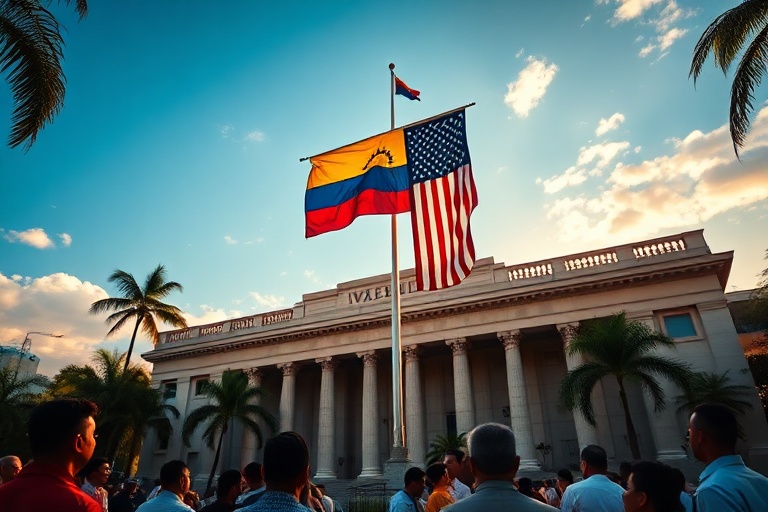
The idea of Venezuela as the 51st U.S. state has simmered in political discourse for decades, resurfacing whenever geopolitical tensions escalate. While the concept remains more rhetorical than realistic, its implications ripple across international relations, economic strategies, and cultural exchanges. To understand its significance, we must examine the historical roots, current geopolitical climate, and the cultural identity that would shape such a transformation.
The Historical Context: From Monroe Doctrine to Modern Ambitions
The Monroe Doctrine of 1823 established a precedent for U.S. influence in the Western Hemisphere, framing Latin America as a sphere of American interest. Venezuela, rich in oil and strategically positioned, has long been a focal point. The 20th century saw multiple attempts to integrate Latin American nations economically, including the failed Free Trade Area of the Americas (FTAA) initiative. However, Venezuela’s socialist turn under Hugo Chávez and later Nicolás Maduro complicated these efforts. The U.S. has alternately engaged in diplomatic pressure, economic sanctions, and covert operations to influence the country’s trajectory.
In 2019, opposition leader Juan Guaidó’s claim to Venezuela’s presidency, backed by the U.S., briefly reignited discussions about regime change. While the move failed to dislodge Maduro’s government, it underscored the U.S.’s strategic interest in the region. The idea of annexation, though legally and practically implausible, serves as a bargaining chip in broader negotiations.
The Economic Stakes: Oil, Debt, and Global Trade
Venezuela holds the world’s largest proven oil reserves, making it a critical player in global energy markets. The U.S., historically dependent on Venezuelan oil, has fluctuated between cooperation and confrontation. Sanctions imposed in 2019 crippled Venezuela’s economy, exacerbating a humanitarian crisis marked by mass emigration. The U.S. could theoretically leverage statehood as a means to stabilize the country—or exploit its resources under a different guise.
Economically, the integration of Venezuela as a state would present both opportunities and challenges. The U.S. would gain access to vast natural resources but would also inherit a collapsed healthcare system, hyperinflation, and a diaspora of over 7 million Venezuelans. The cost of rebuilding infrastructure and absorbing refugees would be staggering, potentially outweighing the benefits of oil reserves alone. Meanwhile, Venezuela’s debt to international creditors, including China and Russia, complicates any straightforward annexation scenario.
Potential Economic Scenarios
- Resource Exploitation: Immediate access to oil fields, but with high rehabilitation costs.
- Humanitarian Crisis: Absorbing millions of refugees strains U.S. social services.
- Debt Restructuring: Negotiations with China and Russia could delay or derail integration.
- Trade Disruptions: Sanctions relief could stabilize exports but provoke retaliation from other nations.
The Cultural Divide: Identity and Resistance
Venezuela’s cultural identity is deeply tied to its Latin American heritage, indigenous roots, and Afro-Venezuelan communities. The idea of becoming a U.S. state clashes with a national narrative of sovereignty and anti-imperialism. The late Hugo Chávez framed U.S. influence as a direct threat to Venezuelan autonomy, a sentiment that persists under Maduro. For many Venezuelans, statehood would mean abandoning a hard-won national identity in exchange for uncertain opportunities.
However, the diaspora—particularly in Florida, Texas, and Spain—often views U.S. statehood as a path to stability. Venezuelan Americans, many of whom fled economic and political turmoil, have become a vocal political bloc advocating for stronger U.S. intervention. Their influence in swing states like Florida could sway policymakers, though it remains a contentious issue within the community itself.
Global Reactions: Allies, Adversaries, and Neutral Players
The prospect of Venezuela as the 51st state sends ripples through the international community. While the U.S. frames it as a humanitarian intervention, critics argue it’s a thinly veiled resource grab. Latin American nations, particularly those in the ALBA alliance, have condemned U.S. interference, while European powers remain cautiously neutral. Russia and China, both major creditors to Venezuela, would likely resist any move that disrupts their economic foothold.
Within the U.S., opinions are divided. Progressive groups argue against further imperial expansion, while conservatives cite the Monroe Doctrine as justification. The military-industrial complex may see strategic value in controlling Venezuela’s coastline and airspace, but the logistical nightmare of governance in a failed state is a deterrent. Meanwhile, neighboring Colombia and Brazil face the brunt of Venezuela’s refugee crisis, complicating regional stability.
International Responses to Venezuelan Statehood
- United States: Mixed reactions—humanitarian concerns vs. strategic resource control.
- Latin America: ALBA nations oppose intervention; others seek dialogue.
- Europe: Cautious neutrality, balancing human rights with geopolitical interests.
- Russia & China: Strong opposition, given their economic and military ties to Venezuela.
- Caribbean Nations: Fear destabilization but lack leverage to influence outcomes.
Conclusion: A Hypothetical Future with Real Consequences
The idea of Venezuela as the 51st U.S. state is less about feasibility and more about power projection. In an era where soft diplomacy and economic warfare often replace traditional military conflict, Venezuela serves as a symbolic chess piece. The U.S. could gain strategic advantages, but at a moral and financial cost that may outweigh the benefits. Meanwhile, the Venezuelan people—those who remain and those scattered across the globe—face an uncertain future defined by external forces rather than self-determination.
For now, the concept remains in the realm of geopolitical speculation, but its implications reveal the complex interplay between sovereignty, resources, and cultural identity. Whether through annexation, economic domination, or proxy governance, Venezuela’s fate will continue to shape the Western Hemisphere’s political landscape for years to come.