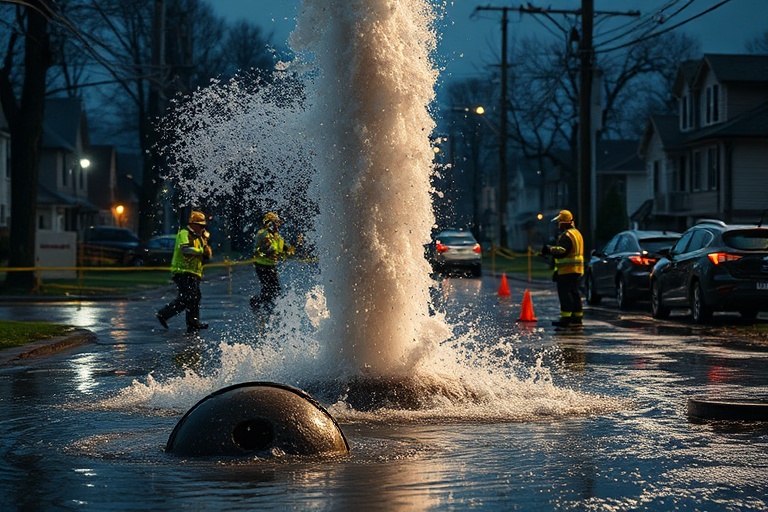
The rupture of a major water main in Oakland County, Michigan, on the morning of October 12 has sent ripples through the community. Residents in several townships reported low or no water pressure as the 24-inch pipe failed, forcing emergency repairs that lasted through the day. The incident underscores broader concerns about water infrastructure across the United States, where aging systems increasingly struggle to meet modern demands.
Local officials confirmed the break occurred near the intersection of Orchard Lake Road and Maple Road in West Bloomfield. The Detroit Water and Sewerage Department (DWSD) responded quickly, dispatching crews to isolate the affected section and restore service. While the outage was temporary, its impact was felt in homes, schools, and businesses across the region.
Immediate Impact: Disruptions to Daily Routines
The water main break disrupted daily life for thousands of residents. Schools in West Bloomfield and neighboring districts canceled classes or shifted to remote learning as a precaution. Businesses, including restaurants and retail stores, temporarily closed or operated with limited services. Hospitals and care facilities maintained operations but relied on backup systems to ensure patient safety.
Residents described the inconvenience in stark terms. “We woke up to no water pressure,” said a homeowner in Farmington Hills. “We couldn’t even flush the toilet or wash our hands properly.” The situation highlighted the fragility of urban infrastructure, where even a single failure can create cascading disruptions.
Emergency alerts sent via text and local news outlets advised residents to conserve water during repairs. While the DWSD assured the public that the water remained safe to drink once pressure was restored, the incident served as a reminder of how dependent modern society is on reliable infrastructure.
Aging Infrastructure: A Global Challenge
The water main break in Oakland County is not an isolated incident. Cities worldwide face similar challenges as their water systems age. In the United States, the American Society of Civil Engineers (ASCE) gave the nation’s infrastructure a “C-” grade in its 2021 report card, with drinking water systems earning a “C.” Many pipes in major cities are over a century old, far exceeding their intended lifespan.
Globally, the issue is even more pressing. In Flint, Michigan, the water crisis of 2014-2019 exposed the dangers of failing infrastructure and inadequate oversight. In cities like London and Mexico City, aging pipes lead to significant water loss—sometimes as much as 30% of supply due to leaks. These challenges are compounded by climate change, which increases the frequency of extreme weather events that strain water systems.
Governments and municipalities are grappling with how to address these issues. Some cities have turned to innovative solutions, such as smart sensors that detect leaks early or pipe relining technologies that extend the life of existing infrastructure. However, funding remains a major hurdle, particularly in regions with limited resources.
Lessons from Abroad: How Other Countries Manage Water Systems
In contrast to the U.S., some countries have managed to modernize their water infrastructure more effectively. Germany, for example, has invested heavily in maintaining its water systems, with many pipes dating back to the 19th century still in use today. The country’s approach combines strict regulations with public-private partnerships to ensure long-term sustainability.
In Singapore, a city-state with limited natural water resources, the government has implemented cutting-edge technologies like seawater desalination and water recycling. These innovations have made Singapore a global leader in water management, despite its challenges.
The contrast between these approaches and the situation in Oakland County highlights the need for proactive investment in infrastructure. Without it, communities will continue to face disruptions, economic losses, and potential health risks.
Community Response and Long-Term Solutions
The water main break sparked a wave of community action. Local volunteers distributed bottled water to affected residents, while nonprofit organizations offered support to families in need. Social media platforms became hubs for sharing updates and organizing assistance, demonstrating the power of digital networks in times of crisis.
Long-term solutions will require collaboration between government agencies, private companies, and residents. Oakland County has already begun assessing its water infrastructure to identify vulnerabilities. Officials are considering upgrades such as pipe replacements, pressure monitoring systems, and emergency response plans to prevent future incidents.
Residents are also taking matters into their own hands. Some have installed water storage tanks or backup filtration systems to prepare for future disruptions. Others are advocating for increased transparency and accountability from local authorities.
What’s Next for Oakland County?
As repairs continue, the focus shifts to preventing future water main breaks. The DWSD has outlined a multi-year plan to replace aging pipes and improve maintenance protocols. However, the cost of such projects is substantial, and funding will likely require a combination of local, state, and federal resources.
For now, residents are left to reflect on the fragility of the systems that sustain their daily lives. The water main break in Oakland County serves as a wake-up call—not just for the region, but for communities across the country grappling with similar challenges.
As one local resident put it, “We take water for granted until it’s gone. This break reminded us that we can’t afford to ignore our infrastructure any longer.”
The Broader Implications for Water Security
The incident in Oakland County is a microcosm of a larger global issue: water security. According to the United Nations, by 2025, two-thirds of the world’s population could face water shortages. Aging infrastructure, climate change, and population growth are exacerbating the problem, making events like water main breaks even more consequential.
In developing nations, the challenges are even more acute. In parts of sub-Saharan Africa, outdated piping and inadequate treatment facilities lead to waterborne diseases that claim thousands of lives each year. The contrast between wealthy nations like the U.S. and lower-income countries highlights the urgent need for global cooperation and investment in water infrastructure.
For Oakland County, the path forward is clear: prioritize infrastructure upgrades, engage the community in planning, and learn from both domestic and international best practices. The cost of inaction is simply too high.
As the region recovers from the water main break, the conversation about infrastructure resilience is just beginning. Whether through policy changes, technological innovation, or community action, the goal remains the same: ensuring that clean, reliable water is available to all.