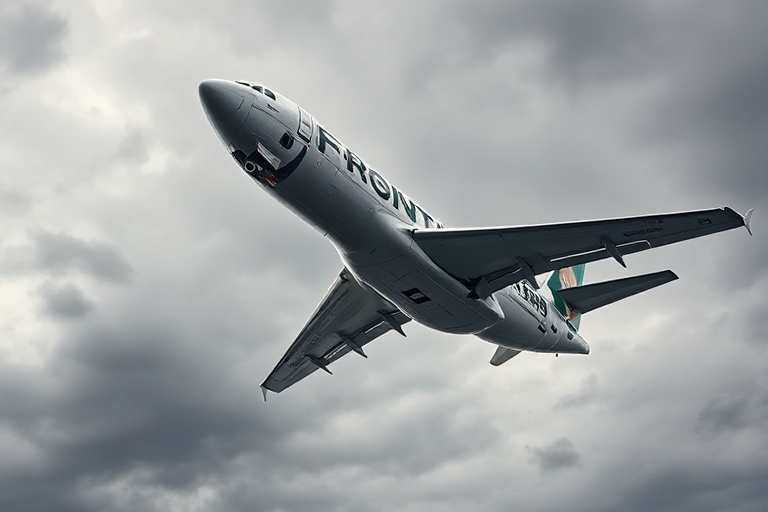
In a rare and unsettling incident, a Frontier Airlines ground crew member was struck by a departing aircraft at Denver International Airport on the evening of June 12. The worker, employed by a third-party contractor, was conducting routine pre-flight checks when the Boeing 737-800 began its takeoff roll. The impact occurred near the rear landing gear, throwing the individual several feet before emergency services arrived.
Airport authorities confirmed the incident in a statement released the following morning, noting that the worker sustained non-life-threatening injuries. The Federal Aviation Administration (FAA) and National Transportation Safety Board (NTSB) launched separate investigations within hours, focusing on operational procedures, communication protocols, and the physical layout of the ramp area. Frontier Airlines issued a brief apology to the affected employee and pledged full cooperation with authorities.
Timeline of Events: What Went Wrong?
The sequence of events leading to the strike remains under scrutiny. According to preliminary reports from airport officials, the ground crew member was positioned near the aircraft’s left wing during the pre-departure inspection. Surveillance footage reviewed by investigators shows the aircraft initiating its takeoff roll at approximately 8:47 PM local time, despite the worker still being in the danger zone.
Key factors being examined include:
- Visual and auditory cues: Ground crew rely on hand signals, headset communications, and aircraft engine noise to determine when it is safe to approach. The NTSB is analyzing whether these signals were missed or misinterpreted.
- Ramp layout modifications: Denver International Airport has undergone several infrastructure updates in recent years. Investigators are assessing whether recent changes to taxiway markings or lighting contributed to the confusion.
- Third-party oversight: The ground crew worker was employed by a subcontractor, not directly by Frontier. This raises questions about training standards and accountability across multiple layers of service providers.
An anonymous source within the airline industry, speaking on condition of anonymity, suggested that high turnover rates among contract ground staff may have played a role. “When training isn’t consistent, communication breaks down,” the source said. “Even small missteps can escalate quickly on the tarmac.”
Safety Culture Under the Microscope
This incident comes at a time when airline safety culture is facing increased public scrutiny. A 2023 report from the FAA highlighted a 15% rise in ground-related incidents across U.S. airports over the past two years, including several near-misses involving passengers and crew. While major accidents remain rare, the frequency of these events is prompting calls for systemic improvements.
Frontier Airlines, known for its ultra-low-cost model, has previously faced criticism for aggressive scheduling and cost-cutting measures that some argue compromise safety margins. In 2022, the airline was cited by the FAA for two maintenance-related violations, though no injuries were reported. The latest incident, however, has intensified concerns about whether efficiency goals are overshadowing safety protocols.
Industry analysts point out that Frontier’s operational model relies heavily on third-party vendors for ground handling—an approach that can dilute direct oversight. “When airlines outsource critical functions, they must maintain rigorous oversight,” said aviation safety consultant Linda Carter. “Otherwise, safety becomes a shared responsibility without clear accountability.”
The airline has emphasized its commitment to safety in public statements, pointing to a 98.7% on-time performance rate over the past year. Still, the recent ground strike has led some travel experts to question whether such metrics adequately reflect underlying risks.
Impact on Passengers and Industry Reputation
For passengers, incidents like this can erode confidence in air travel, even if the majority of flights operate without incident. Denver International Airport, one of the busiest hubs in the U.S., saw a 4% drop in flight operations the day after the strike, according to preliminary data from flight tracking service FlightAware. While this decline may be temporary, it reflects broader concerns about operational reliability.
Frontier Airlines issued a customer advisory the following day, assuring travelers that all flights were operating as scheduled. However, the company did not disclose whether any passengers chose to rebook due to safety concerns. Social media reactions were mixed, with some users expressing sympathy for the injured worker, while others criticized the airline’s operational practices.
“I fly Frontier often because it’s cheap,” said one Twitter user. “But I don’t want to be on a plane where the ground crew barely has time to blink before we’re taking off.” Another commenter wrote, “This isn’t about cost—it’s about care. If they can’t keep their employees safe, how can they keep passengers safe?”
The incident has also drawn the attention of U.S. Representative Peter DeFazio, a long-time advocate for airline safety reforms. In a statement to the press, DeFazio called for stronger federal oversight of third-party contractors and mandatory safety culture audits at all U.S. carriers. “We cannot treat safety as an afterthought,” he said. “Especially when lives are on the line.”
What Happens Next?
The NTSB is expected to release a preliminary report within 30 days, with a final investigation likely taking several months. In the meantime, Frontier Airlines has temporarily suspended ground operations at Denver International Airport for additional safety training. The airline has also announced an internal review of its third-party contracts, with a focus on enhancing communication protocols and safety supervision.
For the injured worker, the recovery process will be closely monitored by both medical professionals and labor advocates. Worker safety advocates have called for stronger whistleblower protections and anonymous reporting systems to prevent retaliation against employees who report unsafe conditions.
As the aviation industry continues to rebound from pandemic-era disruptions, this incident serves as a stark reminder of the human and operational costs of prioritizing speed over safety. Airlines, regulators, and contractors must work together to ensure that every flight begins and ends with the same level of care—and that no one is left in harm’s way.
For more on airline safety trends, visit our Travel section. To understand how operational decisions impact passenger experience, read our analysis in News.
This story will be updated as new information becomes available.