hawaiian monk seals
Hawaiian Monk Seals: Hawaii’s Endangered Icons of the Sea
The Hawaiian monk seal (Neomonachus schauinslandi) is one of the most endangered marine mammals in the United States, found exclusively in the warm waters of the Hawaiian Islands. With fewer than 1,500 individuals remaining, this species represents a living relic of Hawaii’s natural heritage, its survival intertwined with the health of the Pacific Ocean and the cultural values of the islands. Unlike their more widely known cousins, the monk seals of the Mediterranean and Caribbean, Hawaii’s seals are a distinct species, adapted to thrive in the volcanic archipelago’s unique ecosystems.
These seals spend most of their lives in the ocean, hunting for fish and crustaceans near coral reefs and deep-sea slopes. Yet, they rely on the sandy shores of the main Hawaiian Islands and the remote Northwestern Hawaiian Islands for critical activities such as resting, molting, and giving birth. Their presence is not only ecologically vital but also culturally significant, woven into the traditions and identity of Native Hawaiians for centuries. Today, they face existential threats from human activity, climate change, and ecological imbalance—making their conservation a matter of global urgency.
The Life and Behavior of the Hawaiian Monk Seal
The Hawaiian monk seal is a solitary creature, spending up to 50% of its time underwater in search of food. Adults can grow up to 7 feet long and weigh between 375 and 500 pounds, with females generally larger than males. Their life cycle reflects the challenges of their environment. Pups are born on beaches between March and June, weighing around 30–40 pounds. They nurse for about six weeks before being weaned and left to fend for themselves. This period is especially vulnerable, as pups must learn to swim and hunt quickly to survive.
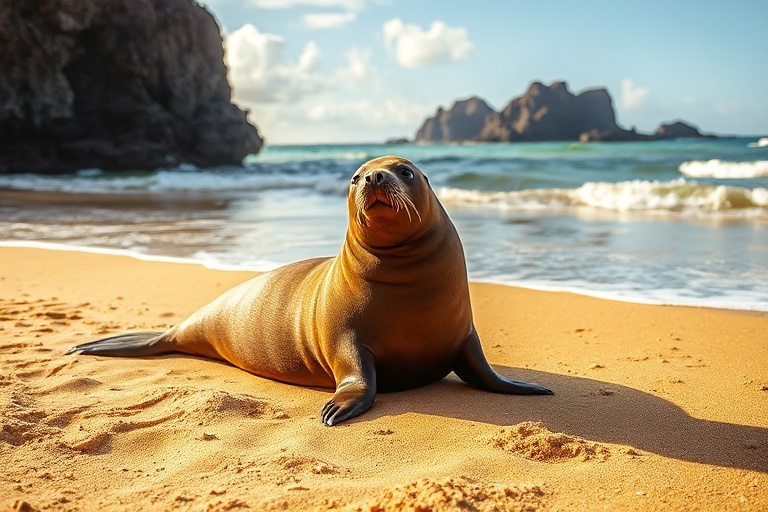
Adults are known for their distinctive appearance: silvery-gray coats that fade to brown with age, and large, dark eyes that peer from beneath a mask of wrinkles. Unlike many seal species, monk seals are not social; they avoid one another except during mating season. Their diet primarily consists of fish, eels, and octopus, which they catch by diving to depths of up to 1,500 feet. Such deep dives require efficient oxygen use and strong physiological adaptations, a testament to their resilience in a changing ocean.
Cultural and Historical Significance
The Hawaiian monk seal holds deep cultural meaning for Native Hawaiians, who refer to it as ʻIlio-holo-i-ka-uaua—“dog that runs in rough water.” In traditional storytelling, seals were seen as guardians of the sea, protectors of fishermen, and symbols of abundance. Their presence on shore was often met with respect, as they were believed to carry the spirits of ancestors or serve as intermediaries between humans and the ocean.
European contact in the late 18th century disrupted this balance. Overhunting by sailors, commercial fisheries, and introduced predators like dogs and rats devastated seal populations. By the 20th century, the species was on the brink of extinction. It wasn’t until 1976—when the Hawaiian monk seal was listed under the U.S. Endangered Species Act—that coordinated conservation efforts began. Today, the seal remains a cultural touchstone, featured in hula, mele (songs), and modern environmental campaigns that blend tradition with science.
Threats to Survival: A Global Crisis in a Local Context
The Hawaiian monk seal faces multiple existential threats, most of them human-driven. Entanglement in fishing gear, particularly in nearshore gillnets, remains a leading cause of injury and death. While efforts have been made to reduce bycatch through gear modifications and seasonal closures, illegal or unmonitored fishing continues to pose risks.
Climate change compounds these challenges. Rising sea levels threaten low-lying nesting beaches, while warming ocean temperatures alter the distribution of fish—a critical food source. Coral bleaching events, driven by warmer waters, degrade the reef ecosystems that support the seals’ prey. Additionally, increased storm intensity from hurricanes can wash away pupping sites overnight.
Human disturbance is another growing concern. As tourism and coastal development expand, seals are increasingly displaced from their preferred resting spots. Well-meaning visitors often approach too closely, disrupting nursing mothers or molting seals, which can lead to fatal stress responses. In response, Hawaiian conservation groups have launched public awareness campaigns, urging beachgoers to keep a safe distance and report injured or entangled seals to authorities.
The following challenges are among the most pressing:
- Predation by sharks and introduced species – Especially dangerous for pups and juveniles.
- Disease and genetic isolation – Low population numbers increase vulnerability to outbreaks.
- Competition with fisheries – Declining fish stocks force seals to venture closer to human activity.
- Marine debris – Plastic ingestion and entanglement in nets or fishing line.
Despite these obstacles, conservation success stories do exist. In 2023, a record number of pups were born in the main Hawaiian Islands, a sign that local protection measures—such as fencing off beaches and increasing monitoring—are having an impact. The National Oceanic and Atmospheric Administration (NOAA) and partners like Conservation organizations continue to translocate at-risk pups to safer habitats and rescue entangled individuals.
A Global Call to Action
While the Hawaiian monk seal is endemic to Hawaii, its survival resonates far beyond the islands. It is a flagship species, representing the health of the entire North Pacific ecosystem. Protecting monk seals means protecting coral reefs, fish populations, and the cultural traditions that depend on a balanced ocean.
International cooperation is essential. The Hawaiian monk seal is protected under the U.S. Endangered Species Act and the Marine Mammal Protection Act, but its habitat spans waters influenced by global climate patterns. Efforts to reduce carbon emissions, regulate international fishing, and manage plastic pollution in the Pacific are all part of the solution.
Local communities play a pivotal role. Native Hawaiian groups, such as the Kanaka Maoli, are leading restoration projects that combine traditional knowledge with modern science. Initiatives like beach cleanups, invasive species removal, and cultural education programs help restore balance to the ecosystem while honoring ancestral connections to the land and sea.
The Future: Can We Save the Hawaiian Monk Seal?
The story of the Hawaiian monk seal is one of fragility and hope. It is a reminder that even in the most remote corners of the world, human actions have consequences—and that conservation is not just about numbers, but about values, identity, and legacy.
With fewer than 1,500 individuals left, every seal matters. Every pup born is a victory. Every community that chooses to protect its beaches is a step forward. The road to recovery will be long, but it is not impossible. By listening to science, respecting culture, and acting with urgency, we can ensure that the ʻIlio-holo-i-ka-uaua continues to glide through Hawaii’s waters for generations to come.
For now, the monk seal remains a symbol—of resilience, of connection, and of the delicate balance between humanity and the natural world. Its fate is not yet sealed. But time is running out.