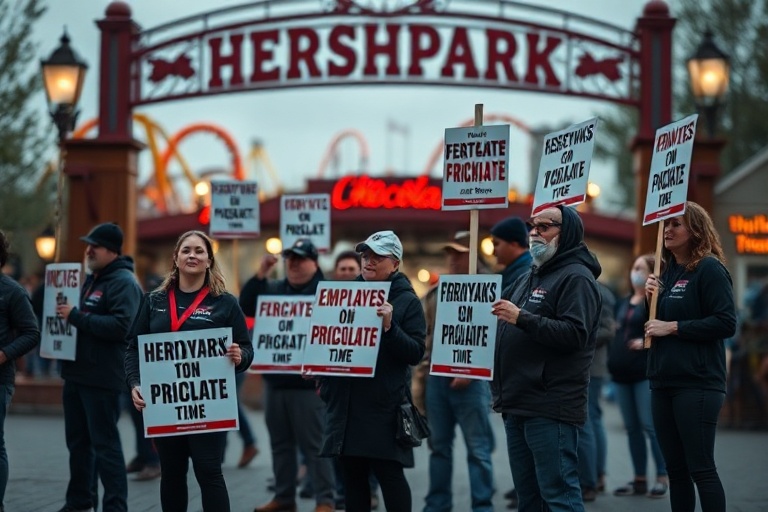
The skies over Hershey, Pennsylvania, darkened not just with gathering clouds but with the weight of decades-long labor disputes last month when employees at Hersheypark voted overwhelmingly to authorize a strike. The 2,500-member workforce, represented by the United Food and Commercial Workers (UFCW) Local 400, delivered a clear message: fair wages, better benefits, and respect on the job are no longer optional. This isn’t the first confrontation between labor and the iconic chocolate company, but it may be the most consequential yet.
The roots of this labor dispute stretch back to the park’s origins in 1907, when Milton Hershey founded not just a theme park, but a legacy. Over the years, Hershey Entertainment & Resorts Company (HE&R), which operates Hersheypark, has grown into a $1.2 billion enterprise, yet many frontline workers say their compensation hasn’t kept pace with the company’s success. Entry-level positions, such as ride operators and food service staff, often start at just $12.50 per hour—barely above the Pennsylvania minimum wage.
What Workers Are Demanding
Negotiations between HE&R and UFCW Local 400 have stalled repeatedly over the past six months. Workers are not asking for radical changes; they’re seeking what many consider basic fairness. The union’s demands include:
- A starting wage of at least $18 per hour, with annual increases tied to inflation
- Affordable, employer-sponsored health insurance with lower deductibles
- Pension restoration for new hires (eliminated in 2012) and improved retirement contributions
- Guaranteed staffing levels to reduce chronic understaffing during peak seasons
- Clear pathways for career advancement without requiring employees to leave the company
“We love Hersheypark. We grew up here. We bring our families here. But you can’t raise a family on $12.50 an hour,” said Maria Rodriguez, a 12-year ride attendant and UFCW shop steward. “We’re not asking for a handout. We’re asking for a handshake—one that acknowledges our work keeps this place running.”
The Company’s Response and Broader Context
Hershey Entertainment & Resorts Company has called the strike authorization “a disappointment,” emphasizing its history of providing “competitive compensation and benefits.” In a statement released last week, HE&R highlighted recent wage increases and bonuses, including a 5% raise in 2023 and a one-time $1,500 bonus for eligible employees. However, union representatives counter that these measures fall short of addressing systemic issues.
HE&R’s parent company, The Hershey Company, reported $11.16 billion in net sales in 2023, up from $10.54 billion in 2022. Profits rose to $1.8 billion, a 12% increase year-over-year. Despite this financial growth, labor advocates point out that executive compensation has also surged. The CEO of The Hershey Company, Michele Buck, received total compensation of $15.4 million in 2023—up from $13.9 million in 2022.
This disparity isn’t unique to Hershey. Across the theme park and hospitality industries, workers have increasingly turned to organized labor to challenge corporate practices that prioritize investor returns over employee welfare. From Disneyland to Six Flags, strikes and organizing efforts have become more frequent as inflation erodes purchasing power and housing costs rise.
What’s at Stake for the Community
Hershey isn’t just a company town—it’s a company culture. The town’s identity is intertwined with the chocolate empire founded by Milton Hershey over a century ago. A prolonged strike could ripple through the local economy, affecting not only park employees but also small businesses that depend on tourist traffic. Hotels, restaurants, and retail shops in Hershey and nearby Harrisburg could see a 15–25% drop in revenue during peak summer months, according to estimates from the Hershey-Derry Township Chamber of Commerce.
“This isn’t just about the park. It’s about the soul of our community,” said Hershey resident James Lee, a former seasonal worker. “If they can’t treat their own employees fairly, what does that say about the values they preach?”
Local leaders are urging both sides to return to the negotiating table. Hershey Mayor Bill Duke has called for “reasonable compromise,” while Pennsylvania Governor Josh Shapiro has offered state mediation services. However, both sides remain far apart on key issues. The union has signaled willingness to extend negotiations if meaningful progress is made, but patience is wearing thin.
Looking Ahead: Possible Outcomes
If a strike materializes, it would be the largest labor action at a U.S. theme park since the 2019 dispute at Disneyland Resort in California. That walkout lasted five days and resulted in a 10% wage increase for hourly workers. A similar outcome in Hershey could set a new standard for the industry, particularly as more seasonal and part-time workers join unions.
Analysts suggest several potential scenarios:
- Short-term strike with quick resolution: If public pressure mounts or state mediation proves effective, a temporary halt to operations could lead to rapid concessions, especially if attendance drops sharply.
- Prolonged conflict with limited impact: A strike during off-peak months (fall or early spring) might have minimal financial impact on HE&R, allowing the company to hold firm on demands.
- Escalation to secondary boycott: Local unions in hospitality and retail could coordinate support, refusing to cross picket lines at affiliated businesses, increasing pressure on HE&R.
- Legal intervention or injunction: HE&R could seek court orders to limit picketing or enforce minimum staffing levels, potentially escalating tensions.
Regardless of the outcome, this labor dispute has already shifted the conversation in Hershey. Younger workers, many of whom have never experienced a strong union presence in the area, are stepping into leadership roles. Social media campaigns under the hashtag #HersheyFairPay have amassed thousands of supporters beyond the park’s gates, drawing attention from labor activists nationwide.
“We’re not just fighting for ourselves,” said Rodriguez. “We’re fighting for the next generation of workers who deserve better than working two jobs just to afford rent.”
Conclusion: A Turning Point for Labor in the Theme Park Industry
The Hersheypark strike authorization is more than a labor dispute—it’s a test of whether corporate legacy can coexist with modern worker expectations. As the chocolate giant celebrates its 120th anniversary this year, its employees are demanding that its values evolve with the times. Fair wages and respect aren’t just ideals; they’re the foundation of any sustainable community.
For now, both sides remain at an impasse. But one thing is clear: the workers at Hersheypark have made their voices heard. Whether that voice leads to change remains to be seen, but the conversation has undeniably shifted. And in a town built on chocolate, perhaps the sweetest victory isn’t in the candy, but in the justice.
As negotiations continue, employees are preparing for the possibility of standing on the picket line this summer. Their message is simple: Hersheypark isn’t just a place to visit—it’s a place to work. And it’s time it started treating its workers that way.
For more on labor trends in the entertainment industry, visit our Entertainment section. To learn about the history of Hershey’s corporate culture, explore our Culture archives.