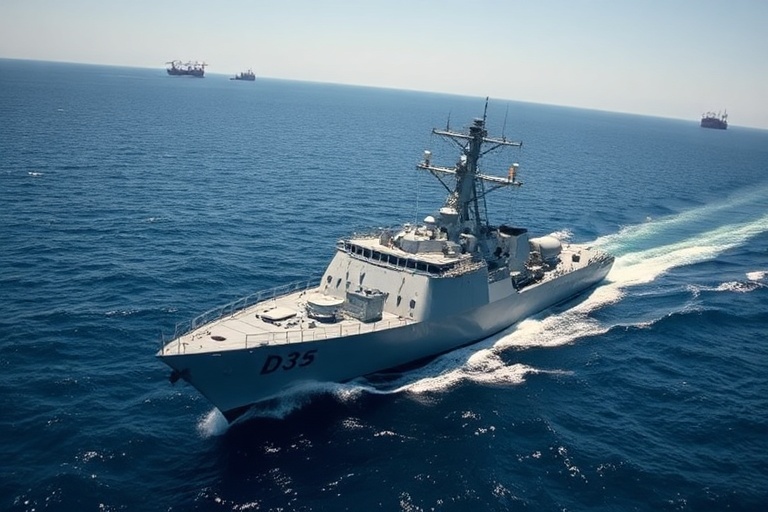
The Strait of Hormuz, a narrow waterway between Oman and Iran, has long been one of the world’s most strategically vital maritime chokepoints. Through this 21-mile-wide passage flows nearly a third of the world’s seaborne oil, making it a flashpoint for geopolitical tension. The Royal Navy’s HMS Dragon, a Type 45 guided missile destroyer, has been a visible presence in these turbulent waters, serving as both a deterrent and a symbol of British maritime commitment. Since its deployment in 2021, HMS Dragon has undertaken multiple patrols in the region, navigating complex diplomatic waters while maintaining operational readiness.
The Strategic Significance of the Strait of Hormuz
The Strait of Hormuz connects the Persian Gulf to the Gulf of Oman and, ultimately, the Arabian Sea. Its narrowest point is just 21 miles wide, with a shipping lane only two miles wide in each direction—separated by a two-mile buffer zone. This geographic constraint makes the strait highly vulnerable to disruption. Disputes involving Iran, regional conflicts, and the presence of international naval forces have turned it into a high-stakes environment where miscalculation could lead to catastrophic consequences.
Oil tankers transiting the strait account for approximately 20–30% of global oil exports. Any prolonged closure—whether due to conflict, sabotage, or political maneuvering—would send shockwaves through global energy markets, triggering price spikes and economic instability. The region has already witnessed several high-profile incidents, including the 2019 attacks on tankers near Fujairah and the 2021 seizure of a South Korean vessel by Iran. In such a context, the presence of a modern warship like HMS Dragon is not merely symbolic; it is a tangible assertion of deterrence and freedom of navigation.
Geopolitical Tensions and Naval Posturing
HMS Dragon’s operations in the Strait of Hormuz occur against a backdrop of escalating regional tensions. Iran, asserting its influence through proxy groups and direct naval actions, has repeatedly threatened to close the strait in response to sanctions and perceived aggression from Western powers. Meanwhile, the United Kingdom, alongside allies such as the United States and France, maintains a policy of ensuring safe passage through the region as part of broader maritime security initiatives.
In 2021, HMS Dragon was deployed as part of Operation Kipion, the UK’s long-standing mission to protect shipping lanes in the Gulf. During its deployment, the destroyer conducted surveillance, escorted commercial vessels, and participated in joint exercises with allied navies. These operations were designed not only to protect British-flagged ships but also to reinforce international norms of free navigation—a principle enshrined in the United Nations Convention on the Law of the Sea.
HMS Dragon: Capabilities and Mission Profile
Commissioned in 2012, HMS Dragon is the fourth of the Royal Navy’s Type 45 destroyers, a class of advanced air-defense vessels. Built by BAE Systems and powered by an integrated electric propulsion system, these ships are designed for high endurance and rapid response. With a displacement of 8,500 tons and a length of 152 meters, HMS Dragon is equipped with sophisticated radar systems, including the SAMPSON multi-function radar, capable of tracking hundreds of targets simultaneously.
The ship’s armament includes the PAAMS (Sea Viper) missile system, which integrates the Aster 15 and Aster 30 surface-to-air missiles. This system provides a layered defense against aircraft, drones, and ballistic missiles. Additionally, HMS Dragon carries a 4.5-inch Mark 8 naval gun, Phalanx close-in weapon systems, and a suite of electronic countermeasures. Its complement of around 191 personnel reflects the Royal Navy’s emphasis on professionalism and operational adaptability.
Operational Realities at Sea
Deploying a warship in the Strait of Hormuz is not without challenges. The region’s extreme heat, high humidity, and the constant threat of asymmetric attacks—such as fast-attack craft, mines, or drone swarms—require crews to maintain high levels of situational awareness. HMS Dragon’s crew undergoes rigorous training in damage control, missile defense, and anti-piracy tactics to ensure readiness for any contingency.
In 2022, HMS Dragon was involved in a notable incident when it responded to a distress call from a merchant vessel under attack by suspected pirates. Working alongside allied forces, the destroyer intercepted the skiff, rescued the crew, and demonstrated the practical application of maritime security operations in real-world conditions. Such events highlight the dual role of modern destroyers: both as symbols of national power and as instruments of crisis response.
International Collaboration and Maritime Security
The Royal Navy does not operate in isolation in the Strait of Hormuz. It is part of a broader coalition of naval forces committed to maintaining stability in the region. The Combined Maritime Forces (CMF), a 34-nation naval partnership headquartered in Bahrain, coordinates patrols and maritime security operations across the Arabian Gulf, Gulf of Oman, and Red Sea. HMS Dragon has participated in CMF-led exercises, including Operation Sentinel, which focuses on countering smuggling, piracy, and unauthorized maritime activity.
Allied cooperation extends beyond mere presence. In 2023, HMS Dragon conducted joint patrols with the USS McCampbell, a U.S. Arleigh Burke-class destroyer. These operations included simulated engagements, electronic warfare drills, and coordinated responses to simulated threats. Such interoperability is critical in a region where rapid communication and shared situational awareness can prevent escalation.
The Role of Diplomacy and Soft Power
While HMS Dragon’s primary mission is military, its presence also serves a diplomatic function. The deployment of a British warship signals support for regional allies, particularly those in the Gulf Cooperation Council (GCC). It reinforces the UK’s commitment to a rules-based international order and its role as a global maritime power.
However, diplomacy in the Strait of Hormuz is a delicate balance. The UK must avoid being drawn into regional conflicts while maintaining a credible deterrent. This requires careful coordination with allies, transparent communication with Iran, and adherence to international law. HMS Dragon’s operations are thus not just about projecting power; they are about preserving stability in one of the world’s most critical waterways.
Conclusion: A Delicate Balance in Turbulent Waters
HMS Dragon’s patrols in the Strait of Hormuz underscore the enduring importance of naval power in an era of shifting geopolitical alliances. In a region where energy security, regional rivalries, and maritime law intersect, the presence of a modern destroyer is both a deterrent and a stabilizing force. Yet, the challenges are immense. From asymmetric threats to diplomatic sensitivities, the crew of HMS Dragon must navigate a complex landscape where every decision carries strategic weight.
As global energy demands continue to rise and regional tensions persist, the role of ships like HMS Dragon will only grow in significance. They are not merely platforms of war; they are guardians of global trade and symbols of international resolve. In the Strait of Hormuz, where the waters are as deep as the stakes are high, HMS Dragon stands as a sentinel—ready, capable, and indispensable.
For those interested in understanding the broader context of maritime security operations, explore our News section for real-time updates on global naval deployments and geopolitical developments. For deeper analysis on defense technology and military strategy, visit our Analysis page.