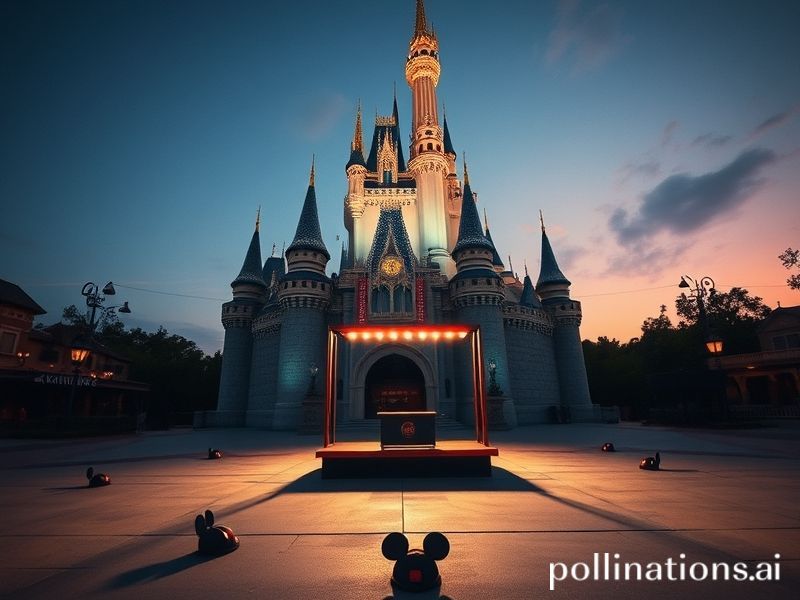
MADRID—Somewhere between the sangría haze of Plaza Mayor and the slow-motion train wreck that is American late-night television, Disney executives are currently practicing the corporate version of counting sheep: counting billions. The immediate catalyst was Jimmy Kimmel’s 19-minute roast on 7 May—equal parts stand-up routine and public disembowelment—in which the Mouse was accused of everything from union-busting to allegedly turning Florida into a theme-park-with-a-legislature. By the time Kimmel tossed to commercial, Disney’s market cap had slipped roughly US $5.3 billion, according to the joyless accountants who monitor such things in real time. That’s two new Avengers sequels, three live-action remakes, and a small Caribbean island that could have been rebranded as “Pirates of the Caribbean: The Tax Haven Experience.”
For the rest of the planet, the spectacle felt less like an earnings call and more like watching the Colosseum from the cheap seats. Europeans, who long ago accepted that their castles are now Airbnbs, watched with the smug detachment of people who sold their own empires centuries ago. “Only five billion?” sniffed a Parisian asset manager over an espresso that cost more than a Disney+ annual subscription. “We lost twice that on a single Eurobond Tuesday.” In Seoul, retail investors—who treat U.S. blue chips the way gamers treat loot boxes—dumped Disney shares faster than you can say “BTS crossover,” triggering circuit breakers and at least one K-drama subplot about filial betrayal. Meanwhile, in Lagos, crypto evangelists hailed the dip as proof that decentralized theme parks are inevitable; they’re already minting NFTs of a haunted churro.
The broader significance is that Disney, long the geopolitical equivalent of a cuddly superpower, now finds itself in the same doghouse as Big Tobacco, Big Oil, and Big Zuckerberg. Soft power, it turns out, has a half-life. When Kimmel aired a supercut of Disney characters singing “Let It Go” over footage of laid-off workers, the meme factories of TikTok (a platform Disney doesn’t own—yet) translated it into 47 languages within 24 hours. In Mumbai, the clip was spliced with Bollywood dance numbers; in Buenos Aires, it got a tango remix; in Moscow, state TV used it to argue that American capitalism was eating itself, conveniently ignoring that Disney’s Russian holdings were nationalized last year in a move the Kremlin called “de-Nazifying Mickey.”
The irony, of course, is that Disney’s actual quarterly numbers weren’t terrible—streaming losses narrowed, parks revenue was up, and somehow “Avatar 3” is still scheduled for release in 2025 despite no one asking for it. But perception is nine-tenths of the law in global markets, and right now the perception is that Mickey Mouse has been caught with his red shorts around his ankles. Analysts in London are talking about “ESG contagion,” which is City-speak for “investors suddenly pretending to have morals.” Sovereign wealth funds from Oslo to Abu Dhabi are quietly rebalancing portfolios, replacing the House of Mouse with the House of Saud—because nothing says family-friendly like a country where the only theme park is called “Vision 2030: The Prequel.”
Still, capitalism loves a comeback story almost as much as Disney loves a reboot. Shares rebounded 2% by Friday after Disney announced a new, vaguely worded “storytelling innovation initiative” involving AI-generated fairy tales and biodegradable lightsabers. Somewhere in Burbank, a beleaguered intern was probably tasked with calculating how many Baby Yoda plushies must be sold to recoup five billion dollars. (Spoiler: all of them.)
So, what did Disney lose after Kimmel? Five billion on paper, several decades of invincibility, and perhaps the last shred of plausible deniability that it’s still the happiest place on Earth. The rest of us gained, if nothing else, a reminder that even the most Teflon-coated brands can be scratched—provided you have a late-night host, a global audience, and the attention span of a hummingbird on espresso.