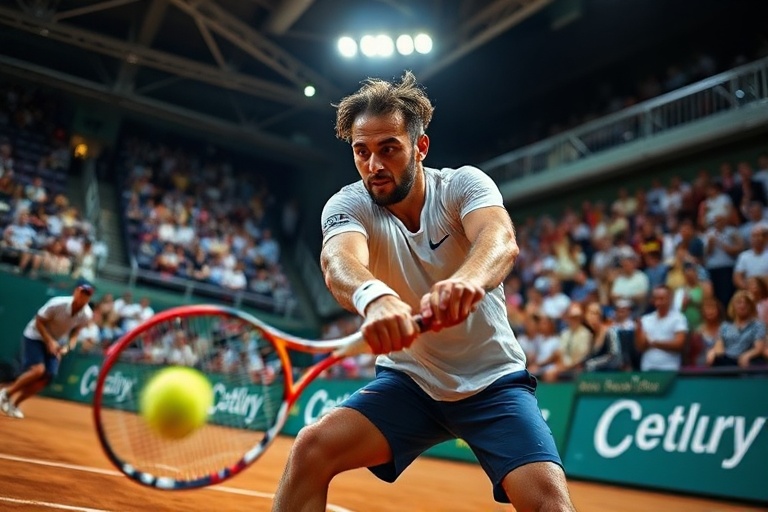
Nikoloz Basilashvili: Georgia’s Tennis Trailblazer and Global Impact
In the world of professional tennis, few stories capture the essence of perseverance and quiet determination quite like that of Nikoloz Basilashvili. Born in Tbilisi, Georgia, in 1992, Basilashvili has carved out a reputation as one of the most resilient competitors on the ATP Tour. His journey from the hard courts of his home country to the global stage reflects not just athletic prowess but a cultural shift in how tennis is perceived beyond traditional powerhouses.
Basilashvili’s rise has been marked by consistency rather than sensationalism. While tennis often celebrates explosive personalities and dramatic comebacks, his career has unfolded methodically, with each victory serving as a testament to his technical skill and mental fortitude. This approach has earned him respect among peers and fans alike, particularly in regions where tennis infrastructure remains underdeveloped.
From Tbilisi to the Tour: A Career Defined by Resilience
Basilashvili turned professional in 2011, but his path to prominence was anything but straightforward. Early in his career, he struggled with injuries and limited opportunities to compete at higher levels. Unlike players from countries with established tennis academies, Basilashvili honed his craft in Tbilisi, where resources were scarce. His breakthrough came in 2015 when he won his first ATP Challenger title, signaling his potential to compete with the sport’s elite.
By 2018, Basilashvili had broken into the top 50, a milestone that placed him among Georgia’s most successful athletes in any sport. His game, built on a powerful baseline style and a formidable forehand, stood out in an era dominated by serve-and-volley specialists and all-court players. That same year, he claimed his first ATP title in Hamburg, defeating an in-form Leonardo Mayer in straight sets. The victory wasn’t just a personal triumph; it was a cultural moment for Georgian sports.
For a country where football and wrestling traditionally dominate headlines, Basilashvili’s success introduced tennis as a viable career path for aspiring athletes. His achievements provided tangible proof that dedication and access to resources—even in less traditional tennis markets—could yield world-class results.
The Georgian Influence: Tennis Beyond the Traditional Powerhouses
Basilashvili’s career mirrors the broader evolution of global tennis, where players from non-traditional markets are increasingly challenging the dominance of established tennis nations. Countries like Georgia, with populations under 4 million, have historically been overlooked in favor of tennis powerhouses like Spain, Serbia, or the United States. Yet Basilashvili’s success has helped shift perceptions, proving that talent can emerge from anywhere with the right combination of opportunity and determination.
His presence on the tour has also inspired a new generation of Georgian players. Tennis academies in Tbilisi and Batumi have seen increased enrollment, as young athletes seek to emulate his achievements. Organizations like the Georgia Tennis Federation have capitalized on his visibility to secure sponsorships and develop grassroots programs, ensuring that his legacy extends beyond his own career.
This cultural shift is not unique to Georgia. Players from Kazakhstan, Ukraine, and other emerging tennis nations have followed similar trajectories, using their success to advocate for infrastructure development and youth engagement. Basilashvili’s role in this movement is particularly significant because he represents a region where tennis infrastructure is still in its infancy. His ability to thrive despite these challenges underscores the sport’s universal appeal.
A Playing Style That Defies Convention
Basilashvili’s game is a study in contrasts. Standing at 6’2″, he combines raw power with tactical precision, a combination that has troubled even the most seasoned opponents. His forehand, often likened to a sledgehammer, is one of the most potent weapons on the tour, capable of dictating rallies from the baseline. Yet, what sets him apart is his ability to adapt. Unlike many power baseliners who rely solely on aggression, Basilashvili incorporates slices, drop shots, and net approaches to keep opponents off balance.
This versatility has been crucial in his biggest matches. In 2021, he reached the quarterfinals of the French Open, a tournament traditionally unforgiving to aggressive baseliners. His run included a five-set victory over world No. 3 Alexander Zverev, a match that showcased his mental resilience as much as his technical skill. While the victory didn’t propel him into the semifinals, it cemented his reputation as a player capable of competing with anyone on any surface.
His playing style also reflects a broader trend in modern tennis, where power and athleticism often overshadow traditional technique. Basilashvili’s success serves as a reminder that even in an era dominated by physicality, there is still room for players who blend power with creativity. This balance is particularly valuable in an ATP Tour landscape where younger players are increasingly prioritizing raw athleticism over nuanced shot-making.
The Challenges of Consistency: Balancing Highs and Lows
Despite his achievements, Basilashvili’s career has been marked by inconsistency. Injuries, form slumps, and the physical toll of a demanding schedule have all played a role in his inability to sustain top-20 rankings for extended periods. In 2020, he reached a career-high ranking of No. 21, but subsequent seasons saw him drop outside the top 50. These fluctuations highlight the challenges faced by even the most talented players in a sport where margins for error are razor-thin.
Yet, Basilashvili’s ability to rebound from setbacks has been a defining feature of his career. In 2023, he returned to the top 30, a testament to his ability to refine his game and manage his physical condition. His resurgence was fueled by a renewed focus on fitness and a more selective approach to tournament participation. This pragmatism reflects a mature understanding of the sport’s demands, a quality that often separates good players from great ones.
For fans and analysts, Basilashvili’s career offers a compelling narrative about the realities of professional tennis. Success is not linear, and even the most talented athletes must navigate the pressures of expectation, injury, and competition. His journey underscores the importance of adaptability—a lesson that resonates far beyond the confines of the tennis court.
Looking Ahead: Legacy and Beyond the Court
As Basilashvili approaches his mid-30s, the question of his long-term future looms large. While he remains competitive, the physical demands of professional tennis make it unlikely he will challenge for Grand Slam titles in the years ahead. However, his influence extends beyond his playing career. Through sponsorships with Georgian brands and appearances at local tennis events, he has positioned himself as a cultural ambassador for the sport in his home country.
Basilashvili’s legacy will likely be defined by two key contributions. First, his success has elevated the profile of Georgian tennis, inspiring a new generation of players to pursue the sport professionally. Second, his career serves as a case study in resilience, demonstrating that talent and determination can overcome even the most daunting obstacles. In a sport often dominated by narratives of instant stardom, Basilashvili’s story is a reminder of the value of persistence.
Off the court, he has also been vocal about the need for better infrastructure in Georgia, advocating for improved training facilities and greater investment in youth programs. His efforts align with a broader movement within tennis to democratize the sport, ensuring that players from all backgrounds have the opportunity to succeed. In this regard, Basilashvili is more than just a player; he is a symbol of progress.
As the ATP Tour continues to evolve, players like Basilashvili remind us that tennis is a global sport, one that thrives on diversity and adaptability. His career may not have followed the conventional path, but that is precisely what makes it compelling. For fans around the world, Nikoloz Basilashvili represents the enduring spirit of competition—a reminder that greatness is not confined to the traditional powerhouses but can emerge from anywhere.