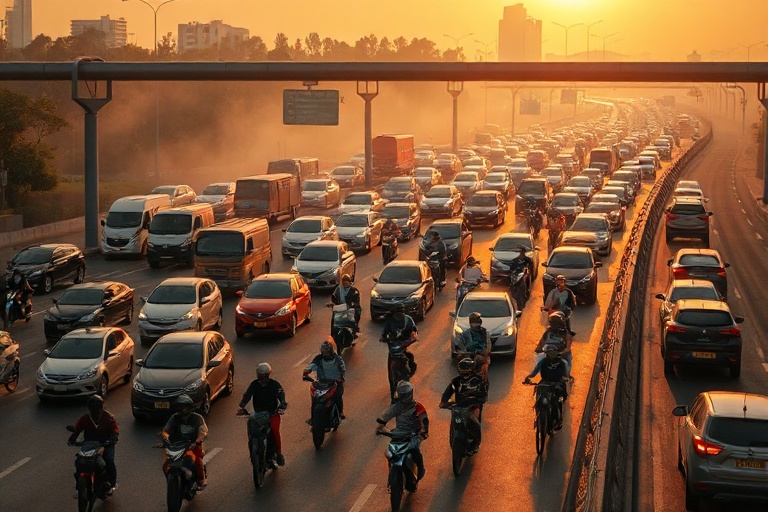
Traffic is one of humanity’s most persistent and quietly devastating challenges. It doesn’t make headlines like wars or pandemics, yet it costs economies billions, steals hours from daily life, and reshapes cities in unseen ways. From the choked arteries of Mumbai to the sprawling freeways of Los Angeles, the story of traffic is a story of human behavior, urban planning, and economic inequality.
What began as a luxury of car ownership has become a necessity—and a burden. The average American spends 54 hours per year stuck in traffic, according to the Texas A&M Transportation Institute. That’s more than two full days lost annually, time that could have been spent with family, working, or simply resting. The frustration isn’t just personal; it’s systemic. It reveals how cities were designed without foresight, how public transit was deprioritized, and how economic access remains unevenly distributed.
The Hidden Costs of a World on the Move
The economic toll of traffic is staggering. In the United States alone, congestion costs the economy over $120 billion per year in lost productivity and wasted fuel. Globally, the figure exceeds $1 trillion when factoring in delays, accidents, and environmental damage. These costs accumulate in unexpected ways: delayed medical deliveries, lost business opportunities, and inflated prices for goods that sit in gridlocked supply chains.
But the impact isn’t evenly felt. In cities like Jakarta or Nairobi, where informal transit systems thrive alongside private vehicles, the burden of traffic falls disproportionately on the working class. Commuters in these cities often spend three to four hours daily in transit, with little access to air-conditioned comfort or reliable schedules. Meanwhile, wealthier residents may bypass congestion via toll roads or helicopter pads—luxuries that underscore a deeper divide.
Traffic also reshapes labor markets. In Tokyo, strict parking regulations and high land costs have pushed many businesses to operate in decentralized hubs, reducing downtown congestion but isolating workers who can’t afford to live near their jobs. In São Paulo, the “Cidade Linda” initiative temporarily reduced traffic by closing major avenues on Sundays, revealing how policy can reshape urban rhythms—if only temporarily.
Techno-Optimism vs. Urban Reality
Technology promised to solve traffic. Ride-sharing apps like Uber and Lyft were supposed to reduce car ownership by offering shared rides. Instead, studies show they’ve increased congestion in major cities by up to 80% in some cases. Each Uber ride adds another vehicle to the road, often driven by someone who wouldn’t otherwise be working behind the wheel.
Autonomous vehicles were next on the list. Proponents argued self-driving cars would communicate with each other, eliminating stop-and-go traffic and reducing accidents. Yet, without widespread adoption or infrastructure upgrades, these promises remain hypothetical. In the meantime, cities like San Francisco have seen autonomous test vehicles contribute to congestion, as curious onlookers slow traffic to gawk at the technology.
Even smart traffic lights, which adjust signals in real time, have had mixed results. While they reduce wait times at intersections, they can create ripple effects elsewhere, shifting bottlenecks to less monitored areas. The problem isn’t just technology—it’s coordination. Cities need integrated systems, not siloed solutions.
What Works: Lessons from Around the World
A few cities have bucked the trend. London’s congestion charge, introduced in 2003, reduced traffic in the city center by 15% and raised £200 million annually for public transit. Singapore’s electronic road pricing system uses dynamic tolls to manage demand, keeping speeds above 45 km/h during peak hours. Both cities demonstrate that pricing, when paired with alternatives, can work.
- Bogotá’s Ciclovía: Every Sunday and holiday, over 120 kilometers of streets are closed to cars, giving pedestrians and cyclists priority. The program has inspired similar initiatives in cities from Guadalajara to Los Angeles.
- Curitiba’s Bus Rapid Transit (BRT): Designed in the 1970s, this system uses dedicated lanes and pre-paid boarding to move passengers as efficiently as subways—at a fraction of the cost.
- Zurich’s Parking Reform: The city capped parking spaces and invested heavily in transit, leading to a 30% reduction in car use since the 1970s.
The Psychological Toll: Stress, Time, and Inequality
Traffic isn’t just a logistical problem; it’s a mental health issue. Studies link long commutes to increased cortisol levels, sleep deprivation, and higher rates of depression. The phenomenon of “commuter rage” has become so common that some cities now offer anger management classes for drivers.
Time spent in traffic is also time stolen from community life. In car-dependent suburbs, neighbors rarely interact. In dense cities, the rush to escape gridlock leaves little room for spontaneity. The result is a society that moves faster but connects less. This isolation is particularly acute for women, who often bear the brunt of multi-stop trips—school runs, grocery shopping, elder care—all while navigating unsafe or unreliable transit options.
Inequality is embedded in traffic patterns. In Houston, wealthier neighborhoods have wider roads and fewer traffic lights, while poorer areas face chronic congestion due to underfunded infrastructure. In Mumbai, the distinction is even starker: the elite travel in air-conditioned cars on elevated expressways, while millions cram into local trains or walk for miles in sweltering heat.
Can We Reimagine Mobility?
The future of traffic lies not in more lanes or smarter apps, but in rethinking what mobility means. Cities like Barcelona are experimenting with “superblocks,” where entire neighborhoods are closed to through traffic, prioritizing pedestrians and cyclists. Oslo has removed 700 parking spaces since 2015 and aims to eliminate cars from its city center entirely by 2030.
Technology still has a role to play, but it must be directed toward public good. Apps like Moovit and Citymapper now offer real-time transit data, helping users choose the fastest route—whether by bus, bike, or foot. Micro-mobility solutions, like e-scooters and bike-share programs, are filling gaps in last-mile connectivity. Yet, without subsidies or infrastructure, these options remain inaccessible to many.
The most promising developments are happening at the policy level. In Paris, mayor Anne Hidalgo has pledged to make the city “15-minute,” where residents can reach daily needs within a short walk or bike ride. In Portland, Oregon, the “20-Minute Neighborhood” concept aims to reduce car dependency by mixing housing, retail, and services in walkable districts.
The fight against traffic isn’t just about speed—it’s about dignity. It’s about ensuring that children can get to school safely, that workers aren’t exhausted before their shifts begin, and that cities remain places where people, not cars, are the priority.
A Call to Rethink the Road Ahead
Traffic is not an inevitability. It is a symptom of choices we’ve made—and choices we can unmake. The solutions exist: better transit, smarter pricing, and inclusive planning. What’s missing is the political will to prioritize people over vehicles.
For too long, traffic has been treated as a personal failing—a sign that someone didn’t leave early enough or plan their route wisely. But traffic is a collective problem, one that demands collective solutions. It’s time to demand cities where movement is fluid, where air is clean, and where no one is left stranded by the side of the road.
Change won’t happen overnight. But in the quiet hum of bicycle bells, the steady hum of electric buses, and the sight of children walking to school without fear, we can begin to imagine a world where traffic is no longer the defining rhythm of our lives.
Explore more on sustainable urban living and transportation innovation on Technology and Culture pages.