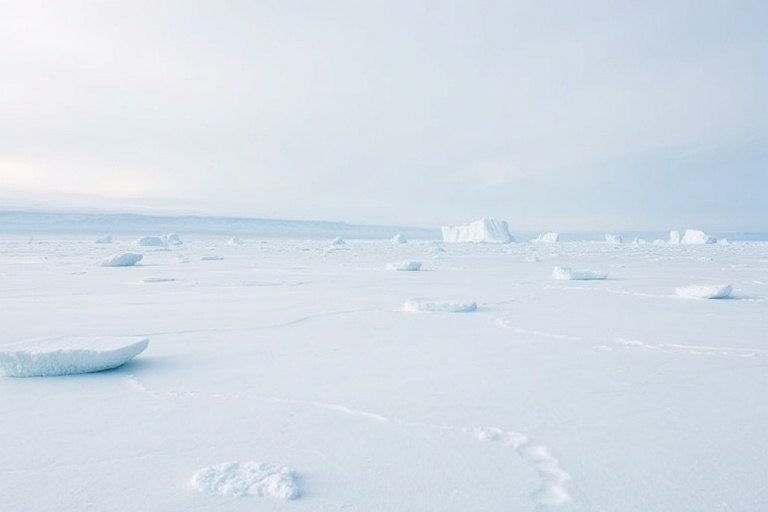
Antarctic Sea Ice: A Delicate Balance in a Warming World
Antarctic sea ice plays a critical role in Earth’s climate system, acting as a thermal regulator and a habitat for countless species. Unlike the Arctic, where sea ice has been steadily declining for decades, Antarctica’s ice has exhibited more complex and, at times, contradictory patterns. Recent observations, however, have raised concerns about the stability of this frozen frontier. Scientists are now closely monitoring shifts in Antarctic sea ice, which could have far-reaching consequences for global weather patterns, marine ecosystems, and even human societies.
The Southern Ocean surrounding Antarctica is home to some of the most dynamic ice formations on the planet. Unlike land-based glaciers, sea ice forms and melts with the seasons, expanding in winter and shrinking in summer. This cycle has historically been predictable, but in recent years, anomalies have emerged. In 2023, Antarctic sea ice reached a record low, shattering previous benchmarks and prompting urgent discussions among researchers. The implications of these changes extend beyond the polar region, influencing ocean currents, weather systems, and even the global carbon cycle.
The Science Behind Antarctic Sea Ice
Antarctic sea ice is not a monolithic structure but a mosaic of different types, each with its own formation and melting processes. The two primary categories are first-year ice and multi-year ice. First-year ice forms during a single winter season and typically melts in the following summer. Multi-year ice, as the name suggests, persists for multiple years, thickening and becoming more resilient over time. The balance between these types has shifted in recent decades, with first-year ice now dominating the Antarctic landscape.
Several factors influence the formation and extent of Antarctic sea ice, including:
- Ocean temperatures: Warmer waters can inhibit ice formation and accelerate melting.
- Wind patterns: Stronger or more persistent winds can push ice together or disperse it, altering its coverage.
- Freshwater input: Melting glaciers and ice shelves release freshwater, which can stabilize the upper ocean layer and promote ice growth.
- Solar radiation: Changes in cloud cover and albedo (reflectivity) affect how much heat is absorbed or reflected.
One of the most significant discoveries in recent years is the role of polynyas—large areas of open water surrounded by sea ice. These polynyas act as critical ventilation systems for the Southern Ocean, releasing heat and gases trapped beneath the ice. Their formation and behavior are closely tied to wind and ocean currents, making them a key area of study for climate scientists.
Record Lows and Unprecedented Changes
The Antarctic sea ice minimum in February 2023 was the lowest since satellite records began in 1979, covering just 1.79 million square kilometers. This was 1 million square kilometers less than the previous record low set in 2022. The decline was particularly pronounced in the Bellingshausen and Amundsen Seas, where ice extent dropped by nearly 50% compared to the 1981–2010 average. Such dramatic reductions are not isolated events but part of a broader trend that has unfolded over the past decade.
Researchers have identified several potential drivers behind this decline:
- Atmospheric warming: The Antarctic Peninsula and surrounding regions have experienced some of the fastest temperature increases on Earth, with regional warming rates exceeding 0.5°C per decade.
- Oceanic heat: Warmer waters from the Southern Ocean’s deeper layers have been upwelling more frequently, melting ice from below.
- Shifts in wind patterns: Changes in the Southern Annular Mode (SAM), a climate driver influenced by greenhouse gas concentrations, have led to stronger westerly winds that push ice away from the continent.
- Ice shelf disintegration: The collapse of ice shelves, such as the Larsen B in 2002 and the Conger in 2022, has reduced the buttressing effect that stabilizes sea ice.
While natural variability has always played a role in Antarctic sea ice dynamics, the recent trends are increasingly difficult to attribute solely to natural causes. A 2023 study published in Nature suggested that the probability of such extreme lows occurring without human-induced climate change is less than 1%. This underscores the urgent need to understand how human activities are altering one of Earth’s most remote yet vital ecosystems.
Ecological and Global Consequences
The decline of Antarctic sea ice has cascading effects on marine life, many of which are uniquely adapted to this icy environment. Krill, small crustaceans that form the base of the Southern Ocean food web, rely on sea ice for shelter during their larval stages. A reduction in ice cover threatens krill populations, which in turn affects predators such as whales, seals, and penguins. Emperor penguins, for example, depend on stable sea ice for breeding. In 2023, scientists observed multiple breeding failures in colonies along the Antarctic coast, directly linked to the absence of ice.
Beyond local ecosystems, Antarctic sea ice influences global climate processes. The ice acts as a giant mirror, reflecting up to 90% of incoming solar radiation back into space. When ice cover declines, more heat is absorbed by the dark ocean surface, accelerating warming. This feedback loop can intensify weather patterns worldwide, potentially leading to more extreme events such as stronger storms, prolonged droughts, or unpredictable precipitation.
Another critical function of sea ice is its role in driving ocean circulation. The formation of dense, salty water around Antarctica helps power the global thermohaline circulation, a vast conveyor belt of ocean currents that distributes heat around the planet. Disruptions to this system could have profound implications for regional climates, particularly in the North Atlantic, where the circulation plays a key role in moderating temperatures.
What the Future Holds
The future of Antarctic sea ice remains uncertain, but most climate models project continued decline over the coming decades. The Intergovernmental Panel on Climate Change (IPCC) estimates that under high-emission scenarios, Antarctic sea ice could shrink by 24% to 76% by 2100, depending on the trajectory of global warming. However, the region’s complex dynamics mean that some areas may still experience temporary increases in ice cover, even as the overall trend is downward.
Addressing the challenges posed by Antarctic sea ice loss requires a multifaceted approach. Reducing greenhouse gas emissions remains the most critical step, as it would slow the rate of ocean warming and atmospheric changes. In parallel, scientists are exploring ways to enhance monitoring and prediction capabilities, using advanced satellites, autonomous drones, and AI-driven models to track ice dynamics in real time. International collaborations, such as the Scientific Committee on Antarctic Research (SCAR), are essential for coordinating research efforts and sharing data across borders.
For policymakers, the Antarctic sea ice crisis presents a stark reminder of the interconnectedness of Earth’s systems. Decisions made today will reverberate for centuries, shaping not only the fate of Antarctica but also the stability of the global climate. The record lows of 2023 should serve as a wake-up call, urging immediate action to protect one of the planet’s last great wildernesses.
Conclusion
Antarctic sea ice is more than just a frozen expanse—it is a linchpin of Earth’s climate system, a habitat for unique species, and a barometer of global change. The recent declines in ice extent are not anomalies but symptoms of a planet under stress. While the full consequences of these changes are still unfolding, one thing is clear: the fate of Antarctic sea ice is inextricably linked to the choices humanity makes in the coming decades. By prioritizing scientific research, sustainable policies, and international cooperation, we can still mitigate the worst impacts and preserve the delicate balance of this frozen frontier.
For those interested in diving deeper into the science behind Antarctic climate systems, explore our Science category for more articles on polar research and environmental trends.