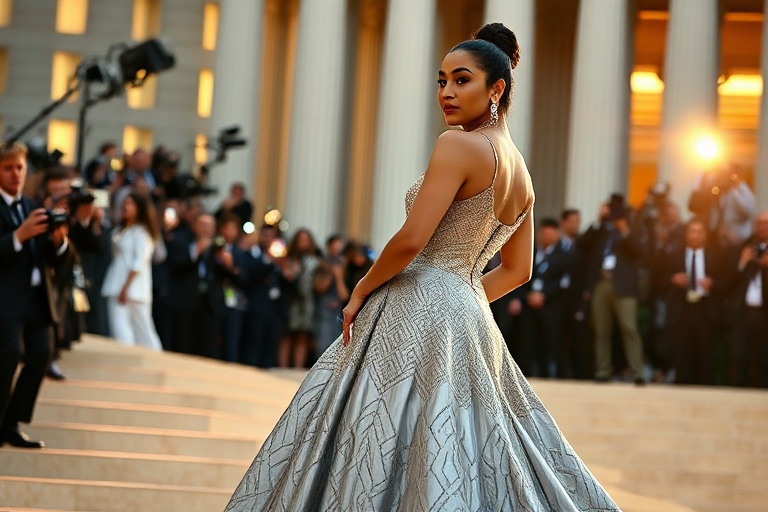
Bhavitha Mandava Redefines Fashion at Met Gala 2026 with Celestial Sari
Bhavitha Mandava Makes Her Mark at the Met Gala 2026
The Met Gala 2026 will long be remembered not just for its extravagant themes or headline appearances, but for the way a rising star from the fashion world redefined what it means to dress for the future. Bhavitha Mandava, the Hyderabad-born designer whose work blends South Asian craftsmanship with avant-garde digital innovation, made her debut on the red carpet with a creation that turned heads and sparked global conversations. Her presence at the event signaled more than a personal milestone—it marked a cultural shift in how traditional artistry meets modern technology on one of fashion’s grandest stages.
Mandava’s journey to the Met Gala reads like a modern fairy tale. After graduating from the National Institute of Fashion Technology in India, she moved to Paris, where she quickly gained attention for her experimental fusion of handwoven textiles and 3D-printed elements. By 2025, she had dressed celebrities for red carpets across Mumbai, Dubai, and Tokyo. But the Met Gala—often called “fashion’s Oscars”—represented her most ambitious platform yet. Her arrival was not merely about celebrity status; it was about bringing a voice from the Global South into an event traditionally dominated by Western designers.
The Design That Captured Global Attention
Mandava’s Met Gala 2026 ensemble was a masterpiece titled Cosmic Sari: A Celestial Weave. Crafted from handwoven Kala cotton sourced from Andhra Pradesh, the sari was embedded with photoluminescent threads that responded to movement, shifting from deep indigo to shimmering silver under gallery lighting. The bodice, structured like a futuristic corset, incorporated biodegradable polymers that mimicked the patterns of constellations. The entire look was powered by a microchip woven into the hem, allowing it to sync with the wearer’s biometrics—pulse, breathing—translating emotion into visual light patterns.
Critics called it a “living garment,” one that blurred the line between wearable art and interactive technology. The ensemble wasn’t just worn; it was experienced. Social media erupted with videos of the sari glowing as Mandava walked the carpet, her movements creating ripples of light across the floor. Within hours, the hashtag #CelestialWeave trended globally, amassing over 12 million views. Designers from Lagos to London began commenting on how Mandava had elevated the sari from traditional attire to a symbol of sustainable innovation.
Cultural Diplomacy on the World Stage
The significance of Mandava’s appearance extended well beyond aesthetics. The Met Gala has increasingly become a forum for cultural exchange, especially as the fashion industry faces scrutiny over representation. In 2026, the event’s theme—Threads of Time: Fashion as Heritage—challenged designers to explore how clothing carries memory, identity, and lineage. Mandava’s work directly answered that call. By reimagining the sari—a garment with over 5,000 years of history—she transformed it into a bridge between ancient craft and future possibility.
Her presence resonated particularly in India, where she was celebrated as a national icon. Major news outlets like The Hindu and Vogue India ran features on her, emphasizing how she had brought global recognition to India’s handloom sector. In an interview with BBC Culture, Mandava reflected, “Fashion is not just about beauty. It’s about storytelling. And every thread I weave carries the voices of the artisans who made it possible.”
Her collaboration with over 200 weavers from Nalgonda district—many of whom had never worked with digital components before—also highlighted the growing role of technology in preserving traditional crafts. The project didn’t just create a dress; it created livelihoods, training programs, and a new market for handwoven textiles in the digital age.
A New Blueprint for Global Fashion
The impact of Mandava’s Met Gala moment is already being felt across the industry. Designers worldwide are rethinking how sustainability and heritage can coexist with cutting-edge design. In an era where fast fashion dominates, her approach—slow, ethical, and rooted in community—offers an alternative model. It’s a shift that aligns with growing consumer demand for transparency and accountability in fashion.
Industry analysts are now pointing to Mandava’s success as evidence of a broader trend: the rise of the “cultural innovator”—designers who use tradition as a foundation for technological and artistic experimentation. This trend is visible in other regions too. In Nigeria, designers are merging Ankara prints with AI-generated patterns, while in Mexico, artisans are integrating smart textiles into traditional embroidery. Mandava’s Met Gala moment may well be remembered as the tipping point for this global movement.
Looking Ahead: What’s Next for Bhavitha Mandava?
With the Met Gala spotlight firmly on her, Mandava is already planning her next steps. She has announced a global exhibition tour for the Cosmic Sari collection, partnering with museums in New York, Tokyo, and Dubai to showcase how fashion can be both wearable art and a medium for social change. She’s also launching a foundation to support rural weavers in India, ensuring that the benefits of her success are shared with the communities that inspired her.
For now, Mandava remains focused on pushing boundaries. “I don’t want to be known just as the designer who made a dress glow,” she said in a recent interview. “I want to be known as someone who helped rewrite the rules of fashion—so that the next generation sees craft not as something from the past, but as a living, evolving art.”
The Met Gala 2026 may have been her debut, but it’s clear that Bhavitha Mandava is here to stay. And the fashion world is watching.
—
The Global Ripple Effect: Fashion, Technology, and Identity in 2026
Mandava’s rise reflects a broader transformation in how we view clothing—not just as adornment, but as a medium of communication, culture, and even activism. Across continents, designers are using fashion to address issues like climate change, gender identity, and decolonization. In Japan, designers are integrating biodegradable sensors into kimono fabrics to monitor pollution levels. In South Africa, a collective of queer designers is using wearable tech to create garments that change color based on the wearer’s mood, challenging rigid notions of identity.
This global shift is not without challenges. The integration of technology into traditional crafts raises questions about authenticity, ownership, and cultural appropriation. Who owns the rights to a digital pattern inspired by a tribal motif? How do we ensure that artisans are fairly compensated when their designs are digitized? These are questions that the fashion industry is only beginning to grapple with.
Yet, figures like Mandava are leading the way in navigating these complexities. By centering artisans in her process and ensuring they retain control over their intellectual property, she sets a standard for ethical innovation. Her work proves that technology and tradition don’t have to be at odds—instead, they can amplify each other.
—
A Call to Reimagine Fashion’s Future
The fashion industry stands at a crossroads. On one hand, it faces criticism for its environmental impact and exploitative labor practices. On the other, it has the power to celebrate diversity, preserve heritage, and drive technological progress. Mandava’s Met Gala moment is a reminder that fashion can—and must—be more than just spectacle. It must be meaningful.
As consumers, we too have a role to play. Supporting designers who prioritize sustainability, fair wages, and cultural respect can shift the industry’s priorities. Platforms like Culture on Dave’s Locker are highlighting voices like Mandava’s, offering readers a chance to engage with fashion as a force for change.
The future of fashion isn’t just about what we wear. It’s about how we wear it—and why.