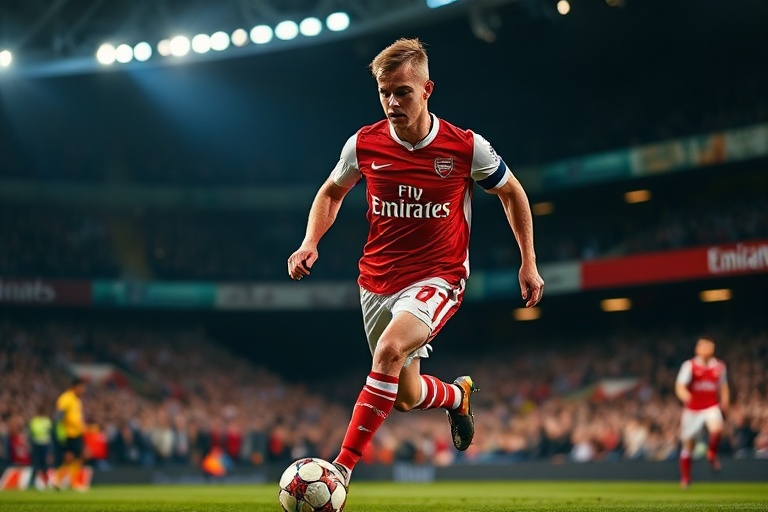
Jack Wilshere: A Career Defined by Promise and Persistence
Jack Andrew Wilshere’s career in professional football reads like a study in contrasts—brilliant flashes of genius sandwiched between persistent struggles with injury and the weight of expectation. Born on January 1, 1992, in Stevenage, England, Wilshere rose through the youth ranks of Arsenal with a reputation as a prodigy, tipped for greatness from a young age. His technical ability, vision, and composure on the ball drew comparisons to footballing legends like Cesc Fàbregas, fueling hopes that he would become the next English midfield maestro.
Yet, despite his undeniable talent, Wilshere’s career has been marked by what might have been. His journey offers a compelling narrative about the fragility of potential in modern football, where physicality and endurance often dictate longevity over pure skill. As he transitioned from a teenage sensation to a seasoned professional, Wilshere became a symbol of unfulfilled promise—a narrative familiar to many young English footballers who burn bright early but face the harsh realities of the sport’s demands.
The Rise of a Prodigy: From Stevenage to Arsenal’s First Team
Wilshere’s ascent began in Arsenal’s Hale End Academy, where his performances quickly caught the attention of coaches and fans alike. By the age of 16, he had already made his senior debut for Arsenal in a League Cup match against Sheffield United in 2008, becoming the second-youngest player in the club’s history at the time. His first Premier League appearance followed shortly after, solidifying his place as one of English football’s most exciting young talents.
The 2009–10 season marked Wilshere’s breakthrough. Still only 17, he became a regular starter under Arsène Wenger, delivering performances that showcased his ability to control games with maturity beyond his years. His partnership with Fàbregas in midfield was particularly notable, as Wilshere’s energy, passing range, and ability to dictate tempo complemented the Spaniard’s creativity. In April 2010, he scored his first senior goal in a 4–2 win over Barcelona in the Champions League, a performance that announced his arrival on the European stage.
The Burden of Expectation and the Reality of Injury
With great promise came great scrutiny. Wilshere was widely seen as the future of English football, a player who could elevate the national team’s midfield alongside the likes of Steven Gerrard and Frank Lampard. However, his career trajectory took a sharp turn when a series of injuries began to derail his progress. A persistent ankle injury, which required multiple surgeries, kept him sidelined for long periods, robbing him of continuity and rhythm.
Between 2010 and 2016, Wilshere’s availability was inconsistent. He spent significant portions of his prime years recovering rather than playing, a cruel irony for a player whose style relied on fluid movement and match fitness. His frustration was evident in interviews, where he spoke openly about the mental toll of injuries and the pressure to live up to his potential. Despite these setbacks, Wilshere remained a figure of intrigue, his talent never fully extinguished, even if his impact was often fleeting.
A Career Across Continents: From England to the Middle East
In 2018, after more than two decades at Arsenal, Wilshere made a surprising move to West Ham United, seeking a fresh start in London. Though he showed glimpses of his former self, injuries continued to plague him, limiting his influence. His time at West Ham was a mix of hope and disappointment, a reminder of the career that could have been.
Wilshere’s journey took another unexpected turn in 2020 when he joined A.F.C. Bournemouth on loan, followed by a permanent move to the club in 2021. However, his time in the south of England was short-lived. By 2022, he had made a bold decision to leave English football entirely, signing with Portuguese side Sporting CP. This move was not just a change of scenery but a cultural shift—Wilshere embraced the challenge of adapting to a new footballing environment, a testament to his resilience and desire to prove himself beyond the familiar confines of the Premier League.
His stint in Portugal was brief but significant. Wilshere’s experience and leadership were valued, and he contributed to the team’s tactical evolution. Though he did not become a household name in Portuguese football, his presence added depth to a squad with European ambitions. His time at Sporting CP highlighted how far he had come—not just as a player, but as a professional who had navigated the complexities of a career in flux.
Legacy and Influence: What Jack Wilshere Means to English Football
Jack Wilshere’s career may not have followed the trajectory many anticipated, but his story is a poignant one in the context of English football. He represents a generation of players who arrived with immense promise, only to face the unforgiving nature of the sport. His struggles with injury and the pressure to succeed have made him a relatable figure, one who embodies the human side of professional football—where talent alone is rarely enough.
Wilshere’s technical attributes—his close control, vision, and passing—remain undeniable. These qualities earned him admiration from teammates, coaches, and opponents alike. Even in his later years, when his physicality waned, his understanding of the game was evident. For younger English players watching, Wilshere’s career serves as both inspiration and cautionary tale: a reminder of the fragility of potential and the importance of resilience.
Beyond his club career, Wilshere’s international journey with England was similarly bittersweet. He made his senior debut in 2010 at the age of 18, becoming the youngest player to represent England in a competitive match since Duncan Edwards. Though he earned 34 caps and scored one goal, his international career was overshadowed by injuries and the emergence of other midfielders. His performances in major tournaments, including the 2014 World Cup and Euro 2016, were limited, leaving fans to wonder what might have been had he stayed fit.
The Cultural Impact of an Underrated Midfield Maestro
Wilshere’s career unfolded during a time when English football was undergoing significant changes. The Premier League’s global reach had transformed it into a spectacle watched by millions worldwide, and English players were under increasing scrutiny to perform on the biggest stages. Wilshere, with his technical style and composed demeanor, stood out in an era dominated by physicality and athleticism. He embodied a different kind of midfielder—one who valued intelligence and technique over sheer power.
His playing style also reflected broader trends in football. As the game became more tactical and possession-oriented, players like Wilshere who could combine creativity with work rate became highly sought after. Though injuries prevented him from reaching the pinnacle of the sport, his influence on younger players, particularly in England, is undeniable. Many current English midfielders, such as Declan Rice and Kalvin Phillips, have cited Wilshere as an inspiration for his ability to control games with his feet and mind.
Wilshere’s career also intersected with cultural shifts in English football. The rise of social media and the 24-hour news cycle meant that young players were under constant scrutiny from an early age. Wilshere’s journey—marked by early adulation and subsequent struggles—highlighted the pressures of fame and expectation in the modern game. His openness about his battles with injury and mental health helped humanize him, making him a figure who resonated with fans beyond his performances on the pitch.
The Future: Life After Professional Football
As of 2024, Wilshere’s future in football remains uncertain. With a career spanning over a decade and multiple clubs across two continents, he has left an indelible mark on the game. Whether he transitions into coaching, punditry, or another role within the sport remains to be seen. What is clear, however, is that his journey is far from over. The same resilience that defined his playing career will likely guide him in his next chapter.
For fans of English football, Wilshere’s story is a reminder of the fleeting nature of careers in the sport. It is also a testament to the enduring appeal of a player who, despite his challenges, never lost his love for the game. In an era where results often overshadow the human stories behind them, Wilshere’s career stands out for its honesty and vulnerability.
As the football world continues to evolve, players like Wilshere serve as a bridge between eras—a link between the technical brilliance of the past and the physical demands of the present. His legacy may not be defined by trophies or accolades, but by the moments of brilliance that kept fans dreaming, even when reality proved more complicated.