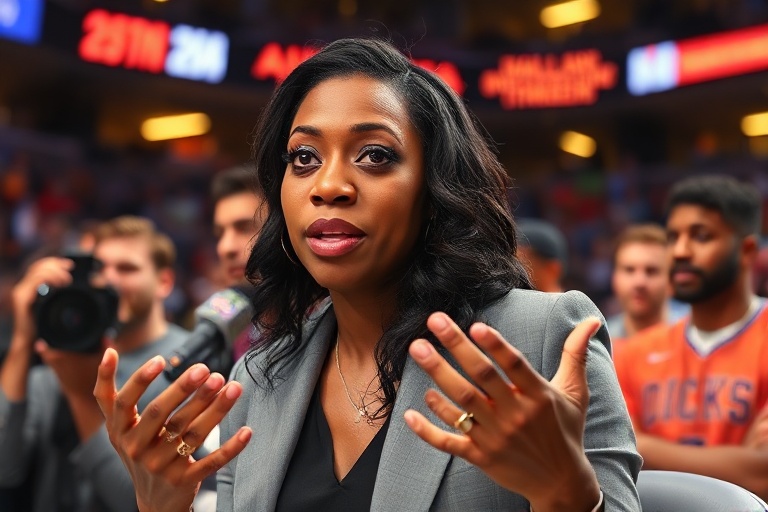
Malika Andrews: The Journalist Redefining Sports Media
Malika Andrews has emerged as one of the most influential voices in sports journalism, reshaping how audiences engage with athletic narratives. Her career trajectory reflects a broader shift in media, where authenticity and accessibility often outweigh traditional gatekeeping. As a woman of color in a predominantly male industry, Andrews has consistently challenged norms while delivering incisive coverage of major sports events.
Born in Oakland, California, Andrews grew up in a family deeply connected to sports. Her father, a former basketball player, instilled in her a love for the game early on. This foundation, combined with her sharp analytical mind, positioned her for success in a field where preparation and adaptability are paramount. Andrews attended the University of Portland, where she honed her reporting skills before joining ESPN in 2012 as an intern. Her rise within the network has been marked by a willingness to tackle complex stories with both depth and clarity.
The Evolution of a Sports Journalist
Andrews’ career at ESPN has been defined by her ability to transcend conventional sports reporting. She began as a production assistant but quickly transitioned into on-air roles, where her poise and depth of knowledge set her apart. By 2018, she had become a regular contributor to SportsCenter and NBA Countdown, covering the league with a perspective that blended statistical rigor with human interest storytelling.
Her reporting on the NBA’s social justice initiatives during the 2020 season exemplified her approach. While many journalists focused solely on athletic performance, Andrews delved into the intersection of sports and activism, interviewing players about their roles in movements like Black Lives Matter. This willingness to address uncomfortable yet critical topics has cemented her reputation as a journalist unafraid to ask probing questions.
Key Milestones in Her Career
- 2012: Joined ESPN as an intern, laying the groundwork for her future success.
- 2015: Became a full-time reporter, covering the NBA and NCAA basketball.
- 2018: Joined SportsCenter and NBA Countdown as a regular contributor.
- 2020: Led coverage of the NBA’s return-to-play bubble during the pandemic, highlighting player experiences.
- 2021: Named a host of NBA Today, further solidifying her role as a primary voice in basketball journalism.
Cultural Impact: Representation and Influence
Andrews’ presence in sports media carries significant cultural weight, particularly for young women and people of color. Studies show that diverse representation in media not only broadens perspectives but also inspires future generations to pursue careers in fields where they have historically been underrepresented. Andrews has acknowledged this responsibility, often speaking about the importance of mentorship and visibility.
Her work extends beyond basketball. Andrews has covered major global events, including the Olympics and FIFA World Cup, offering audiences a nuanced understanding of how sports intersect with politics, economics, and social issues. In an era where sports media is increasingly consumed as entertainment, her commitment to substantive journalism has distinguished her from peers who prioritize sensationalism over substance.
Breaking Barriers in a Male-Dominated Field
Women in sports journalism have long faced challenges, from dismissive attitudes to outright hostility. Andrews has navigated these obstacles with a blend of professionalism and resilience. She has been vocal about the need for systemic change, advocating for equal opportunities and fair treatment in media workplaces. Her advocacy aligns with broader movements within journalism to dismantle barriers and foster inclusivity.
Andrews’ influence can also be seen in the way she engages with her audience. Through social media, she provides behind-the-scenes insights and responds to fan questions, creating a more interactive and transparent relationship with viewers. This approach contrasts with the often one-way communication of traditional sports media, where audiences are passive consumers rather than active participants.
Challenges and Criticisms
Despite her success, Andrews has not been immune to criticism. Some detractors argue that her reporting leans too heavily into social issues rather than focusing solely on athletics. Others have scrutinized her interviews, questioning whether she pushes interviewees to provide deeper insights. Andrews has addressed these critiques directly, emphasizing that sports are inherently tied to larger societal conversations.
Professionally, she has weathered the turbulence of industry shifts, including the rise of digital media and the decline of traditional cable news. Her adaptability—whether covering a game or moderating a panel discussion—has allowed her to thrive in an evolving landscape. This adaptability reflects a broader trend in journalism, where versatility is often the key to longevity.
The Future of Malika Andrews
As Andrews continues to ascend in her career, her potential impact on sports media remains vast. With rumors of expanded roles at ESPN and possible ventures into documentary filmmaking, her future appears boundless. Her work serves as a reminder that sports journalism is not just about scores and highlights—it is about storytelling, context, and the people behind the performances.
For aspiring journalists, Andrews’ career offers a blueprint for success in a competitive field. Her journey underscores the importance of perseverance, adaptability, and a commitment to authenticity. As media consumption habits evolve, her ability to connect with diverse audiences will likely keep her at the forefront of the industry.
What’s Next for Malika Andrews?
- Potential expansion into long-form storytelling, including documentaries or podcasts.
- Increased involvement in mentorship programs to support underrepresented voices in journalism.
- Exploration of international sports coverage, further broadening her global perspective.
- Possible transition into executive roles within media organizations, shaping the future of sports journalism.
In a media landscape often criticized for its superficiality, Malika Andrews stands out as a journalist who prioritizes substance over spectacle. Her career is a testament to the power of thoughtful reporting and the importance of representation in shaping how we understand sports—and the world beyond them.
Explore more sports journalism on Dave’s Locker or dive into our analysis section for deeper insights.