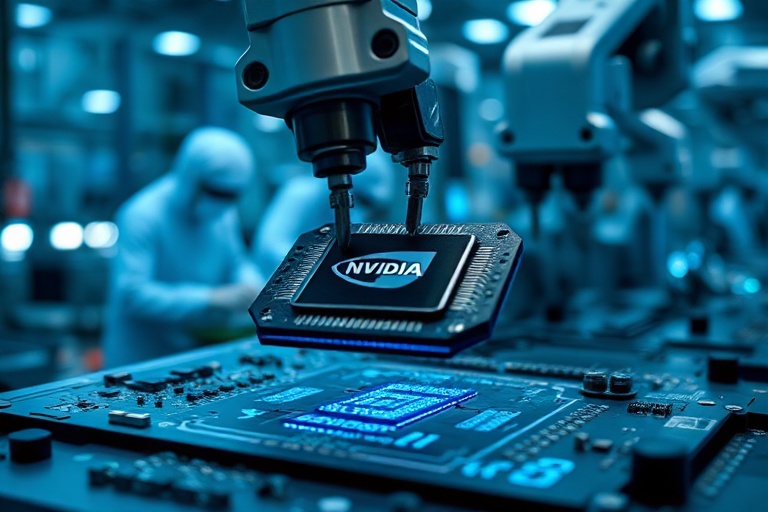
Nvidia’s $10 Billion Supply Chain Bet: How the AI Boom is Reshaping Global Tech
Nvidia’s announcement of a $10 billion investment into its supply chain marks one of the most aggressive moves yet in the artificial intelligence revolution. The chipmaker, already synonymous with high-performance computing, is doubling down on infrastructure to meet surging demand for AI processors. But this isn’t just about building faster GPUs—it’s a strategic pivot with ripple effects across global technology, manufacturing, and even geopolitics.
At the heart of this initiative is a push to secure critical components like advanced semiconductors, advanced packaging materials, and specialized manufacturing equipment. Nvidia is diversifying its supplier base, reducing reliance on single points of failure while accelerating production cycles. The move comes as AI adoption accelerates across industries, from healthcare diagnostics to autonomous vehicles, all of which depend on Nvidia’s silicon.
Why Supply Chain Dominance Matters in the AI Era
AI chips are not like traditional processors. They require precision-engineered components, exotic materials, and fabrication processes that push the limits of semiconductor physics. Nvidia’s investment reflects a broader industry trend: supply chain resilience is now a competitive advantage.
Consider the timeline. In 2022, global semiconductor shortages exposed vulnerabilities in tech manufacturing. By 2023, Nvidia’s AI chip sales surged by over 170%, straining even the most robust supplier networks. Today, delays in advanced packaging—such as the use of high-bandwidth memory (HBM)—can stall AI development for months. Nvidia’s $10 billion infusion aims to preempt such bottlenecks by locking in long-term agreements with key suppliers in Taiwan, South Korea, and the United States.
The strategy includes partnerships with TSMC for cutting-edge 3nm and 4nm process nodes, SK Hynix for HBM memory, and new collaborations with U.S.-based materials firms to reduce reliance on Asian supply chains. This aligns with U.S. government incentives like the CHIPS Act, which offers subsidies for domestic semiconductor production.
The Geopolitical Chessboard Behind the Investment
Nvidia’s supply chain gambit isn’t happening in a vacuum. It’s unfolding against a backdrop of U.S.-China technological decoupling, where access to advanced chips has become a flashpoint in global relations. The Biden administration has restricted exports of high-end AI GPUs to China, forcing Nvidia to develop compliant alternatives like the A800 and H800 chips.
This has created a paradox. While Nvidia invests billions to expand production, it must navigate export controls that limit where its products can be sold. The company’s recent earnings show that China still accounts for nearly 20% of its revenue, despite restrictions. By strengthening its supply chain outside China, Nvidia is hedging against future regulatory risks.
But the stakes go beyond trade policy. Taiwan remains the linchpin of global semiconductor manufacturing, producing over 90% of advanced chips. Any disruption—whether due to geopolitical tensions or natural disasters—could cripple AI development worldwide. Nvidia’s investments in U.S. and European foundries are a tacit acknowledgment of this risk, even as Taiwanese suppliers remain indispensable.
The Cultural Shift: From Silicon Valley to a Global AI Ecosystem
The AI boom isn’t just a technological phenomenon; it’s a cultural one. The demand for AI processors has created a global ecosystem of startups, data centers, and cloud providers that all depend on Nvidia’s hardware. In cities like Singapore, Berlin, and Tel Aviv, AI innovation hubs are emerging, fueled by access to Nvidia’s GPUs and developer tools.
This shift is redefining what it means to be a “tech company.” Traditional hardware firms are now service providers, offering AI-as-a-Service (AIaaS) platforms built on Nvidia’s infrastructure. Meanwhile, industries from gaming to agriculture are racing to integrate AI, creating a domino effect that stretches from chip fabs to end users.
Nvidia’s supply chain investment is accelerating this transition. By ensuring a steady flow of high-performance chips, the company is enabling a new wave of innovation. Developers can prototype AI models without worrying about hardware shortages, while businesses can scale AI deployments more confidently.
What’s Next for Nvidia and the AI Supply Chain?
The road ahead is fraught with challenges. Supply chain investments take years to bear fruit, and the AI market is notoriously volatile. Regulatory hurdles, economic downturns, and technological disruptions could all derail Nvidia’s plans. Yet, the company’s bet underscores a fundamental truth: in the AI era, control over the supply chain is as critical as control over the technology itself.
For now, Nvidia is playing the long game. The company’s $10 billion investment is a signal to competitors like AMD and Intel that the race for AI dominance isn’t just about performance—it’s about endurance. As AI permeates every corner of the global economy, those who control the supply chain will dictate the pace of innovation.
For consumers and businesses alike, the implications are profound. Faster AI adoption could lead to breakthroughs in medicine, climate science, and education. But it could also exacerbate inequalities, as access to advanced AI tools becomes a privilege of the well-connected. Nvidia’s supply chain strategy is a step toward democratizing AI—but the path forward remains uncertain.
The Bottom Line
Nvidia’s $10 billion supply chain investment is more than a corporate maneuver. It’s a statement about the future of technology, geopolitics, and culture. In an era where AI is reshaping industries at an unprecedented pace, control over the supply chain is the ultimate competitive edge. Whether Nvidia’s bet pays off will depend not just on engineering prowess, but on navigating a world where technology, trade, and power are increasingly intertwined.
Key Takeaways
- Nvidia is investing $10 billion to secure its AI chip supply chain, focusing on advanced semiconductors and packaging materials.
- The move addresses vulnerabilities exposed by the 2022 semiconductor shortage and accelerates AI adoption across industries.
- Geopolitical tensions, particularly U.S.-China trade restrictions, are pushing Nvidia to diversify its supplier base.
- The AI boom is fostering a global ecosystem of innovation, with Nvidia’s hardware at its core.
- Regulatory risks and economic uncertainties remain challenges for Nvidia’s long-term supply chain strategy.
As the AI revolution unfolds, Nvidia’s supply chain gambit will be a bellwether for the entire tech industry. The question isn’t whether AI will transform the world—it’s who will control the levers of that transformation.