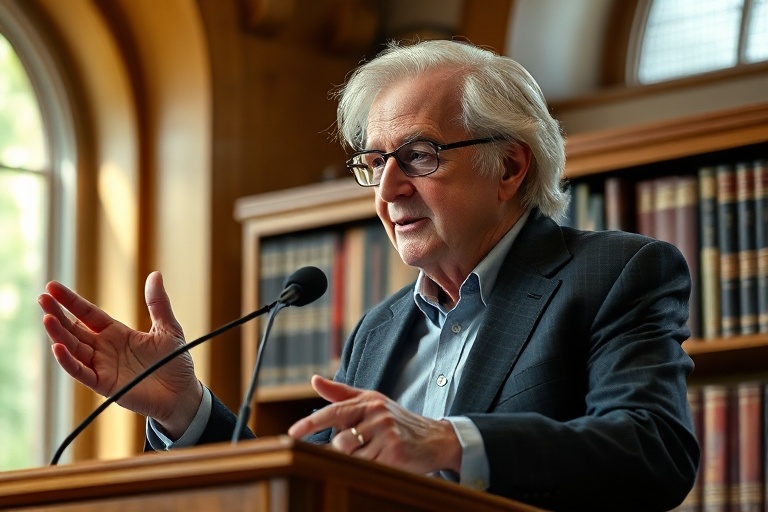
Richard Dawkins stands as one of the most influential scientific minds of the past half-century. His groundbreaking work in evolutionary biology, combined with his forceful advocacy for atheism and rationalism, has positioned him as both a revered scholar and a polarizing public intellectual. Born in Nairobi in 1941 and raised in England, Dawkins earned his doctorate at the University of Oxford under the guidance of Nobel laureate Niko Tinbergen. His academic contributions, particularly the concept of the selfish gene, have reshaped how scientists understand natural selection and heredity.
Beyond his scientific achievements, Dawkins has become a prominent voice in public discourse, challenging religious dogma and promoting evidence-based thinking. His 2006 book The God Delusion became a global bestseller, sparking both admiration and controversy. Whether celebrated as a champion of reason or criticized as a provocateur, Dawkins remains a defining figure in modern intellectual history. This article examines his life, work, and enduring impact on science and society.
The Selfish Gene and the Birth of a Scientific Revolution
In 1976, Dawkins published The Selfish Gene, a book that would alter the trajectory of evolutionary biology. The central thesis—that genes, not individuals or species, are the primary units of natural selection—challenged prevailing orthodoxies. Dawkins argued that organisms are merely “vehicles” for gene propagation, a perspective that emphasized the role of replication and competition in evolution.
This idea was not entirely new—evolutionary biologists like W.D. Hamilton had explored similar concepts—but Dawkins distilled and popularized the theory with remarkable clarity. His use of the term “meme” to describe cultural replicators further expanded the book’s reach, introducing a framework that later influenced fields ranging from anthropology to internet culture. The book’s accessible prose made complex science digestible for general audiences, cementing Dawkins’ reputation as a gifted communicator.
Critics, however, questioned whether Dawkins’ gene-centered view oversimplified evolution. Some biologists argued that it ignored the role of group selection and phenotypic plasticity. Yet, despite these debates, The Selfish Gene remains a foundational text in evolutionary biology, frequently cited in academic research and undergraduate curricula. Its influence extends beyond science; the book’s ideas have permeated popular culture, inspiring discussions about human behavior, altruism, and even artificial intelligence.
From Science to Activism: The Rise of the New Atheism
Dawkins’ shift from evolutionary biology to atheist advocacy began in earnest with the publication of The God Delusion in 2006. The book argued that belief in a supernatural deity is irrational, harmful, and unsupported by evidence. It sold millions of copies, becoming a cornerstone of the New Atheism movement alongside works by Sam Harris, Christopher Hitchens, and Daniel Dennett.
Dawkins’ approach was unapologetically confrontational. He dismissed religious faith as a “delusion,” a term he used deliberately to underscore its incompatibility with reason. His arguments rested on several key pillars:
- Lack of Empirical Evidence: Dawkins contended that no verifiable proof exists for the existence of God, making faith a matter of personal conviction rather than objective truth.
- The Problem of Evil: He highlighted the inconsistency between an all-powerful, benevolent deity and the existence of suffering in the world.
- Religious Harm: Dawkins cited historical and contemporary examples of violence, oppression, and discrimination justified by religious doctrine.
- God as a Scientific Hypothesis: He framed belief in God as a hypothesis that fails to meet the standards of scientific inquiry.
Reactions to The God Delusion were visceral. Religious leaders condemned the book as an attack on faith, while secular thinkers praised it as a bold defense of reason. Dawkins embraced the controversy, engaging in high-profile debates with theologians and public figures. His 2007 documentary The Root of All Evil? further amplified his message, drawing millions of viewers and sparking global discussions about religion’s role in society.
Controversies and Criticisms: A Polarizing Figure
Dawkins’ outspokenness has made him a lightning rod for criticism, particularly from religious communities and even some fellow scientists. His 2013 tweet suggesting that Islam poses a greater threat than Christianity drew accusations of Islamophobia. Critics argued that his generalized statements about Muslims risked stigmatizing an entire faith community. Dawkins defended his remarks as a critique of extremism rather than a condemnation of all Muslims, but the controversy underscored the challenges of balancing free speech with sensitivity.
Other criticisms focus on his perceived reductionism. Some philosophers and theologians argue that Dawkins’ dismissal of religion as entirely irrational overlooks its cultural, psychological, and historical significance. For instance, psychologist Jonathan Haidt has suggested that Dawkins underestimates the role of religion in fostering social cohesion and moral frameworks. Similarly, philosopher John Gray has accused Dawkins of substituting one dogma (scientific materialism) for another.
Dawkins has responded to these critiques with characteristic bluntness. He maintains that his goal is not to insult believers but to challenge ideas that, in his view, obstruct progress. Whether one agrees with his methods or not, his willingness to engage in contentious debates has kept him at the forefront of public intellectual life.
Legacy and Influence: Beyond Science and Atheism
Dawkins’ impact extends far beyond the ivory tower. His popularization of science has inspired generations of students and educators. Programs like Dave’s Locker Science owe much to his ability to make complex ideas accessible. His foundation, the Richard Dawkins Foundation for Reason and Science (RDFRS), promotes secular education and scientific literacy through grants, lectures, and digital content.
In the realm of education, Dawkins’ work has influenced curricula worldwide. His emphasis on critical thinking and evidence-based reasoning aligns with modern pedagogical trends. However, his vocal atheism has also led to debates about the separation of church and state in educational settings. Some argue that his advocacy undermines the neutrality required in public institutions, while others see it as a necessary counterbalance to religious indoctrination.
Dawkins’ influence is also evident in the rise of the “brights” movement, which sought to rebrand atheists and secular humanists as a cohesive social group. Though the term never gained widespread traction, it reflected a broader cultural shift toward secularism in Western societies. Today, Dawkins remains a sought-after speaker, frequently addressing audiences on topics ranging from artificial intelligence to the ethics of genetic engineering.
Conclusion: A Life Dedicated to Reason
Richard Dawkins’ career is a testament to the power of ideas. Whether through his scientific contributions, his advocacy for atheism, or his unyielding defense of reason, he has left an indelible mark on modern intellectual history. Love him or loathe him, his work forces us to confront fundamental questions about belief, evidence, and the nature of existence.
For those interested in exploring similar themes, resources like Dave’s Locker Analysis offer further insights into the intersection of science, philosophy, and public discourse. As Dawkins enters his eighth decade, his voice remains as relevant as ever, challenging us to think critically and question dogma in all its forms.