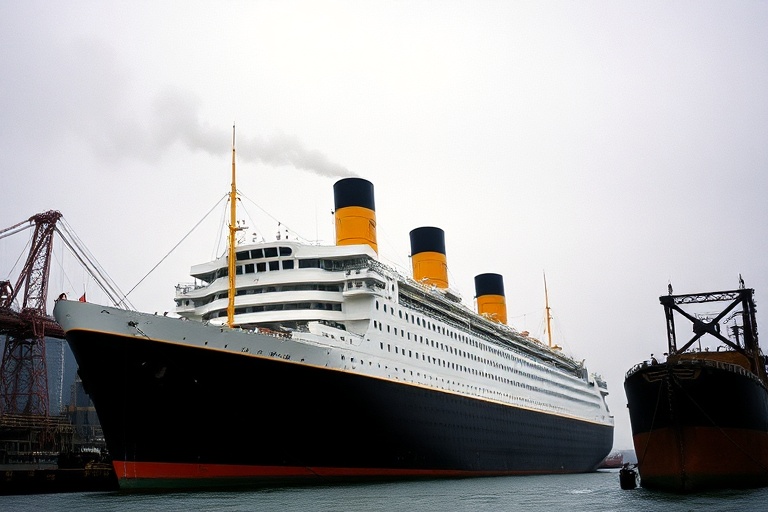
The Grand Dame of the Atlantic
Few vessels in maritime history evoke as much fascination as the SS United States. Launched in 1952, this American ocean liner was not merely a ship—it was a bold declaration of postwar ambition, technological prowess, and Cold War-era competition. Designed to outpace anything afloat, the SS United States shattered speed records during its maiden voyage, crossing the Atlantic in a record 3 days, 10 hours, and 40 minutes. Its sleek, streamlined silhouette became an icon of modernity, embodying the optimism of an era eager to leave wartime hardships behind.
Yet, despite its groundbreaking achievements, the SS United States’ story is one of unfulfilled potential. After decades of service, it was retired in 1969, its grandeur fading into obscurity. Today, the ship’s rusting hull in Philadelphia’s reserve fleet serves as a poignant reminder of a bygone era—one where transatlantic travel was as much about prestige as it was about speed. Its legacy, however, continues to captivate historians, preservationists, and travelers alike, offering a window into the golden age of ocean liners and the cultural shifts that followed.
A Symbol of Cold War Innovation
The SS United States was born from a unique convergence of military strategy and civilian ambition. During the early 1950s, the U.S. government funded its construction as part of a contingency plan to quickly convert the liner into a troop transport in the event of war. This dual-purpose design led to innovations that would redefine maritime engineering. The ship’s lightweight aluminum superstructure, unprecedented in civilian vessels at the time, allowed it to achieve speeds unmatched by its contemporaries. Its turbines generated 240,000 horsepower, propelling it to a top speed of 44 knots—records that still stand today.
This technological leap wasn’t just about speed; it reflected America’s post-WWII confidence. The SS United States was a floating embassy, carrying dignitaries, celebrities, and immigrants between New York and Europe. Its interiors, designed by renowned architect Dorothy Marckwald, featured lavish Art Moderne styling, with materials like gold-plated cutlery and rare woods that mirrored the opulence of the 1950s. For many travelers, a voyage aboard the SS United States was a rite of passage—a chance to experience luxury at a scale few could afford.
Its most famous passenger, Queen Elizabeth II, sailed on the SS United States in 1954 as a princess, reinforcing its reputation as the “Queen of the Sea.” The ship’s ability to carry thousands of troops or hundreds of first-class passengers made it a strategic asset, but its true legacy lies in how it captured the imagination of the public during an era when air travel was still in its infancy.
The Decline of an Era
By the 1960s, the SS United States’ dominance began to wane. The rise of commercial aviation dealt a fatal blow to ocean liners, as passengers opted for the speed and convenience of air travel. The ship’s high operating costs made it an unsustainable business venture, and in 1969, it was withdrawn from service. Unlike its contemporaries, which were scrapped or repurposed, the SS United States found itself in a precarious limbo. It was sold multiple times, its ownership passing through corporate hands before ultimately ending up in Philadelphia’s reserve fleet, where it remains to this day.
The ship’s decline mirrored broader shifts in global transportation and culture. The jet age had arrived, rendering the romance of ocean liners anachronistic. Yet, the SS United States resisted the scrapyard’s torch, becoming a symbol of nostalgia for a lost era. Its story is one of resilience, not just in its engineering but in its ability to endure decades of neglect while retaining a fragile, almost spectral presence.
A Global Perspective
The SS United States’ influence extended beyond American shores. Its speed records inspired British and French engineers to push the boundaries of maritime design, leading to the development of iconic liners like the RMS Queen Mary 2. The ship’s transatlantic dominance also reflected America’s cultural and economic ascendancy in the mid-20th century, a period when U.S. influence stretched from Hollywood to the halls of European capitals.
In Europe, where ocean liners were deeply embedded in the cultural fabric, the SS United States was both admired and viewed with skepticism. Some critics dismissed it as a gimmick—an American attempt to outshine traditional European elegance with sheer technological might. Yet, its success proved that speed and luxury could coexist, a philosophy that would later influence modern cruise ships.
Today, the SS United States’ legacy is kept alive by preservationists and historians. Organizations like the SS United States Conservancy have fought to save the ship from scrapping, envisioning a future where it could be restored as a museum, hotel, or cultural center. Their efforts highlight a growing global trend: the repurposing of historic vessels as living museums, a way to connect modern audiences with the past.
The Future: Can the Queen of the Sea Rise Again?
The question of the SS United States’ future remains unresolved. While its hull shows signs of deterioration, the ship’s structure is remarkably intact. Engineers who have inspected it argue that, with proper funding, the vessel could be restored to its former glory. Proposals have ranged from a floating museum in New York to a luxury hotel in Philadelphia. Each idea speaks to the ship’s enduring allure, a tangible link to an era when travel was an adventure, not just a means to an end.
Yet, the challenges are significant. The cost of restoration could exceed $250 million, and finding a sustainable business model is no small feat. Some argue that the ship’s true value lies in its historical significance, not its commercial viability. Others believe that the SS United States deserves a second act, much like the Titanic’s museum in Belfast, which has become a cultural landmark.
What is clear is that the SS United States occupies a unique place in maritime history. It is not just a relic of the past; it is a testament to human ingenuity and ambition. Its story invites us to reflect on the evolution of travel, the fleeting nature of technological triumphs, and the enduring power of nostalgia.
Why the SS United States Still Matters
In an age dominated by digital connectivity, the SS United States reminds us of a time when journeys across the ocean were transformative experiences. It was a bridge between continents, a stage for human drama, and a symbol of progress. Its legacy challenges us to consider how we preserve our shared history—whether through restoration, storytelling, or simply keeping its memory alive in our collective imagination.
For those who lived through its heyday, the SS United States evokes memories of glamorous evenings in the grand dining saloon or the thrill of watching the New York skyline fade into the horizon. For younger generations, it offers a glimpse into a world where travel was an art form, where the journey itself was as important as the destination.
As discussions about its future continue, one thing is certain: the SS United States will not be forgotten. Whether it remains a rusting hulk or rises again as a vibrant cultural landmark, its story is far from over. It stands as a monument to an era when the world was connected by ships, not screens—and when the sea was the ultimate frontier.