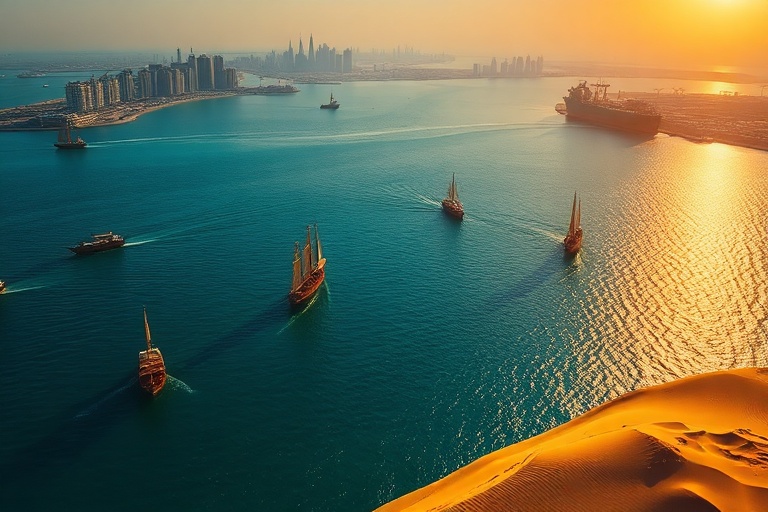
The Persian Gulf: A Strategic Waterway of Global Importance
The Persian Gulf, a narrow body of water bordered by eight nations, has long been a focal point of geopolitical tension, economic significance, and environmental concern. Stretching approximately 989 kilometers from the Shatt al-Arab delta to the Strait of Hormuz, this waterway connects the oil-rich nations of the Middle East to the Arabian Sea and beyond. Its strategic location has shaped the region’s history, influenced global energy markets, and continues to define international relations today.
A Cradle of Civilization and Modern Geopolitics
The Persian Gulf’s significance dates back thousands of years. Ancient civilizations such as Mesopotamia and the Indus Valley relied on its waters for trade and sustenance. The region’s historical importance is underscored by archaeological sites like the ancient city of Dilmun in Bahrain and the ruins of Siraf in Iran, which once thrived as bustling trade hubs. Today, the Gulf remains a crossroads of cultures, economies, and political alliances.
Geopolitically, the Persian Gulf is one of the most contested regions in the world. The eight nations bordering its shores—Iran, Iraq, Kuwait, Saudi Arabia, Bahrain, Qatar, the United Arab Emirates, and Oman—each play a critical role in shaping the area’s dynamics. The discovery of oil in the early 20th century transformed the Gulf into a global energy powerhouse, attracting foreign intervention and sparking conflicts. The Iran-Iraq War (1980-1988) and the Gulf War (1990-1991) highlighted the region’s vulnerability to instability, while ongoing tensions between Iran and its Gulf neighbors continue to influence international diplomacy.
Key Players and Alliances
The Persian Gulf’s geopolitical landscape is defined by shifting alliances and rivalries. Saudi Arabia and Iran, the region’s two largest powers, have long been at odds, with their competition playing out in proxy conflicts across the Middle East. The Gulf Cooperation Council (GCC), established in 1981, serves as a political and economic bloc uniting six Gulf states—Saudi Arabia, Kuwait, Bahrain, Qatar, the UAE, and Oman—in an effort to counterbalance Iranian influence.
The United States has also played a pivotal role in the region, maintaining a military presence since the 1990s to ensure the free flow of oil and deter aggression. Meanwhile, China’s growing economic ties with Gulf states, particularly through its Belt and Road Initiative, have introduced new dynamics to the region’s power structure. These evolving relationships reflect the Persian Gulf’s enduring importance in global affairs.
The Economic Engine: Oil, Gas, and Beyond
No discussion of the Persian Gulf would be complete without acknowledging its unparalleled economic significance. The region holds nearly 50% of the world’s proven oil reserves and a third of its natural gas reserves, making it indispensable to global energy markets. Saudi Arabia, the world’s top oil exporter, and the UAE, a hub for financial and trade activity, exemplify the Gulf’s economic might.
The discovery of oil in the early 20th century catapulted Gulf nations from regional backwaters to global players. The formation of the Organization of the Petroleum Exporting Countries (OPEC) in 1960 further solidified the Gulf’s role in shaping energy policies worldwide. Today, these nations are diversifying their economies to reduce dependence on hydrocarbons. Projects like Saudi Vision 2030 and Qatar’s National Vision 2030 aim to invest in tourism, technology, and renewable energy, signaling a shift toward sustainable growth.
Challenges to Economic Stability
Despite its wealth, the Persian Gulf faces significant economic challenges. Fluctuating oil prices have forced Gulf states to adapt their fiscal strategies, often leading to austerity measures and reforms. The COVID-19 pandemic exacerbated these issues, disrupting global supply chains and reducing demand for oil. Additionally, water scarcity and climate change pose long-term threats to the region’s stability, prompting investments in desalination and green energy.
Another critical challenge is the reliance on foreign labor. Gulf nations employ millions of migrant workers, particularly in construction and domestic services, under a sponsorship system known as kafala. While this system has driven economic growth, it has also faced criticism for labor abuses and poor working conditions. Reforms in countries like Qatar and the UAE aim to address these issues, but challenges remain.
Environmental Pressures and Ecological Concerns
The Persian Gulf is not only a hub of economic activity but also an ecosystem under threat. Its marine environment supports diverse species, including dugongs, sea turtles, and over 500 species of fish. However, rapid industrialization, oil spills, and unchecked coastal development have taken a toll on its biodiversity. The region’s coral reefs, once vibrant, are increasingly degraded due to rising sea temperatures and pollution.
One of the most pressing environmental issues is the recurring phenomenon of harmful algal blooms, or “red tides,” which have devastated fish stocks and threatened desalination plants. In 2008, a severe red tide killed millions of fish and forced the closure of fisheries in Kuwait and Bahrain. Climate change is expected to exacerbate these problems, with rising sea levels and increased storm activity posing additional risks to coastal communities.
Conservation Efforts and Future Prospects
In response to these challenges, Gulf nations are taking steps to protect their fragile ecosystems. Saudi Arabia’s NEOM project, a $500 billion futuristic city, includes ambitious sustainability goals, such as running entirely on renewable energy. The UAE has launched initiatives like the Dubai Mangroves Initiative to restore coastal habitats, while Qatar has established marine protected areas to safeguard endangered species.
International cooperation is also critical. The Regional Organization for the Protection of the Marine Environment (ROPME) works to coordinate environmental policies among Gulf states. However, enforcement remains inconsistent, and the region’s rapid development often outpaces conservation efforts. Balancing economic growth with environmental stewardship will be key to ensuring the Persian Gulf’s long-term survival.
The Future of the Persian Gulf: Stability or Instability?
The Persian Gulf’s future hinges on its ability to navigate a complex web of economic, political, and environmental challenges. On one hand, the region’s energy resources ensure its continued relevance in global markets. On the other, simmering tensions, climate change, and economic diversification efforts create uncertainty about its stability.
One potential path forward is increased regional cooperation. While historical rivalries have hindered collaboration, recent diplomatic breakthroughs, such as the 2023 China-brokered agreement between Saudi Arabia and Iran, offer a glimmer of hope. Strengthening economic ties and addressing shared challenges like water scarcity could foster greater stability.
For the international community, the Persian Gulf remains a critical area of focus. Energy security, maritime trade, and regional security all depend on the stability of this vital waterway. As Gulf nations continue to evolve, their choices will shape not only their own futures but also the broader global landscape.
What Lies Ahead?
The Persian Gulf’s story is far from over. Its waters have witnessed the rise and fall of empires, the discovery of vast energy reserves, and the birth of modern nations. Today, it stands at a crossroads, balancing tradition with innovation, conflict with cooperation. One thing is certain: the decisions made by its leaders and the actions of the international community will determine whether the Persian Gulf remains a source of prosperity or a flashpoint for instability in the decades to come.
For those interested in exploring the region’s rich history and modern dynamics, Travel sections on Dave’s Locker offer insights into the cultural and natural wonders of the Gulf. Additionally, the Politics category provides deeper analysis of the geopolitical forces shaping the region.