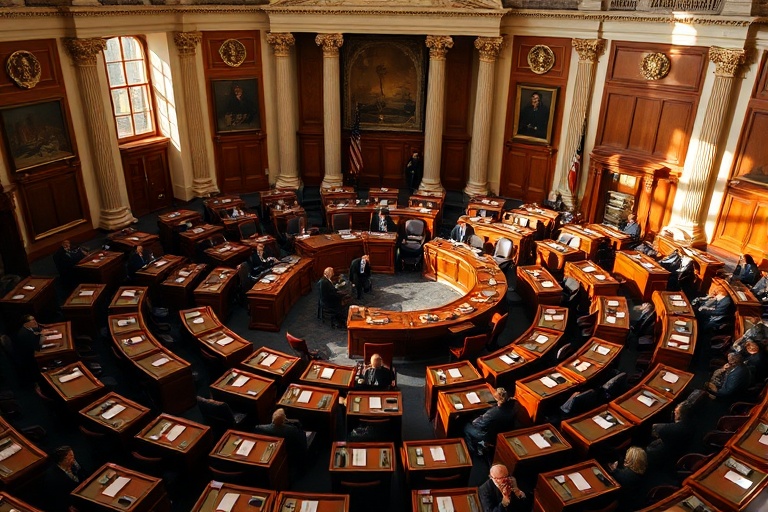
The United States Senate stands as one of the world’s most influential legislative bodies, shaping national policy since 1789. Often described as the “cooling saucer” of American democracy by George Washington, the Senate was designed to temper the passions of the House of Representatives with deliberation and stability. Its 100 members—two from each state—hold significant authority over legislation, judicial appointments, and foreign affairs. Yet beneath its formal procedures and dignified traditions lies a dynamic institution where power, politics, and personality constantly collide.
Unlike the House, where representation is based on population, the Senate’s equal state representation gives smaller states a stronger voice. This structure was a compromise during the Constitutional Convention, balancing the interests of large and small states. Today, that balance continues to influence policy debates, from healthcare reform to Supreme Court confirmations. The Senate’s unique role makes it both a bastion of tradition and a battleground for modern political battles.
The Structure and Functions of the Senate
The U.S. Senate operates under a set of rules and procedures that distinguish it from the House of Representatives. Senators serve six-year terms, with about one-third of the chamber up for election every two years. This staggered election process is intended to provide continuity and reduce the volatility of public opinion. The Senate’s smaller size—100 members compared to the House’s 435—allows for more detailed debate and greater individual influence per member.
One of the Senate’s most distinctive features is its reliance on unanimous consent agreements to expedite business. These informal arrangements allow routine matters to move forward without lengthy debate, provided no senator objects. However, when consensus breaks down, individual senators can use procedural tools like the filibuster to delay or block legislation. While the filibuster has evolved over time—most notably with the shift from a talking filibuster to a silent one in the 1970s—it remains a powerful tool for the minority party.
The Senate’s role in confirming presidential appointments, including Supreme Court justices and Cabinet members, further underscores its importance. The “advice and consent” clause of the Constitution grants the Senate significant leverage over executive branch personnel. This power has led to high-stakes confirmation battles, particularly in divided governments, where partisan tensions often overshadow qualifications.
Key Senate Leadership Positions
The Senate’s leadership structure plays a crucial role in organizing its work. The Vice President of the United States serves as the President of the Senate, though this role is largely ceremonial. The real power lies with the Majority Leader, currently Chuck Schumer (D-NY), who sets the legislative agenda and negotiates with the minority party. The Majority Whip, Dick Durbin (D-IL), ensures party discipline by rallying votes. On the Republican side, Mitch McConnell (R-KY) has wielded significant influence as Minority Leader, particularly during periods of divided government.
- President pro tempore: A largely honorary position held by the most senior senator of the majority party, currently Patty Murray (D-WA). This role presides over the Senate in the Vice President’s absence.
- Committee chairs: Senators who lead standing committees, such as the Judiciary or Appropriations Committees, hold substantial power over policy areas within their jurisdiction.
- Senate Parliamentarian: A nonpartisan official who interprets the chamber’s rules, ensuring that procedures are followed correctly.
The Senate’s Role in American Democracy
The Senate’s design reflects the Founders’ intent to create a deliberative body that would act as a check on both the executive branch and the more volatile House of Representatives. James Madison, in Federalist No. 62, argued that the Senate’s stability would prevent “improper acts of legislation” driven by fleeting passions. This vision has held true in many ways, particularly in its role as a moderating force during crises.
However, the Senate’s structure also creates challenges. The filibuster, once a rare tactic, has become a routine tool for obstruction, leading to gridlock in recent decades. Critics argue that the Senate’s supermajority requirements—whether for ending debate or confirming nominees—have made it increasingly difficult to govern effectively. In 2013, Senate Democrats invoked the “nuclear option” to eliminate the filibuster for most executive branch and judicial nominees, a move that Senate Republicans later extended to Supreme Court nominations in 2017. These changes highlight the Senate’s adaptability, but also its susceptibility to partisan warfare.
The Senate’s role in confirming Supreme Court justices has become particularly contentious. The confirmation of Justice Brett Kavanaugh in 2018 and Justice Amy Coney Barrett in 2020 were marked by intense partisan divisions, with Democrats accusing Republicans of rushing through nominees and Republicans defending their actions as within constitutional bounds. These battles have eroded public trust in the Senate’s ability to conduct thorough, bipartisan reviews.
Notable Senators and Their Legacies
Throughout its history, the Senate has been home to towering figures whose leadership and vision have shaped the nation. These senators often transcended party lines, leaving lasting legacies that extend beyond their time in office.
Historical Figures
The Senate has seen its share of giants, from Daniel Webster, whose oratory skills defined 19th-century politics, to Robert Taft, the isolationist leader who opposed U.S. involvement in NATO. In the 20th century, Lyndon B. Johnson used his position as Senate Majority Leader to push through civil rights legislation, demonstrating the chamber’s potential for transformative change. Meanwhile, Barry Goldwater became a conservative icon whose presidential campaign in 1964 reshaped the Republican Party.
Modern Influential Senators
In recent decades, senators like Ted Kennedy (D-MA) and John McCain (R-AZ) have left indelible marks on American politics. Kennedy, a champion of healthcare reform and civil rights, became one of the Senate’s most effective legislators despite facing personal struggles. McCain, a former prisoner of war, earned bipartisan respect for his maverick approach to issues like campaign finance reform and immigration.
More recently, senators like Bernie Sanders (I-VT) and Mitch McConnell (R-KY) have redefined the chamber’s role in national debates. Sanders, an independent who caucuses with Democrats, has used his platform to push for progressive policies like Medicare for All, while McConnell has become synonymous with obstructionist tactics aimed at limiting Democratic agendas.
The Future of the Senate: Challenges and Opportunities
The Senate faces a moment of reckoning as it grapples with declining public trust, increasing polarization, and calls for reform. Polls consistently show that Americans view the Senate—and Congress as a whole—with skepticism, if not outright disdain. A 2023 Gallup poll found that only 20% of Americans approve of the way Congress is handling its job, reflecting widespread frustration with legislative gridlock.
Several proposals have emerged to address these challenges. One of the most discussed is reforming or eliminating the filibuster, which many argue has become a tool for minority obstruction. Advocates for change point to the Senate’s historical flexibility, noting that it has adapted its rules over time to meet the needs of the moment. Others propose term limits for senators or structural reforms to reduce the influence of money in politics.
However, any significant change faces steep odds. The Senate’s rules are designed to protect the status quo, and altering them requires broad consensus. Moreover, the chamber’s small size and the power of individual senators make it resistant to sweeping reforms. Despite these challenges, the Senate remains a vital institution, one that continues to shape the nation’s trajectory.
Opportunities for Renewal
Despite its struggles, the Senate has opportunities to restore public confidence. Bipartisan efforts on issues like infrastructure, veterans’ affairs, and technological innovation have shown that cooperation is still possible. Senators like Joe Manchin (D-WV) and Lisa Murkowski (R-AK) have demonstrated that cross-party collaboration can yield tangible results.
The Senate’s role in confirming federal judges also presents an opportunity for renewal. With the Supreme Court’s approval ratings at historic lows, the Senate could prioritize nominees with bipartisan support, emphasizing judicial temperament and legal expertise over ideological litmus tests. Such an approach could help rebuild public trust in the judiciary and, by extension, the Senate itself.
Ultimately, the Senate’s future will depend on its ability to adapt to the demands of a rapidly changing America. Whether through reforming its rules, electing leaders who prioritize governance over partisanship, or finding new ways to engage with the public, the Senate must prove that it remains worthy of its place in the American experiment.
Conclusion
The United States Senate is more than a legislative body; it is a reflection of the nation’s ideals, flaws, and enduring struggles. Its history is marked by moments of great compromise and even greater conflict, from the passage of the Civil Rights Act to the failed nominations of Robert Bork. Yet through it all, the Senate has endured, adapting to the changing tides of American politics while maintaining its core functions.
As the Senate approaches its 235th year, its relevance is often questioned. But in an era of political polarization and institutional distrust, the Senate’s role as a deliberative body remains crucial. The challenges it faces—from the filibuster to partisan warfare—are not insurmountable. With thoughtful reform and a renewed commitment to public service, the Senate can reclaim its place as a cornerstone of American democracy.
For those interested in exploring the Senate’s role in broader political trends, Dave’s Locker’s Politics section offers in-depth analysis and commentary on the latest developments. Similarly, our News section provides real-time updates on Senate hearings, confirmations, and legislative battles.